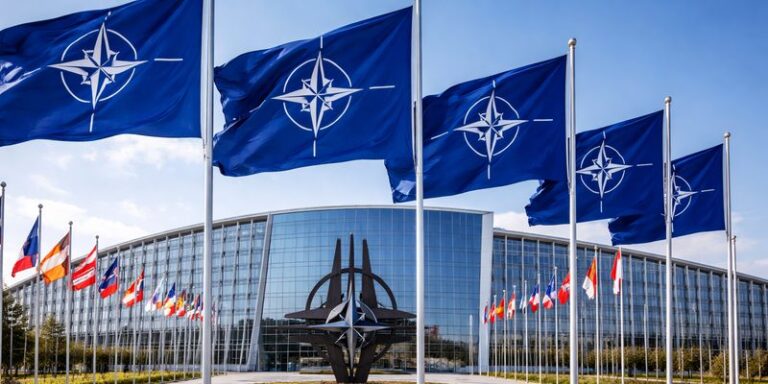
In times of war, crisis, and uncertainty, one question matters more than almost any other: who will stand together when security is threatened? That question lies at the heart of NATO, one of the most influential alliances in modern international politics. For more than seven decades, NATO has shaped the security order of Europe and North America, influenced defence planning, and helped define how states respond to danger through collective defence and political coordination.
Although the name is familiar, many readers still want a clear explanation of what NATO actually is. Is it simply a military pact? Is it a political organisation? Or is it something broader—a long-term security community built on shared interests and strategic cooperation? In reality, NATO is all of these at once. Founded in 1949, the North Atlantic Treaty Organization was created to bind member states together through a mutual security commitment, most famously expressed in Article 5, which states that an attack on one member is considered an attack on all (NATO, 1949).
Over time, NATO has adapted to changing threats, from Cold War confrontation to terrorism, cyber risks, and renewed territorial defence. It has also grown in membership and political significance, while remaining rooted in the transatlantic relationship between Europe and North America (Yost, 2010; Johnston, 2017). To understand why NATO still matters, it is necessary to explore its origins, structure, member states, and enduring role in global security.
1.0 What Is NATO?
NATO stands for the North Atlantic Treaty Organization. It is a political and military alliance formed in 1949 by countries in Europe and North America. Its main purpose is to provide collective defence, meaning that the security of one member is treated as a concern for all members (NATO, 1949; Rupp, 2013).
At its core, NATO is built on cooperation. It is not just a wartime arrangement. It is also a permanent framework through which member states consult one another, coordinate policy, improve military interoperability, and manage shared security concerns. That is why scholars often describe NATO as both a traditional alliance and a broader security community (Risse-Kappen, 1996; Gheciu, 2005).
2.0 The Origins of NATO
The origins of NATO lie in the aftermath of the Second World War. Europe was physically devastated, politically fragile, and increasingly divided by the growing rivalry between the Western powers and the Soviet Union. Western leaders feared both instability within Europe and possible external aggression. In response, they sought a durable framework that could reassure vulnerable states and anchor American involvement in European security (Haglund, 2004).
The North Atlantic Treaty was signed in Washington on 4 April 1949 by twelve founding members. From the beginning, NATO was intended to do more than deter attack. It was also meant to support a broader political order based on consultation, cooperation, and relative stability. This mixture of military necessity and political identity helps explain why NATO has lasted far longer than many other alliances formed in the twentieth century (Hemmer and Katzenstein, 2002).
3.0 NATO Member States
A key part of understanding NATO is understanding its membership. As of 2026, NATO has 32 member states, and one of its defining features is that it links European states with North American states in a single security framework. This transatlantic character gives NATO much of its strategic weight.
3.1 European NATO member states
The European member states of NATO are: Albania, Belgium, Bulgaria, Croatia, Czech Republic, Denmark, Estonia, Finland, France, Germany, Greece, Hungary, Iceland, Italy, Latvia, Lithuania, Luxembourg, Montenegro, the Netherlands, North Macedonia, Norway, Poland, Portugal, Romania, Slovakia, Slovenia, Spain, Sweden, Türkiye, and the United Kingdom.
3.2 North American NATO member states
The North American member states of NATO are: Canada and the United States.
This division matters because it shows that NATO is not simply a European organisation with outside support. It is a genuinely transatlantic alliance, combining the security interests of European states with those of North America. That broader geographic base strengthens deterrence, but it also means decision-making requires constant consultation across different political traditions, threat perceptions, and defence priorities (Sloan, 2005; Olsen, 2017).
4.0 NATO and Article 5
No explanation of NATO is complete without Article 5, the alliance’s best-known principle. Article 5 states that an armed attack against one or more members shall be considered an attack against them all. This is the legal and symbolic heart of NATO’s collective defence commitment (NATO, 1949; Deni, 2017).
However, Article 5 does not mean that every response must be identical or automatic in form. Member states agree to take such action as they consider necessary to restore and maintain security. In practice, the value of Article 5 lies not only in the promise of help, but also in its power to deter aggression in the first place. The message is simple: attacking one NATO member risks confronting the alliance as a whole.
5.0 How NATO Works
5.1 Political Decision-Making In NATO
NATO operates primarily through consultation and consensus. Its central political body is the North Atlantic Council, where representatives of member states discuss major security issues and make decisions together. Each member state has a voice, and decisions are not imposed by formal majority vote. This consensus model can be slow, but it reinforces the principle that NATO is a shared political alliance rather than a top-down command structure (Johnston, 2017).
5.2 Military Cooperation In NATO
On the military side, NATO helps member states train together, standardise procedures, and improve interoperability so that their armed forces can operate effectively together. This is one of the alliance’s greatest practical strengths. NATO is influential not only because of treaty language, but because it turns political commitment into organised military cooperation (Olsen, 2017).
6.0 How NATO Has Evolved Over Time
The history of NATO is a story of adaptation. During the Cold War, its main task was to deter the Soviet Union and defend allied territory. After the Cold War, NATO expanded its membership, revised its strategic thinking, and became involved in crisis management and security operations beyond its traditional territorial focus (Yost, 2010; Stuart, 2004).
That evolution has generated debate. Some analysts argue that NATO’s ability to adapt proves its resilience. Others worry that expanding too far in mission or membership risks weakening clarity and cohesion. Still, NATO has repeatedly shown that it can revise its Strategic Concepts and redefine priorities in response to new realities, including cyber threats, hybrid warfare, terrorism, and renewed concern with territorial defence (Zapolskis, 2012; Perot, 2025).
7.0 Why NATO Still Matters
7.1 NATO Provides Deterrence
The first reason NATO matters is deterrence. By making clear that member states will not face aggression alone, NATO raises the potential cost of attack. Deterrence depends not only on military strength but on credibility, planning, and unity.
7.2 NATO Connects Europe And North America
The second reason is geopolitical. NATO binds the security of Europe to the strategic commitments of Canada and the United States. This transatlantic link has been one of the defining features of post-war international order and remains central to NATO’s weight in global politics (Rupp, 2013).
7.3 NATO Supports Long-Term Cooperation
A third reason is that NATO creates habits of consultation, standard-setting, and political coordination among its member states. It is easier to think of NATO only in military terms, but its institutional role is just as important. NATO helps states plan together, respond together, and think strategically together over long periods.
8.0 Debates and Criticisms Around NATO
Despite its importance, NATO is not free from criticism. One long-running debate concerns burden-sharing. Some member states spend more on defence than others, which can create recurring arguments over fairness and responsibility. Scholars have especially examined the different expectations placed on European members compared with North American members, particularly the United States (Jakobsen, 2018).
Another debate concerns NATO enlargement and its wider geopolitical effects. Critics argue that alliance expansion can deepen tensions with non-member powers, especially Russia. Supporters respond that sovereign states have the right to choose their own alliances and security arrangements. This dispute has become one of the most contested issues in European security politics (Sperling and Webber, 2017).
There is also a broader question of identity. Is NATO primarily a collective defence alliance, or has it become too broad in its mission? Analysts such as Yost (2010) and Deni (2023) suggest that NATO’s future strength will depend on balancing adaptation with strategic focus.
9.0 NATO Beyond Military Power
One reason NATO remains so significant is that it is more than a military structure. It also functions as a political symbol of transatlantic solidarity. Smaller states, in particular, often view NATO not only as a defence umbrella but also as a source of reassurance and diplomatic standing.
Scholars have also argued that NATO has helped shape norms, expectations, and political identity within the wider Western security community (Gheciu, 2005; Risse-Kappen, 1996). Even where those shared values are debated or imperfectly applied, NATO’s role in sustaining a framework of consultation and cooperation remains important.
10.0 The Future of NATO
The future of NATO will depend on whether the alliance can remain both credible and cohesive. Traditional territorial defence has regained urgency, but NATO must also address cyber threats, emerging technologies, disinformation, and infrastructure vulnerability. These are not secondary issues; they are now part of how security is understood.
To stay relevant, NATO must continue to combine military preparedness with political unity. That means resources matter, but so do trust, strategic clarity, and the willingness of member states to see their security as genuinely shared. NATO has lasted because it has adapted. Its challenge now is to keep adapting without losing sight of its core purpose.
NATO remains one of the most important institutions in international politics because it offers a clear answer to a difficult question: how can states defend one another through organised, long-term cooperation? Since 1949, NATO has evolved from a Cold War alliance into a broader transatlantic security institution that links 30 European states with 2 North American states under a shared defence commitment.
Its importance lies not only in military capability, but in the combination of collective defence, political consultation, and transatlantic solidarity. NATO has faced criticism, disagreement, and changing threats, yet it continues to matter because its central promise remains powerful: security is stronger when it is shared. In a world where uncertainty persists, that idea still carries enormous weight.
References
Deni, J.R. (2017) NATO and Article 5: The Transatlantic Alliance and the Twenty-First-Century Challenges of Collective Defense. Lanham, MD: Rowman & Littlefield.
Deni, J.R. (2023) ‘Collective defence’, in Ringsmose, J. and Rynning, S. (eds.) Research Handbook on NATO. Cheltenham: Edward Elgar, pp. 278–291.
Gheciu, A. (2005) ‘Security institutions as agents of socialisation? NATO and the “New Europe”’, International Organization, 59(4), pp. 973–1012.
Haglund, D.G. (2004) ‘The case of the missing democratic alliance: France, the “Anglo-Saxons” and NATO’s deep origins’, Contemporary Security Policy, 25(3), pp. 453–480.
Hemmer, C. and Katzenstein, P.J. (2002) ‘Why is there no NATO in Asia? Collective identity, regionalism, and the origins of multilateralism’, International Organization, 56(3), pp. 575–607.
Jakobsen, J. (2018) ‘Is European NATO really free-riding? Patterns of material and non-material burden-sharing after the Cold War’, European Security, 27(4), pp. 489–507.
Johnston, S.A. (2017) How NATO Adapts: Strategy and Organization in the Atlantic Alliance Since 1950. Baltimore: Johns Hopkins University Press.
NATO (1949) The North Atlantic Treaty. Available at: https://www.nato.int/cps/en/natohq/official_texts_17120.htm.
Olsen, J.A. (2017) NATO and the North Atlantic: Revitalising Collective Defence. London: RUSI.
Perot, E. (2025) ‘The return to collective defence: navigating the politics of allied war planning within NATO’, International Affairs, 101(6), pp. 2129–2148.
Risse-Kappen, T. (1996) ‘Collective identity in a democratic community: the case of NATO’, in Katzenstein, P.J. (ed.) The Culture of National Security. New York: Columbia University Press, pp. 357–399.
Rupp, R. (2013) ‘NATO 1949 and NATO 2000: from collective defence toward collective security’, in NATO Enters the 21st Century. London: Routledge, pp. 95–112.
Sloan, S.R. (2005) NATO, the European Union, and the Atlantic Community: The Transatlantic Bargain Challenged. Lanham, MD: Rowman & Littlefield.
Sperling, J. and Webber, M. (2017) ‘NATO and the Ukraine crisis: collective securitisation’, European Journal of International Security, 2(1), pp. 19–46.
Stuart, D.T. (2004) ‘NATO and the wider world: from regional collective defence to global coalitions of the willing’, Australian Journal of International Affairs, 58(1), pp. 33–46.
Yost, D.S. (2010) ‘NATO’s evolving purposes and the next Strategic Concept’, International Affairs, 86(2), pp. 489–522.
Zapolskis, M. (2012) ‘1999 and 2010 NATO Strategic Concepts: a comparative analysis’, Lithuanian Annual Strategic Review, 10(1), pp. 35–64.