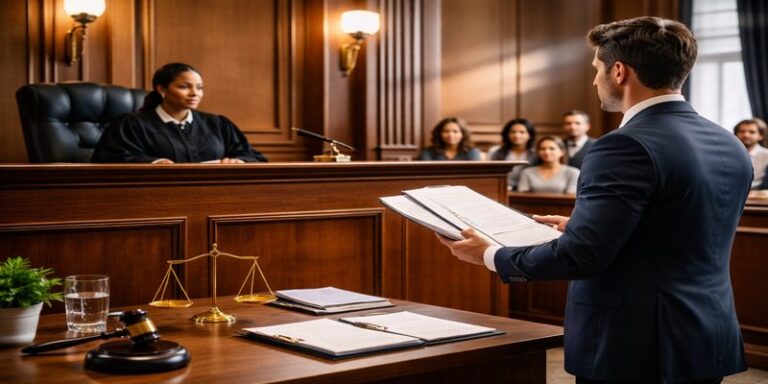
Litigation is the formal process of resolving disputes through the court system. When negotiation fails, relations break down, or legal rights need authoritative protection, litigation becomes the route by which individuals, businesses, and public bodies ask a court to decide a case. In practical terms, litigation is how law moves from abstract principle to enforceable reality. A contract may promise payment, a landlord may owe repair duties, or a business may be liable for negligence, but those rights often matter only if a court can recognise and enforce them.
For many people, litigation sounds daunting. It is often associated with cost, delay, procedural complexity, and public confrontation. Yet it also remains one of the most important mechanisms in any legal system. Unlike informal settlement, litigation produces a binding judgment backed by the authority of the state. Unlike many private dispute-resolution processes, it is usually conducted within a framework of due process, judicial accountability, and public reasoning. This article explores what litigation is, how it works, why it remains important, and the challenges it faces in modern justice systems.
1.0 What Is Litigation?
1.1 A Formal Legal Process
At its simplest, litigation is the process by which disputes are brought before a court for determination. One party, usually the claimant or plaintiff, starts proceedings against another, usually the defendant, alleging a legal wrong and asking for a remedy. That remedy may be damages, an injunction, a declaration of rights, or another court order.
Litigation is most often discussed in connection with civil disputes, such as contract claims, negligence actions, property disagreements, employment claims, and consumer matters. It may also arise in public law disputes, where people challenge the decisions of public authorities. Kerley, Hames and Sukys (2001) describe civil litigation as the practical machinery through which non-criminal disputes move through the court structure.
1.2 More Than Just a Trial
A common misunderstanding is that litigation means a dramatic courtroom trial. In reality, a great deal of litigation happens long before trial. Cases involve pleadings, disclosure of documents, witness statements, procedural hearings, negotiations, and case management. Many cases settle before the final hearing. Even so, the possibility of a judicial decision shapes the entire process.
2.0 How the Litigation Process Works
2.1 Starting Proceedings
Litigation begins when a formal claim is issued. The claimant sets out the facts, legal basis, and remedy sought. The defendant then responds, either admitting, denying, or partly contesting the case. This exchange defines the issues in dispute.
For example, if a customer sues a builder for defective home repairs, the litigation may centre on whether the work breached the contract, whether the defects caused financial loss, and what compensation is appropriate.
2.2 Case Management and Evidence
Modern litigation depends heavily on case management. Judges do not simply wait for parties to appear at trial. They often supervise timetables, narrow issues, and encourage efficiency. Sela and Gabay-Egozi (2020) show that judicial involvement in civil procedure can significantly affect settlement, fairness, and access to justice.
Evidence is central. Documents, expert reports, witness testimony, and legal submissions all play a role. The court’s task is to apply the law to the facts in a structured and transparent way.
2.3 Judgment and Enforcement
If a case goes to final hearing, the court gives a judgment. That judgment explains the result and, in many systems, the legal reasoning behind it. If the claimant succeeds, the court may order payment, performance, restraint, or another remedy. If the losing party does not comply, enforcement procedures may follow.
3.0 Why Litigation Matters
3.1 Protecting Legal Rights
The most obvious value of litigation is that it protects legal rights. A right without enforcement is fragile. A tenant living with dangerous mould, a worker denied contractual wages, or a consumer harmed by a defective product may need litigation to turn legal entitlement into practical relief.
Genn (2009) argues that civil justice is not merely a forum for private complaints. It is part of the infrastructure of the rule of law. Courts make rights meaningful by providing an authoritative process through which disputes can be resolved.
3.2 Creating Public Accountability
Unlike many private forms of dispute resolution, litigation is usually public. This matters because open courts promote accountability, transparency, and the development of legal precedent. When a court explains why one side wins, it guides future conduct and clarifies the law for others.
For example, litigation over unsafe products may not only compensate one injured claimant; it may also encourage better industry standards more widely.
3.3 Balancing Power
Litigation can also help correct power imbalances. A large company may dominate a private negotiation with an individual consumer, but in court both parties are formally subject to the same procedural rules and judicial oversight. That does not eliminate inequality, but it does create a framework intended to promote fairness.
4.0 The Strengths of Litigation
4.1 Due Process and Procedural Fairness
One of litigation’s greatest strengths is due process. Courts operate under established rules of evidence, procedure, and appeal. This can make litigation slower than informal dispute resolution, but it also provides safeguards against arbitrary decision-making.
Croley (2017) suggests that although litigation is often criticised as costly, its formal structure is also what gives it legitimacy. People may dislike delay, but they often value the sense that the process is careful, reasoned, and reviewable.
4.2 Binding and Enforceable Outcomes
Court judgments are binding and backed by the authority of the state. This makes litigation especially important when one party is unwilling to compromise or comply voluntarily. A mediated agreement may depend on cooperation; a litigated judgment can be enforced.
4.3 Development of the Law
Litigation does more than end individual disputes. It also shapes the law. Resnik (1991) showed how modern litigation has expanded beyond isolated “cases” into broader forms of legal problem-solving, including complex and aggregate disputes. Through judgments and appeals, courts clarify principles that affect society well beyond the immediate parties.
5.0 The Criticisms and Challenges of Litigation
5.1 Cost and Delay
The most common criticism of litigation is that it can be expensive, slow, and procedurally intimidating. Legal fees, court costs, expert evidence, and long waiting times may discourage people from bringing even strong claims. Rhode (2004) and Sandefur (2008) both emphasise that access to courts is deeply unequal, often shaped by class, race, gender, and available resources.
5.2 Complexity
Litigation can also be highly technical. Filing rules, deadlines, evidential burdens, and procedural applications can overwhelm unrepresented parties. Zorza (2012) argues that simplification of court process is essential if civil justice is to be truly accessible.
5.3 Unequal Access to Justice
Formal equality does not always mean real equality. A wealthy litigant with experienced lawyers has a clear advantage over a poorer or unrepresented opponent. Shapiro (2020) describes civil justice as something unevenly distributed across society, with some groups reaching the courts far more easily than others.
6.0 Litigation in a Changing Justice Landscape
Today, litigation exists alongside mediation, arbitration, and other forms of dispute resolution. Many legal systems encourage settlement before trial, partly to reduce pressure on courts. That can be useful, but litigation still has a distinct role. It remains essential where a dispute needs public adjudication, urgent court powers, precedent, or strong enforcement.
The challenge for modern justice systems is not to replace litigation, but to make it more proportionate, accessible, and effective.
Litigation remains a central pillar of the legal system because it offers something unique: a formal, public, and enforceable method of resolving disputes according to law. It protects rights, holds powerful actors to account, and contributes to the development of legal principle. At the same time, litigation faces serious criticism for its cost, delay, and complexity, all of which can limit real access to justice. Even so, its importance should not be underestimated. In the end, litigation matters because it expresses a basic promise of the rule of law: that disputes can be resolved not by force or influence, but by reasoned judgment under legal authority.
References
Croley, S.P. (2017) Civil Justice Reconsidered: Toward a Less Costly, More Accessible Litigation System. Chicago: University of Chicago Press.
Genn, H. (2009) Judging Civil Justice. Cambridge: Cambridge University Press.
Greene, S.S. (2015) ‘Race, class, and access to civil justice’, Iowa Law Review, 101(4), pp. 1263–1321. Available at: https://papers.ssrn.com/sol3/papers.cfm?abstract_id=2592150 (Accessed: 6 March 2026).
Kerley, P.N., Hames, J.B. and Sukys, P. (2001) Civil Litigation. 2nd edn. Albany, NY: Delmar.
Resnik, J. (1991) ‘From “cases” to “litigation”’, Law and Contemporary Problems, 54(3), pp. 5–36. Available at: https://openyls.law.yale.edu/handle/20.500.13051/17136 (Accessed: 6 March 2026).
Rhode, D.L. (2004) Access to Justice. Oxford: Oxford University Press.
Sandefur, R.L. (2008) ‘Access to civil justice and race, class, and gender inequality’, Annual Review of Sociology, 34, pp. 339–358. Available at: https://doi.org/10.1146/annurev.soc.34.040507.134534 (Accessed: 6 March 2026).
Sela, A. and Gabay-Egozi, L. (2020) ‘Judicial Procedural Involvement (JPI): A metric for judges’ role in civil litigation, settlement, and access to justice’, Journal of Law and Society, 47(2), pp. 292–326. Available at: https://papers.ssrn.com/sol3/papers.cfm?abstract_id=3131647 (Accessed: 6 March 2026).
Shapiro, M.A. (2020) ‘Distributing civil justice’, Georgetown Law Journal, 109(1), pp. 77–141. Available at: https://papers.ssrn.com/sol3/papers.cfm?abstract_id=3675848 (Accessed: 6 March 2026).
Zorza, R. (2012) ‘Some first thoughts on court simplification: The key to civil access and justice transformation’, Drake Law Review, 61(3), pp. 845–864. Available at: https://drakelawreview.org/wp-content/uploads/2015/06/irvol61-3_zorza.pdf (Accessed: 6 March 2026).