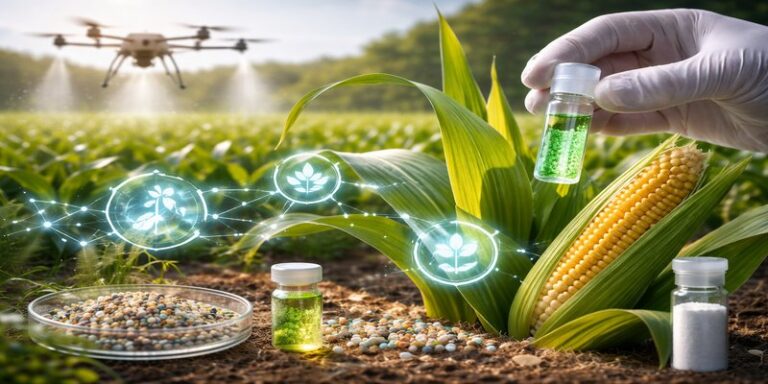
Agriculture faces unprecedented pressures in the twenty-first century. A growing global population, declining arable land, climate variability and environmental degradation demand more efficient and sustainable farming practices. Conventional approaches to fertilisation and pest control have undoubtedly increased productivity, yet they have also contributed to soil degradation, water pollution and greenhouse gas emissions. In this context, nanotechnology has emerged as a promising approach to enhancing agricultural efficiency through the development of nano-fertilisers, nano-pesticides and nanosensors, while simultaneously reducing environmental impact.
Nanotechnology involves manipulating materials at the nanoscale (1–100 nanometres), where they exhibit unique physical and chemical properties (Roco, 2003). In agriculture, nanotechnology is being applied to develop controlled-release fertilisers, targeted pesticide delivery systems, nanosensors for crop monitoring, and soil remediation technologies. Notably, nano-enabled fertilisers and pesticides improve nutrient use efficiency and reduce waste through controlled-release mechanisms, offering significant agronomic and environmental benefits. This article explores these applications in detail, drawing on academic research and authoritative sources.
1.0 Understanding Nanotechnology in Agriculture
1.1 What Makes Nanomaterials Unique?
At the nanoscale, materials display enhanced surface area, increased reactivity and improved solubility compared with bulk materials (Bhushan, 2017). These characteristics make them particularly suitable for agricultural applications, where nutrient delivery, pest control and environmental interactions require precision.
For example, nanoparticles can be engineered to respond to specific environmental triggers such as moisture, pH or temperature, enabling smarter delivery systems. This precision underpins many agricultural innovations.
1.2 Nano-Fertilisers: Enhancing Nutrient Efficiency
1.2.1 The Problem with Conventional Fertilisers
Traditional fertilisers are often inefficient. According to the Food and Agriculture Organization (FAO, 2022), a significant proportion of applied nitrogen fertiliser is lost through leaching, volatilisation or runoff. This contributes to water pollution, eutrophication and nitrous oxide emissions, a potent greenhouse gas.
1.2.2 Controlled-Release Nano-Fertilisers
Nano-fertilisers are designed to release nutrients gradually and in synchrony with plant demand. Encapsulation techniques and nanostructured carriers allow nutrients such as nitrogen, phosphorus and potassium to be delivered more precisely (Subramanian and Tarafdar, 2011).
For instance:
- Nano-encapsulated urea can reduce nitrogen losses by slowing release into the soil.
- Zinc oxide nanoparticles have been shown to enhance micronutrient uptake in crops such as wheat.
- Hydroxyapatite nanoparticles can serve as phosphorus carriers with reduced leaching potential.
These innovations improve nutrient use efficiency (NUE), meaning plants absorb a higher proportion of applied nutrients. As a result, farmers may apply lower quantities while maintaining or even increasing yields.
1.3 Environmental Benefits
Controlled-release systems reduce nutrient runoff into rivers and lakes, mitigating eutrophication. They also lower greenhouse gas emissions associated with excess fertiliser application. According to Nair et al. (2010), nano-fertilisers have the potential to significantly reduce environmental contamination compared with conventional formulations.
2.0 Nano-Pesticides: Targeted and Efficient Pest Management
2.1 Limitations of Conventional Pesticides
Traditional pesticides are often applied broadly, affecting non-target organisms and requiring repeated applications due to rapid degradation or runoff. This can lead to resistance development, biodiversity loss and contamination of soil and water.
2.2 Controlled-Release Nano-Pesticides
Nanotechnology enables the development of nano-formulated pesticides with improved stability and targeted delivery. Active ingredients can be encapsulated within polymeric nanoparticles or nano-emulsions that release their contents slowly over time (Kah and Hofmann, 2014).
Key advantages include:
- Enhanced adhesion to plant surfaces
- Reduced volatility and degradation
- Lower required dosages
- Minimised exposure to non-target species
For example, nano-encapsulated insecticides can be designed to release only under specific environmental conditions, such as changes in humidity. This targeted action increases efficiency while reducing environmental impact.
2.3 Reducing Chemical Waste
Controlled-release mechanisms ensure that pesticides are released gradually, matching pest life cycles more effectively. This reduces the need for frequent reapplication and lowers total chemical input, enhancing sustainability.
3.0 Nanosensors for Precision Agriculture
3.1 Real-Time Monitoring
Precision agriculture relies on accurate data regarding soil conditions, plant health and environmental factors. Nanosensors can detect minute concentrations of nutrients, pathogens or chemical residues in soil and crops (Prasad et al., 2017).
For example:
- Carbon nanotube-based sensors can detect plant stress signals.
- Nanosensors embedded in soil can monitor moisture and nutrient levels.
- Biosensors can identify early-stage plant diseases.
These technologies support data-driven farming, enabling farmers to apply fertilisers and pesticides only when necessary.
3.2 Improved Decision-Making
By integrating nanosensors with digital platforms and satellite data, farmers can optimise irrigation, fertilisation and pest management strategies. This reduces input waste while improving crop productivity.
4.0 Soil Health and Remediation
Nanotechnology also offers solutions for soil remediation. Certain nanoparticles, such as iron oxide nanoparticles, can immobilise heavy metals or degrade organic pollutants in contaminated soils (Nair et al., 2010).
For instance:
- Nano-scale zero-valent iron (nZVI) particles are used to remediate soils contaminated with chlorinated compounds.
- Nanoclays can bind pesticide residues, preventing groundwater contamination.
Such approaches contribute to restoring degraded agricultural land and improving long-term soil health.
5.0 Challenges and Safety Considerations
5.1 Environmental and Health Risks
Despite its promise, agricultural nanotechnology raises concerns about nanoparticle toxicity, persistence and bioaccumulation. Due to their small size, nanoparticles may interact with soil microorganisms or enter food chains in unpredictable ways (Kah and Hofmann, 2014).
Long-term ecological impacts remain insufficiently understood, highlighting the need for robust risk assessment.
5.2 Regulatory Frameworks
In the United Kingdom and European Union, nanomaterials used in agriculture fall under existing chemical and environmental regulations, including REACH. Regulatory bodies require safety data before approval, yet standardised testing methods for nanomaterials are still evolving (European Commission, 2020).
5.3 Economic and Accessibility Issues
The cost of nano-enabled products may initially limit adoption among smallholder farmers. Ensuring equitable access will be critical if nanotechnology is to contribute to global food security.
6.0 Future Prospects
The future of nanotechnology in agriculture lies in integrating nano-fertilisers, nano-pesticides and nanosensors within holistic precision farming systems. Potential developments include:
- Smart fertilisers responsive to root exudates
- Biodegradable nanoparticle carriers
- Integrated sensor networks for autonomous farm management
- Reduced-input farming systems aligned with climate mitigation goals
As research progresses, interdisciplinary collaboration between agronomists, chemists, toxicologists and policymakers will be essential to ensure responsible innovation.
The applications of nanotechnology in agriculture offer transformative opportunities to enhance productivity while reducing environmental harm. Through controlled-release fertilisers and pesticides, nanotechnology improves nutrient use efficiency, minimises waste and lowers chemical runoff. Meanwhile, nanosensors and soil remediation technologies support precision farming and sustainable land management.
Nevertheless, challenges related to safety, regulation and accessibility must be carefully addressed. Comprehensive risk assessments and transparent governance frameworks are vital to ensure that nanotechnology contributes positively to agricultural sustainability. When responsibly implemented, agricultural nanotechnology holds considerable potential to support global food security in an era of mounting environmental pressures.
References
Bhushan, B. (2017) Springer Handbook of Nanotechnology. 4th edn. Berlin: Springer.
European Commission (2020) Nanomaterials in agriculture: Regulatory aspects and policy considerations. Brussels: European Commission.
Food and Agriculture Organization (FAO) (2022) Fertiliser use and environmental sustainability. Rome: FAO.
Kah, M. and Hofmann, T. (2014) ‘Nanopesticide research: Current trends and future priorities’, Environment International, 63, pp. 224–235.
Nair, R., Varghese, S., Nair, B., Maekawa, T., Yoshida, Y. and Kumar, D. (2010) ‘Nanoparticulate material delivery to plants’, Plant Science, 179(3), pp. 154–163.
Prasad, R., Kumar, V. and Prasad, K. (2017) ‘Nanotechnology in sustainable agriculture: Present concerns and future aspects’, African Journal of Biotechnology, 13(6), pp. 705–713.
Roco, M. C. (2003) ‘Nanotechnology: Convergence with modern biology and medicine’, Current Opinion in Biotechnology, 14(3), pp. 337–346.
Subramanian, K. and Tarafdar, J. (2011) ‘Prospects of nanotechnology in Indian farming’, Indian Journal of Agricultural Sciences, 81(10), pp. 887–893.