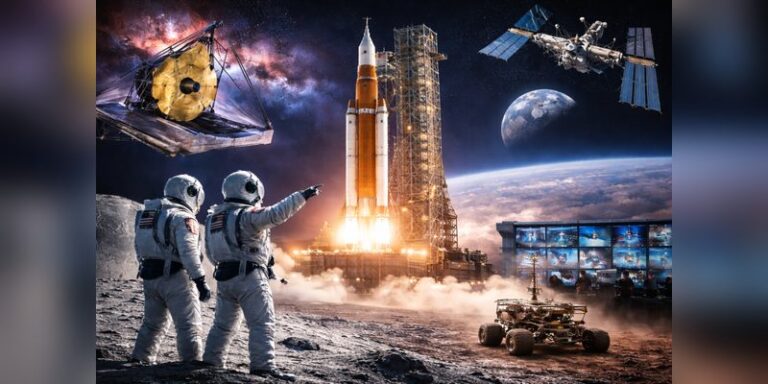
✧ At dawn, a launch pad can appear almost motionless: steel towers stand in silence, vapour drifts into the air, and a rocket waits beneath floodlights as if holding its breath. In those moments, NASA is often imagined only as a symbol of dramatic launches and distant planets. Yet the agency’s real significance reaches far beyond spectacle. It has helped shape modern understanding of the Moon, Mars, Earth’s climate system and the wider universe, while also influencing engineering, education and international cooperation (McDougall, 1985; NASA, n.d.-a).
Since its establishment in 1958, NASA has become one of the most recognisable scientific institutions in the world. Its work spans human spaceflight, robotic exploration, Earth observation, space telescopes and aeronautics research. More importantly, it has linked scientific ambition with public imagination in a way few organisations have managed. To understand why the agency still matters, it is necessary to examine not only its past achievements, but also its continuing role in a new era of lunar and deep-space exploration.
1.0 Why NASA Was Created
1.1 The Origins of NASA In the Space Age
NASA was created by the National Aeronautics and Space Act of 1958, at a time when the United States was responding to the political and technological shock of Sputnik (National Aeronautics and Space Act, 1958). The early Cold War context gave the new agency strategic importance, but its purpose extended beyond competition. It was also intended to coordinate civilian space activity, expand scientific research and develop aeronautical knowledge.
Historians have shown that the rise of the American space programme cannot be separated from broader political pressures and national identity (McDougall, 1985). However, the long-term value of the agency came from turning geopolitical urgency into lasting scientific infrastructure. Laboratories, mission centres, test programmes and partnerships created under that framework enabled later achievements that went far beyond symbolic rivalry.
1.2 From Competition to Capability
The early Mercury and Gemini missions were essential because they built the technical capability for more complex exploration. That process culminated in Apollo, which remains one of the clearest examples of large-scale scientific and engineering coordination in modern history (Logsdon, 2010). The lunar landings demonstrated that space exploration required not only rockets, but also sustained investment in systems engineering, operations, computing and human performance.
2.0 How NASA Changed Space Exploration
2.1 Human Spaceflight and the Lunar Legacy
The Apollo era gave NASA its most famous public image, yet its influence did not end with the first Moon landings. The agency later developed the Space Shuttle, contributed to the International Space Station, and helped establish long-duration experience in orbit through international collaboration (Krige, Russo and Sebesta, 2000; NASA, n.d.-e). These programmes expanded knowledge of spacecraft operations, life-support systems and the practical realities of living and working in space.
Human spaceflight scholars have argued that such missions matter because they produce operational knowledge that cannot be fully reproduced through simulation alone (Larson and Pranke, 2010). They also help prepare for more distant ambitions, including renewed lunar exploration and eventual missions towards Mars.
2.2 Robotic Missions and Scientific Discovery
The scientific impact of NASA has been equally powerful through robotic exploration. Missions to Mars, the outer planets and small bodies have transformed planetary science, while space telescopes have reshaped understanding of the cosmos. The Hubble Space Telescope and James Webb Space Telescope, for example, have revealed galaxies, nebulae and exoplanetary environments with extraordinary detail (NASA, n.d.-d).
There is also a strong intellectual case for combining robotic and human exploration rather than treating them as rivals. Crawford (2012) argues that human and robotic approaches offer different strengths, with robots often providing cost-effective reconnaissance and humans contributing adaptability and real-time judgement. In practice, the space programme has benefited from both.
3.0 NASA and Science Closer to Earth
3.1 NASA And Earth Observation
Although deep-space imagery attracts most attention, NASA also plays a major role in observing Earth. Its satellite missions support research into climate, weather systems, oceans, ice sheets and land-use change (NASA, n.d.-c). These observations are not merely technical achievements; they help governments, researchers and communities understand environmental change on a planetary scale.
This work is especially significant because the agency’s identity is sometimes reduced to rockets alone. In reality, Earth science remains one of its most socially relevant functions. Data from space-based instruments contribute to climate modelling, disaster response and long-term environmental analysis. In that sense, the agency does not only study distant worlds; it also helps interpret the condition of the home planet.
3.2 Innovation Beyond Spaceflight
The wider impact of NASA includes innovation, materials research, imaging technologies and engineering methods that have influenced sectors beyond space activity. Dick and Launius (2007) note that the societal value of spaceflight is not confined to direct economic return. It also includes cultural influence, educational aspiration, scientific literacy and the development of new technical capabilities.
3.0 Why NASA Still Matters Today
3.1 NASA and the Return to The Moon
The agency remains central to current plans for renewed lunar exploration through the Artemis programme, which aims to return astronauts to the Moon and support longer-term exploration architecture (NASA, n.d.-b). This is significant because the modern lunar effort has been framed not as a brief political race, but as part of a more sustained strategy involving partnerships, technology development and future preparation for Mars.
Books and policy studies on human exploration emphasise that long-duration missions demand reliable systems, international coordination and careful risk management (Johnson-Freese, 2017; National Academies of Sciences, Engineering, and Medicine, 2022). The contemporary lunar programme therefore reflects a broader shift from one-off achievement towards durable capability.
3.2 International Cooperation and Public Meaning
Modern space activity is increasingly international, and NASA has become a key participant in collaborative frameworks rather than a solitary national actor. The International Space Station remains the clearest example of this cooperative model, but lunar exploration is also increasingly shaped by partnerships (Krige, Russo and Sebesta, 2000).
The agency also retains unusual public visibility. Few scientific organisations occupy such a strong place in popular culture, education and national memory. That visibility can sometimes simplify the reality of space policy, yet it also helps sustain public interest in science and engineering.
4.0 Challenges Facing NASA
Despite its achievements, NASA faces real challenges. Human spaceflight is expensive, technically risky and politically vulnerable to shifting priorities. Deep-space missions must balance scientific goals, safety standards and budget constraints. Radiation, mission duration and systems reliability remain serious issues for exploration beyond low Earth orbit (Chancellor, Scott and Sutton, 2014).
There is also a continuing debate about how resources should be divided between robotic science, human exploration, aeronautics and Earth observation. That debate is not a weakness; it reflects the breadth of the agency’s responsibilities. The challenge lies in sustaining a coherent long-term vision while preserving scientific depth across multiple fields.
∎ NASA endures because it represents more than launch vehicles and famous photographs. It is an institution that has combined science, engineering and public ambition in ways that have shaped the modern space age. From Apollo and the Shuttle to Earth-observing satellites, Mars missions and the Artemis programme, its work has influenced how space is explored and how Earth itself is understood.
Its continuing importance lies in this dual role: it looks outward towards the Moon, Mars and the wider universe, while also looking back at Earth with increasingly powerful tools. As long as exploration, discovery and scientific cooperation remain valued, NASA is likely to remain a defining force in global space activity.
References
Chancellor, J.C., Scott, G.B.I. and Sutton, J.P. (2014) ‘Space radiation: The number one risk to astronaut health beyond low Earth orbit’, Life, 4(3), pp. 491–510. https://doi.org/10.3390/life4030491.
Crawford, I.A. (2012) ‘Dispelling the myth of robotic efficiency: Why human space exploration will tell us more about the Solar System than will purely robotic exploration’, Astronomy & Geophysics, 53(2), pp. 2.22–2.26. https://doi.org/10.1111/j.1468-4004.2012.53222.x.
Dick, S.J. and Launius, R.D. (2007) Societal Impact of Spaceflight. Washington, DC: NASA.
Johnson-Freese, J. (2017) Space as a Strategic Asset. 2nd edn. New York: Columbia University Press.
Krige, J., Russo, A. and Sebesta, L. (eds.) (2000) NASA in the World: Fifty Years of International Collaboration in Space. Dordrecht: Kluwer Academic Publishers.
Larson, W.J. and Pranke, L.K. (eds.) (2010) Human Spaceflight: Mission Analysis and Design. New York: McGraw-Hill.
Logsdon, J.M. (2010) John F. Kennedy and the Race to the Moon. New York: Palgrave Macmillan.
McDougall, W.A. (1985) …The Heavens and the Earth: A Political History of the Space Age. New York: Basic Books.
NASA (n.d.-a) About NASA. Available at: https://www.nasa.gov/about/ (Accessed: 11 April 2026).
NASA (n.d.-b) Artemis. Available at: https://www.nasa.gov/artemis/ (Accessed: 11 April 2026).
NASA (n.d.-c) Earth Science. Available at: https://science.nasa.gov/earth-science/ (Accessed: 11 April 2026).
NASA (n.d.-d) James Webb Space Telescope. Available at: https://science.nasa.gov/mission/webb/ (Accessed: 11 April 2026).
NASA (n.d.-e) International Space Station. Available at: https://www.nasa.gov/international-space-station/ (Accessed: 11 April 2026).
National Academies of Sciences, Engineering, and Medicine (2022) Origins, Worlds, and Life: A Decadal Strategy for Planetary Science and Astrobiology 2023–2032. Washington, DC: The National Academies Press. https://doi.org/10.17226/26522.