✧ Few space missions have captured public imagination quite like Artemis II. Against the backdrop of renewed lunar ambition, this mission stands as a decisive step between symbolic exploration and sustained human presence beyond low Earth orbit. Unlike a simple demonstration flight, Artemis II is designed to test whether modern crews, spacecraft and mission systems can operate safely in deep space as part of a long-term return to the Moon (NASA, n.d.-a).
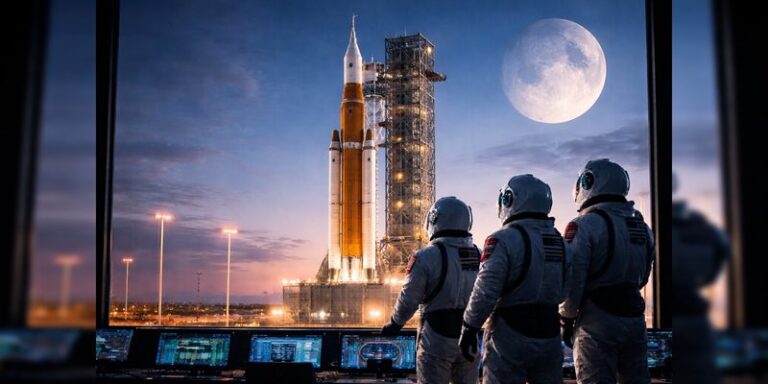
As the first crewed mission in NASA’s Artemis programme, Artemis II is intended to send astronauts around the Moon aboard the Orion spacecraft, launched by the Space Launch System. It does not aim to land on the lunar surface. Instead, its value lies in something equally important: proving that the technologies, procedures and human systems needed for future lunar missions can function under real operational conditions (NASA, n.d.-b). In strategic terms, the mission represents a bridge between the success of Artemis I and the more demanding goals of later lunar surface exploration.
1.0 What Is Artemis II?
1.1 Artemis II as a Crewed Test Mission
Artemis II is best understood as a crewed lunar flyby mission. Its primary function is to validate the performance of Orion’s life-support systems, navigation, communications and crew operations during a journey beyond Earth orbit (NASA, n.d.-a). This matters because human spaceflight outside the relative shelter of low Earth orbit introduces a different level of operational difficulty, including radiation exposure, communication constraints and the psychological realities of longer-duration missions (Chancellor, Scott and Sutton, 2014).
NASA selected a four-person crew for the mission: Reid Wiseman, Victor Glover, Christina Koch and Jeremy Hansen, making the flight notable not only technically but also symbolically, as an international and representative crew for a new phase of lunar exploration (NASA, 2023; Canadian Space Agency, 2023). In this sense, Artemis II is both an engineering exercise and a public statement that human exploration remains a multinational endeavour.
1.2 Artemis II Within the Wider Artemis Programme
The mission also sits within a broader architecture. The Artemis campaign seeks to develop a sustained presence near and on the Moon, partly through surface missions and partly through systems that support longer-term exploration, including preparation for Mars (NASA, n.d.-b). In contrast with Apollo, which prioritised rapid geopolitical achievement, Artemis has been framed as a more durable programme involving international cooperation, infrastructure development and scientific continuity.
2.0 Why Artemis II Matters
2.1 Artemis II and the Return to Deep Space
The greatest significance of Artemis II lies in the fact that it returns astronauts to deep space for the first time since Apollo. Human missions beyond low Earth orbit remain rare because they are technically demanding and operationally unforgiving. According to Larson and Pranke (2010), successful human spaceflight depends on the integration of mission design, life support, crew performance and risk management. A mission like Artemis II is therefore crucial because it tests these elements together, rather than in isolation.
Scholars of space policy and exploration have also argued that the Moon is not merely a nostalgic destination but a strategic one. Neal (2004) describes the Moon as a logical next step in human expansion beyond Earth, while Spudis (2016) argues that lunar exploration has scientific, economic and logistical value for future space development. From that perspective, Artemis II is more than a rehearsal. It is part of a wider effort to rebuild the practical experience required for operating farther from Earth.
2.2 Scientific and Operational Value
Although Artemis II is not principally a science mission, it still has scientific importance. Human missions can produce operational knowledge that robotic systems cannot fully replicate, especially in relation to crew decision-making, real-time problem solving and the interaction between people and spacecraft systems (Crawford, 2012). For example, testing manual control, onboard procedures and habitability in actual deep-space conditions can inform spacecraft design for later lunar and Martian missions.
There is also a planning benefit. The National Academies of Sciences, Engineering, and Medicine (2022) emphasise that future planetary science and exploration strategies benefit from coherent long-term frameworks. Artemis II contributes to that framework by reducing uncertainty before more ambitious missions are attempted.
3.0 The Technology Behind Artemis II
3.1 Orion, Life Support and Crew Safety
A central focus of Artemis II is the Orion spacecraft. Orion is designed to support astronauts on missions beyond low Earth orbit, providing life support, power, navigation and re-entry capability. Crew safety is especially important because deep-space missions expose astronauts to higher risks than those faced on missions closer to Earth, including radiation and communication delays (Chancellor, Scott and Sutton, 2014).
The mission therefore acts as a live systems test. It evaluates how the crew interacts with the spacecraft over time, how effectively systems perform under stress, and whether design choices made after Artemis I function as intended. In practical terms, that makes Artemis II a mission of risk reduction. Future lunar landing attempts depend on the lessons gathered Here.
3.2 Artemis II and Mission Architecture
Mission architecture is equally important. Human exploration requires launch capability, spacecraft reliability, trajectory design and recovery planning to work together as a single system (Larson and Pranke, 2010). A lunar flyby offers a realistic but controlled environment in which to test this architecture. It allows procedures to be examined under authentic conditions without the additional complexity of landing operations.
4.0 Artemis II, Politics and International Cooperation
No major space mission exists outside politics. Artemis II reflects a blend of scientific aspiration, national capability and diplomatic partnership. Jeremy Hansen’s place on the crew highlights Canadian involvement, while the wider Artemis framework includes a growing network of partner nations and institutions (Canadian Space Agency, 2023; NASA, n.d.-b).
This international dimension matters because long-term lunar exploration is expensive, technically complex and politically sensitive. Crawford and Joy (2014) note that the Moon has re-emerged as an important destination for both scientific and strategic reasons. In that context, Artemis II functions as a demonstration that collaborative exploration remains achievable.
5.0 Challenges Facing Artemis II
Despite its promise, the mission also illustrates the difficulty of human spaceflight. Space systems must operate with extremely high reliability, and even modest technical issues can create major programme consequences. Safety, budget control, schedule pressure and public expectation all shape mission planning. That tension is familiar in the history of exploration: ambition drives progress, but complexity imposes caution.
Moreover, some critics argue that robotic missions can often deliver greater scientific return at lower cost. Yet Crawford (2012) contends that this comparison can be misleading because human missions offer flexibility, rapid judgement and operational learning that robots cannot fully match. The importance of Artemis II lies partly in testing that argument in practice.
∎ Artemis II represents a pivotal moment in twenty-first-century spaceflight. As a crewed lunar flyby, it is intended to validate spacecraft systems, operational procedures and human performance in deep space before more ambitious lunar missions proceed. Its significance lies not in spectacle alone, but in its role as a foundation for sustained exploration.
By linking technology, international partnership and long-term lunar strategy, Artemis II shows that the return to the Moon is being approached as a structured programme rather than a one-off achievement. Whether viewed through the lens of policy, engineering or scientific ambition, the mission stands as a critical step in rebuilding humanity’s capacity to travel farther from Earth with purpose, safety and endurance.
References
Canadian Space Agency (2023) Jeremy Hansen. Available at: https://www.asc-csa.gc.ca/eng/astronauts/biographies/jeremy-hansen.asp.
Chancellor, J.C., Scott, G.B.I. and Sutton, J.P. (2014) ‘Space radiation: The number one risk to astronaut health beyond low Earth orbit’, Life, 4(3), pp. 491–510. https://doi.org/10.3390/life4030491.
Crawford, I.A. (2012) ‘Dispelling the myth of robotic efficiency: Why human space exploration will tell us more about the Solar System than will purely robotic exploration’, Astronomy & Geophysics, 53(2), pp. 2.22–2.26. https://doi.org/10.1111/j.1468-4004.2012.53222.x.
Crawford, I.A. and Joy, K.H. (2014) ‘Planetary science: Return to the Moon’, Astronomy & Geophysics, 55(4), pp. 4.24–4.27. https://doi.org/10.1093/astrogeo/atu126.
Larson, W.J. and Pranke, L.K. (eds.) (2010) Human Spaceflight: Mission Analysis and Design. New York: McGraw-Hill.
NASA (2023) NASA Names Astronauts to Next Moon Mission, First Crew Under Artemis. Available at: https://www.nasa.gov/news-release/nasa-names-astronauts-to-next-moon-mission-first-crew-under-artemis/.
NASA (n.d.-a) Artemis II. Available at: https://www.nasa.gov/mission/artemis-ii/.
NASA (n.d.-b) Artemis. Available at: https://www.nasa.gov/artemis/.
National Academies of Sciences, Engineering, and Medicine (2022) Origins, Worlds, and Life: A Decadal Strategy for Planetary Science and Astrobiology 2023–2032. Washington, DC: The National Academies Press. https://doi.org/10.17226/26522.
Neal, V. (2004) Back to the Moon: The Next Giant Leap for Humankind. New York: Copernicus Books.
Spudis, P.D. (2016) The Value of the Moon: How to Explore, Live, and Prosper in Space Using the Moon’s Resources. Washington, DC: Smithsonian Books.