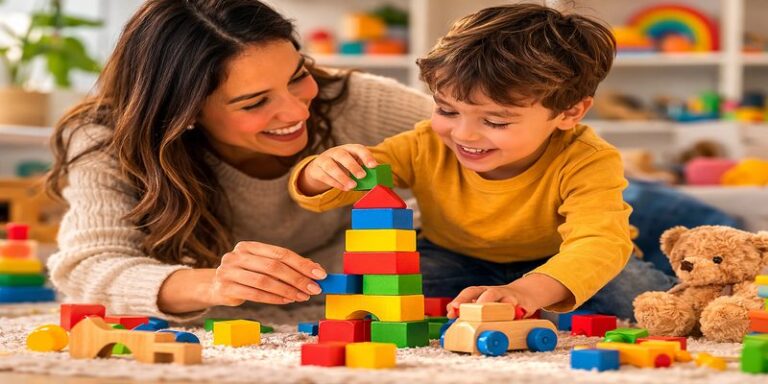
Choosing to play with preschool child regularly is one of the simplest, most effective ways to support healthy development between ages 3–5. At this stage, children learn best through hands-on experiences, imagination, and responsive interaction with trusted adults. Play is where they practise the building blocks of school readiness: communication, self-control, problem-solving, social understanding, and confidence. Developmental theory highlights play as a central “engine” of learning because it allows children to try ideas, test boundaries, and make sense of the world in a low-pressure way (Vygotsky, 1978). Modern paediatric guidance also emphasises that play supports wellbeing, relationships, and learning—especially when caregivers are warm, present, and engaged (Yogman et al., 2018).
1.0 Play with Preschool Child Time Strengthens Your Bond
When you play with preschool child consistently, you communicate: “You matter, and I enjoy being with you.” This kind of attentive, responsive time supports emotional security and trust. Attachment theory suggests that children thrive when they experience caregivers as reliable, sensitive, and available, because it helps them feel safe enough to explore and learn (Bowlby, 1988). A child who feels secure is often more willing to attempt tricky tasks, tolerate mistakes, and return to calm after upsets.
Example:
Your child begins a pretend café. Instead of correcting or directing, you follow their lead: “What’s today’s special?” If the child says “mud pie”, you respond with delight: “Delicious! Shall I pay with coins or a card?” These small choices build connection, shared humour, and a sense of being valued.
Tip: Aim for short, frequent “micro-moments” of play—10 minutes of genuine attention can be more powerful than an hour where you are distracted.
2.0 Play Develops Brain Skills Like Planning and Problem-Solving
Preschool play supports executive functions—a set of mental skills including working memory, planning, flexible thinking, and inhibitory control (Diamond, 2013). Children strengthen these skills by building, negotiating rules, adapting when a plan fails, and persisting through trial-and-error. These are the same skills that help children sit in a group, follow instructions, and solve early maths and literacy tasks in school.
Example:
During block play, your child’s tower keeps falling. You model gentle problem-solving: “What could we change?” Then you suggest a strategy: “Let’s make the base wider.” When it works, you label the learning: “You tested an idea and kept trying.” This encourages persistence rather than perfection.
Mini-activity:
Try a “build challenge”: “Can we make a bridge that holds three toy cars?” Your child practises planning and revision without even noticing they are “learning”.
3.0 Play with Preschool Child Activities Boost Language
Ages 3–5 are a major period for vocabulary growth, longer sentences, and early storytelling. When you play with preschool child and talk naturally, you create abundant opportunities for meaningful language practice: naming objects, explaining ideas, describing feelings, and negotiating roles (Hirsh-Pasek and Golinkoff, 2003). Importantly, children learn best when language is connected to what they are doing and feeling in the moment.
Try these language boosters:
- Narrate: “You’re building a tall tower with a red block on top.”
- Expand: Child says “car fast”; adult says “Yes, the car is very fast—it’s racing!”
- Ask open questions: “What do you think happens next?”
- Introduce richer words: “That’s enormous,” “You look frustrated,” “Let’s make it stronger.”
Example:
While playing with toy animals, you can naturally introduce categories and verbs: “The tiger is stalking. The rabbit is hiding. Who is running?” This supports vocabulary, grammar, and comprehension.
4.0 Pretend Play Builds Social and Emotional Understanding
Pretend play (“doctors”, “families”, “shops”, “superheroes”) helps children practise perspective-taking—understanding that other people have thoughts and feelings that may differ from their own. Vygotsky (1978) described pretend play as a setting where children practise self-control by staying in role and following the “rules” of the story. Over time, this supports empathy, cooperation, and emotional awareness.
Example:
Playing “doctor”, you say: “I feel a bit nervous—can you tell me what you’re going to do?” Your child practises reassurance: “It’s okay, I’ll listen to your heart.” You are teaching emotional language and supportive behaviour inside an enjoyable game.
Helpful prompt:
When a toy “gets upset” in play, ask: “What might help them feel better?” You’re building early emotional coaching.
5.0 Play Supports Self-Regulation and Better Behaviour
Preschoolers are still learning to manage disappointment, wait their turn, and recover from frustration. Play—especially games with simple rules—gives repeated practice in self-regulation (Diamond, 2013). Regular time to play with preschool child can also reduce power struggles, because connection often improves cooperation.
Best games for self-control:
- Simon Says (stop/start control)
- Freeze dance (listening + inhibition)
- Simple board games (turn-taking and coping with losing)
Example:
If your child loses and gets upset, you can coach calmly: “It’s hard to lose. Let’s take a breath and try again.” This teaches coping skills more effectively than a lecture.
6.0 Play with Preschool Child Time Supports Physical Development
Active play builds gross motor skills (running, balancing, jumping, climbing) and fine motor skills (colouring, threading beads, cutting with child-safe scissors). These skills support independence (dressing, using utensils) and later classroom tasks (holding pencils, manipulating objects). Health guidance encourages active play as part of healthy routines for young children (NHS, 2023).
Example:
A “park scavenger hunt”: “Find something smooth, something tiny, something green.” This combines movement, attention, and language. Indoors, try an obstacle course using cushions and tape lines on the floor for jumping and balancing.
7.0 Play Naturally Builds Early Maths and Literacy
You do not need worksheets to support early learning. When you play with preschool child, early maths and literacy appear naturally through sorting, counting, comparing, and pretend writing.
Examples:
- Sorting toys by colour/size (patterns and categories)
- Counting steps/snacks (number sense)
- Pretend menus/tickets (mark-making and literacy motivation)
- Acting out storybooks (sequencing and comprehension)
Example:
During pretend shop play, you can introduce practical numeracy: “That’s three apples. Shall we count them together?” Then add coins for simple addition in a playful way.
8.0 Why Your Attention Matters More Than Expensive Toys
Children benefit most from responsive adult interaction, not expensive gadgets. Guidance on child development emphasises that play supports learning and wellbeing, and that caregiver involvement strengthens these benefits (Yogman et al., 2018). A cardboard box can become a rocket; a spoon can become a microphone—what matters is the shared attention and the child’s imagination.
A helpful routine (10–15 minutes daily):
- Put your phone away
- Let your child lead the play
- Describe what you notice (“You’re lining them up carefully”)
- Encourage effort (“You kept trying”)
- Save teaching or correcting for later unless safety is involved
This approach supports confidence, autonomy, and a positive parent-child relationship.
9.0 Play with Preschool Child Routines Reduce Stress for Everyone
Play can be a “reset button” after nursery, busy mornings, or emotional days. Shared laughter and calm attention support emotional regulation for children and can reduce stress for adults too (Yogman et al., 2018). Regular play routines also provide predictability, which many preschoolers find calming.
Example:
After a tricky day, choose soothing activities like puzzles, colouring, or building. Keep your goal clear: connection, not performance. A calm shared activity often helps a child settle faster than lots of talking.
Making time to play with preschool child (ages 3–5) supports bonding, brain development, language growth, self-regulation, physical skills, and early maths and literacy—while also strengthening wellbeing for the whole family. The best part is that it does not need to be complicated. Consistent, warm, child-led play—just a few minutes most days—builds confidence and skills that last well beyond the preschool years.
References
Bowlby, J. (1988) A Secure Base: Parent-Child Attachment and Healthy Human Development. London: Routledge.
Diamond, A. (2013) ‘Executive functions’, Annual Review of Psychology, 64, pp. 135–168.
Hirsh-Pasek, K. and Golinkoff, R.M. (2003) Einstein Never Used Flashcards: How Our Children Really Learn—and Why They Need to Play More and Memorise Less. Emmaus, PA: Rodale.
NHS (2023) Play and child development. Available at: https://www.nhs.uk/ (Accessed: 15 March 2026).
Vygotsky, L.S. (1978) Mind in Society: The Development of Higher Psychological Processes. Cambridge, MA: Harvard University Press.
Yogman, M., Garner, A., Hutchinson, J., Hirsh-Pasek, K. and Golinkoff, R.M. (2018) ‘The power of play: A paediatric role in enhancing development in young children’, Pediatrics, 142(3), e20182058.
UNICEF (2018) Learning through play. Available at: https://www.unicef.org/ (Accessed: 15 March 2026).