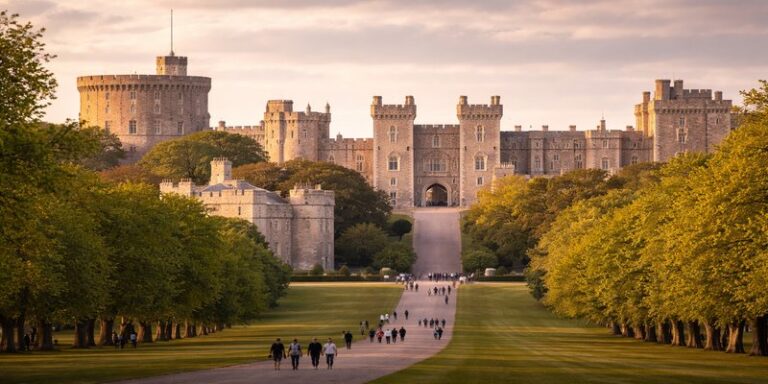
Windsor Castle stands not merely as a historic building, but as a living symbol of continuity, power, and national identity in Britain. Founded by William the Conqueror in the aftermath of the Norman Conquest of 1066, it is the oldest and largest occupied castle in the world, having served as a royal residence for over nine centuries. Across this remarkable span of time, Windsor Castle has evolved architecturally and politically, reflecting the changing nature of monarchy, governance, and society in Britain.
1.0 Norman Origins and Strategic Power
The origins of Windsor Castle lie firmly in the military logic of Norman rule. William the Conqueror constructed the castle in the late eleventh century as part of a defensive ring protecting London. Positioned on a chalk ridge overlooking the River Thames, Windsor offered strategic surveillance and control over key routes into the capital (Hope, 1913). Like many early Norman castles, it began as a motte-and-bailey fortress, built primarily of timber before gradually being reconstructed in stone.
From the outset, Windsor Castle was both a fortress and a statement of authority. Its commanding presence symbolised Norman dominance over a newly conquered land, embedding royal power directly into the English landscape (James, 2018).
2.0 Medieval Expansion and Royal Identity
Under Henry II in the twelfth century, Windsor Castle was significantly expanded and transformed into a permanent stone residence. However, it was Edward III in the fourteenth century who reshaped Windsor into a true royal palace, investing unprecedented resources into its development. Edward III’s rebuilding programme coincided with the founding of the Order of the Garter, Britain’s most prestigious chivalric order, firmly linking Windsor Castle to ideals of knighthood, loyalty, and monarchy (Brindle, 2019).
At the heart of this chivalric tradition lies St George’s Chapel, one of the finest examples of Perpendicular Gothic architecture in England. Constructed primarily during the reigns of Edward IV and Henry VII, the chapel is not only a place of worship but also a royal mausoleum, housing the tombs of monarchs including Henry VIII, Charles I, and Queen Elizabeth II (Royal Collection Trust, 2023).
3.0 From Fortress to Ceremonial Palace
By the early modern period, Windsor Castle’s military function had diminished, and its role as a ceremonial and symbolic residence grew. During the Tudor and Stuart eras, monarchs increasingly used Windsor as a setting for courtly life, diplomacy, and display. Architectural modifications reflected broader European influences, as Renaissance and Baroque elements were incorporated into the medieval fabric (Airs, 2004).
The most dramatic transformation came in the early nineteenth century under George IV, who commissioned architect Jeffry Wyatville to remodel the castle in a romantic Gothic Revival style. This extensive project reshaped Windsor into the imposing, fairy-tale silhouette familiar today, reinforcing its role as a theatre of monarchy and national prestige (de Bellaigue & Kirkham, 1972).
4.0 Windsor Castle in the Modern Age
In the twentieth and twenty-first centuries, Windsor Castle became closely associated with Queen Elizabeth II, who regarded it as her true home. Her long reign reinforced the castle’s image as a place of stability and continuity, particularly during times of social and political change. The castle served as a backdrop for state occasions, royal weddings, and moments of national mourning, most notably following the death of Prince Philip and later the Queen herself (BBC, 2022).
A defining moment in recent history was the 1992 fire, which destroyed or damaged over 100 rooms. The subsequent restoration project was widely praised for its combination of historical fidelity and modern craftsmanship, demonstrating Britain’s commitment to preserving its architectural heritage while adapting it for contemporary use (Historic Royal Palaces, 2021).
5.0 Symbolism, Heritage, and National Identity
Beyond its architectural grandeur, Windsor Castle functions as a symbolic anchor for British identity. Scholars argue that its continued occupation by the monarchy gives it a unique status among heritage sites, blending living tradition with historical memory (Rowse, 1975). Unlike ruins preserved solely for tourism, Windsor remains a working royal residence, reinforcing the idea of monarchy as an enduring institution rather than a relic of the past.
In an age marked by political debate over the relevance of monarchy, Windsor Castle represents a tangible connection between past and present. It embodies the adaptability of British institutions, showing how tradition can be maintained while evolving in response to changing social values (Paterson, 2013).
Windsor Castle is far more than an architectural masterpiece. It is a chronicle in stone, recording the ambitions, anxieties, and ideals of successive generations of monarchs. From Norman stronghold to Gothic revival palace, and from medieval fortress to modern royal home, Windsor Castle encapsulates the long, complex story of Britain itself. Its continued presence in national life underscores the enduring power of place in shaping history, identity, and collective memory.
References
Airs, M. (2004) Architecture, Politics and Society. Oxford: Wiley-Blackwell.
BBC (2022) Queen Elizabeth II and Windsor Castle. Available at: https://www.bbc.co.uk (Accessed: 8 February 2026).
Brindle, S. (2019) ‘Windsor Castle in its cultural landscape’, ICOMOS-Hefte, 2(1), pp. 45–62.
de Bellaigue, G. and Kirkham, P. (1972) ‘George IV and the furnishing of Windsor Castle’, Furniture History, 8, pp. 1–24.
Historic Royal Palaces (2021) The Fire at Windsor Castle. Available at: https://www.hrp.org.uk (Accessed: 8 February 2026).
Hope, W.H.S.J. (1913) Windsor Castle: An Architectural History. London: Country Life.
James, T.B. (2018) Medieval Palaces and Royal Houses. Oxford: Oxford University Press.
Paterson, M. (2013) A Brief History of the House of Windsor. London: Robinson.
Royal Collection Trust (2023) St George’s Chapel, Windsor Castle. Available at: https://www.rct.uk (Accessed: 8 February 2026).
Rowse, A.L. (1975) ‘Windsor Castle in the history of the nation’, Journal of the Royal Society of Arts, 123(5212), pp. 345–357.