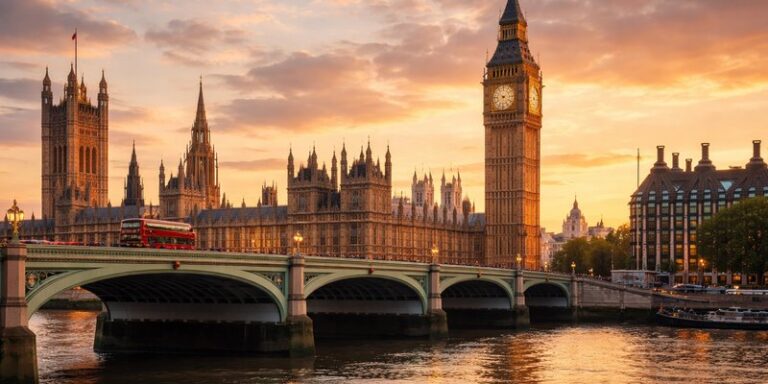
Stand on Westminster Bridge at sunset and the scene feels almost theatrical. The Elizabeth Tower glows honey-gold, the Thames ripples beneath you, and the Gothic silhouette of the Houses of Parliament rises dramatically against the sky. The chimes of Big Ben echo across the river, mingling with the chatter of visitors and the distant hum of city traffic.
This is not merely a district of London. Westminster is Britain’s symbolic centre, where monarchy, democracy and faith intersect. Few places in the world allow you to walk from a royal palace to the seat of government and into a coronation church within minutes. It is grandeur and gravity wrapped into one unforgettable experience.
1.0 Brief Background and History
Westminster’s story begins long before the cameras and crowds. The area developed around Westminster Abbey, originally founded in the tenth century and rebuilt in grand Gothic style in the thirteenth century. The Abbey became the site of royal coronations, weddings and burials, embedding Westminster at the core of British identity (Timothy, 2011).
Adjacent to it stands the Palace of Westminster, once a medieval royal residence and now home to the UK Parliament. After the devastating fire of 1834, the palace was rebuilt in Gothic Revival style, reinforcing its monumental character (Baxendale, 2007).
Urban tourism scholars argue that such historic political centres serve as magnets for both domestic and international visitors, shaping perceptions of national heritage (Law, 1992; Palmer, 1998). Westminster’s architecture and ceremonial traditions continue to reinforce its global profile.
2.0 Accommodation: Staying in the Seat of Power
Accommodation in Westminster reflects its prestige. Research suggests that central urban districts cluster hotels near heritage attractions and transport links (Morrison & Coca-Stefaniak, 2020; Page & Connell, 2020). Westminster exemplifies this pattern.
- Luxury hotels such as The Corinthia and The Savoy (nearby along the Strand) offer five-star elegance with views across the Thames.
- Boutique stays around St James’s and Victoria provide stylish, intimate experiences.
- Business-oriented hotels cater to government visitors and conference delegates.
- Serviced apartments appeal to families seeking proximity to landmarks.
Given its centrality, Westminster accommodation can be premium-priced, but excellent Underground and rail connections allow visitors to stay slightly further afield while exploring the district easily.
3.0 Food & Drink: Tradition with a Modern Twist
While Westminster is renowned for politics and pageantry, it also offers a satisfying culinary scene. Tourism literature highlights how food enhances cultural immersion and shapes visitor satisfaction (Holloway & Humphreys, 2022).
In Westminster, you can enjoy:
- A traditional afternoon tea near the Abbey.
- Classic British dishes such as fish and chips in historic pubs.
- International cuisine reflecting London’s multicultural fabric.
- Refined dining in Michelin-starred establishments.
Historic pubs like The Red Lion have long served Members of Parliament and curious travellers alike, blending political folklore with hearty fare. As research on heritage tourism suggests, gastronomy often reinforces place identity and memory (Timothy, 2011).
4.0 Things to Do: Icons at Every Turn
Westminster offers a concentration of globally recognised landmarks within walking distance. According to urban tourism scholarship, such density strengthens destination appeal (Law, 1992).
Must-see highlights include:
- Westminster Abbey – a masterpiece of Gothic architecture.
- The Houses of Parliament – guided tours reveal centuries of debate.
- Parliament Square – Statues of Famous Leaders
- Elizabeth Tower (Big Ben) – one of the world’s most photographed clocks.
- Buckingham Palace – official residence of the monarch.
- St James’s Park – a tranquil green space framed by royal views.
- The Churchill War Rooms – underground insight into wartime Britain.
The district also connects seamlessly to nearby cultural attractions such as Trafalgar Square and the National Gallery. As Goodey (2013) argues, effective heritage interpretation transforms monuments into meaningful narratives rather than static structures.
- When to Visit
Westminster is vibrant throughout the year, yet timing can shape your experience.
- Spring: Parks bloom and temperatures are mild.
- Summer: Ceremonial events such as Trooping the Colour draw large crowds.
- Autumn: Fewer tourists and crisp air enhance architectural appreciation.
- Winter: Christmas lights and festive services in the Abbey create a magical atmosphere.
Peak visitation often coincides with summer and major national events (Middleton & Lickorish, 2007). Early mornings or weekdays typically offer quieter exploration.
6.0 Sample Two-Day Itinerary
Day 1: Monarchy and Majesty
Morning tour of Westminster Abbey. Walk through Parliament Square. Lunch in St James’s. Afternoon visit to Buckingham Palace (when open). Evening stroll through St James’s Park.
Day 2: Democracy and Discovery
Guided tour of the Houses of Parliament. Lunch at a traditional pub. Afternoon at the Churchill War Rooms. Sunset walk across Westminster Bridge.
This blend of political heritage and reflective spaces mirrors the principles of cultural tourism identified by Timothy (2011) and Page and Connell (2020).
7.0 Travel Tips
- Book tickets for Parliament and the Abbey in advance.
- Allow time for security checks at major sites.
- Wear comfortable shoes – the area is best explored on foot.
- Check ceremonial schedules, such as the Changing of the Guard.
- Combine your visit with nearby districts for a fuller experience.
Efficient public transport and pedestrian-friendly streets enhance accessibility, reinforcing Westminster’s status as a prime urban tourism zone (Morrison & Coca-Stefaniak, 2020).
8.0 Why Westminster Is Worth Visiting
Westminster is not simply a neighbourhood; it is a stage upon which Britain’s past and present unfold daily. From coronations to parliamentary debates, from solemn remembrance to vibrant celebration, its buildings have witnessed defining national moments.
Academic research underscores the power of heritage districts to anchor identity and attract sustained visitor interest (Palmer, 1998; Timothy, 2011). Westminster’s appeal lies in its authenticity – these are not replicas or themed attractions, but living institutions still shaping the country’s future.
To visit Westminster is to stand at the crossroads of monarchy, democracy and faith. It is to hear the echo of centuries in the toll of a bell. And in that moment, history feels not distant, but alive.
References
Baxendale, J. (2007) ‘The construction of the past and the origins of royal tourism in 19th-century Britain’, in Royal Tourism: Excursions around Monarchy.
Goodey, B. (2013) Interpreting Urban Heritage. London: Routledge.
Holloway, J.C. and Humphreys, C. (2022) The Business of Tourism. Harlow: Pearson.
Law, C.M. (1992) ‘Urban tourism and its contribution to economic regeneration’, Urban Studies, 29(3–4), pp. 599–618.
Middleton, V.T.C. and Lickorish, L.J. (2007) British Tourism: The Remarkable Story of Growth. Oxford: Butterworth-Heinemann.
Morrison, A.M. and Coca-Stefaniak, J.A. (2020) Routledge Handbook of Tourism Cities. London: Routledge.
Page, S.J. and Connell, J. (2020) ‘Visitor attractions’, in Tourism: A Modern Synthesis. London: Cengage.
Palmer, C. (1998) Heritage Tourism and English National Identity. London Metropolitan University.
Picello, R. (2017) English for Cultural Tourism Management and Interpretation. Bologna: Bononia University Press.
Timothy, D.J. (2011) Cultural Heritage and Tourism: An Introduction. Bristol: Channel View Publications.