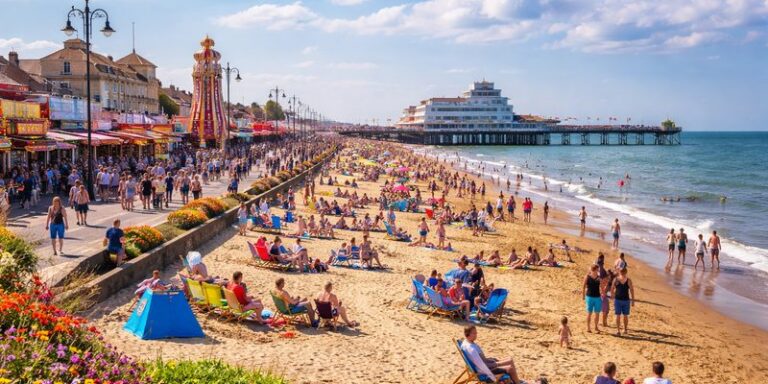
There is something unmistakably British about the crunch of sand beneath your shoes, the salty tang of the North Sea in the air, and the cheerful glow of arcade lights flickering along a promenade at dusk. Great Yarmouth, perched on the Norfolk coast, is a place where nostalgia and reinvention meet. Here, Victorian piers stretch into restless waters, fishing boats still nod gently in the harbour, and families queue patiently for paper-wrapped fish and chips.
Yet beneath its postcard charm lies a more complex and fascinating story — one of maritime enterprise, tourism booms and busts, and bold regeneration efforts. As scholars of British seaside development note, towns like Great Yarmouth have long stood at the heart of the UK’s coastal tourism heritage (Middleton & Lickorish, 2007; Beatty et al., 2010). Today, the town is rediscovering its rhythm, blending traditional seaside pleasures with new cultural and heritage experiences.
Whether you are drawn by its golden beaches, historic piers, or vibrant seaside atmosphere, Great Yarmouth remains a compelling holiday destination.
1.0 Brief Background/History
Great Yarmouth’s story begins as a medieval fishing port, strategically positioned at the mouth of the River Yare. By the eighteenth and nineteenth centuries, like many coastal settlements, it evolved into a fashionable seaside resort, benefitting from improved transport links and the Victorian passion for sea bathing (Travis, 1993; Middleton & Lickorish, 2007).
The arrival of the railway in the nineteenth century transformed Great Yarmouth into a mass tourism destination. Hotels, boarding houses, pleasure gardens, and piers emerged rapidly. The iconic Britannia Pier, originally opened in 1858, became central to its entertainment culture (Chapman, Light & Richards, 2021).
However, as international package holidays rose in popularity in the late twentieth century, many British seaside towns faced decline (Gale, 2001; Beatty et al., 2010). Great Yarmouth was no exception. Changing travel patterns, economic restructuring, and competition from overseas resorts contributed to reduced visitor numbers (House of Lords, 2019).
In recent years, regeneration initiatives and heritage-led tourism strategies have aimed to revitalise the town’s identity (Barnard & Costello, 2023). The town now blends traditional seaside entertainment with cultural heritage, maritime history, and family attractions.
2.0 Accommodation
Accommodation in Great Yarmouth reflects its long-standing tourism heritage. The town offers a mix of Victorian guesthouses, modern hotels, caravan parks, and self-catering apartments. According to Averby (2018), seaside hotels historically defined the social hierarchy of British resorts, and traces of this legacy remain in the town’s seafront architecture.
Budget-conscious travellers will find numerous bed-and-breakfast options along the Golden Mile, while larger establishments such as seafront hotels cater to families and coach tours. Caravan and holiday parks in nearby Caister-on-Sea provide a more contemporary holiday park experience.
Regeneration efforts have sought to improve accommodation quality and diversify the offer (Barnard & Costello, 2023). Today’s visitor can choose between nostalgic charm and modern comfort, depending on preference and budget.
3.0 Food & Drink
Food is central to the Great Yarmouth experience. The town’s culinary identity is shaped by its maritime past. Fresh seafood, particularly herring, has historically defined the local economy (Hall, 2002).
No visit is complete without sampling fish and chips on the promenade, ideally eaten while watching the tide roll in. Traditional tearooms serve cream teas, while family-friendly restaurants cater to holidaymakers seeking familiar comforts.
As scholars of seaside tourism observe, food offerings have long been part of the resort experience, contributing to the atmosphere of indulgence and leisure (Middleton & Lickorish, 2007). Today, visitors will also find international cuisine, reflecting broader demographic and economic changes in the region (Barnard & Costello, 2023).
Local pubs and amusement arcades further enhance the lively, informal dining culture typical of British seaside towns.
4.0 Things to Do
Great Yarmouth’s appeal lies in its diverse attractions. The Golden Mile remains the vibrant heart of the town, lined with arcades, amusement rides, and seaside shops.
- Britannia Pier: A historic landmark offering theatre shows, concerts, and classic seaside entertainment (Chapman et al., 2021).
- Sea Life Centre: A family-friendly indoor attraction ideal for wet-weather days.
- Time and Tide Museum: Showcasing the town’s rich maritime and fishing heritage.
- Norfolk Broads: Just inland, this network of waterways provides boating, walking, and wildlife experiences.
Academic analyses of British seaside resorts emphasise the importance of diversifying attractions to remain competitive (Beatty et al., 2010; House of Lords, 2019). Great Yarmouth has embraced this strategy by combining heritage interpretation with modern leisure facilities.
5.0 Sample Itinerary
5.1 Day 1:
Morning stroll along the Golden Mile → Lunch of fish and chips → Afternoon at Britannia Pier → Evening theatre show.
5.2 Day 2:
Visit the Time and Tide Museum → Harbour walk → Afternoon boat trip on the Norfolk Broads → Dinner at a local seafood restaurant.
5.3 Day 3:
Relax on the beach → Explore independent shops → Visit Sea Life Centre → Sunset walk along the promenade.
This balanced itinerary combines heritage, leisure, and relaxation, reflecting the multifaceted appeal of the town.
6.0 When to Visit
The peak season runs from June to September, when warm temperatures and school holidays bring the town to life. Summer offers classic seaside weather, though British conditions can be unpredictable.
Spring and early autumn provide quieter beaches and milder crowds — ideal for those seeking a more relaxed atmosphere. As research into seaside tourism trends indicates, shoulder seasons increasingly attract visitors seeking value and authenticity (House of Lords, 2019).
7.0 Travel Tips
- Transport: Great Yarmouth is accessible by train from Norwich, with road connections via the A47.
- Weather: Pack layers — coastal winds can be brisk, even in summer.
- Budgeting: Arcades and attractions can add up; plan accordingly.
- Explore Beyond the Seafront: Venture into historic lanes and nearby coastal villages for a fuller experience.
Understanding the broader socio-economic context of British seaside towns enhances appreciation for the destination (Gale, 2001; Beatty et al., 2010). Visitors contribute to ongoing regeneration and local livelihoods.
8.0 Why It’s Worth Visiting
Great Yarmouth is more than a nostalgic seaside resort. It represents the enduring spirit of British coastal tourism, shaped by centuries of maritime trade, Victorian leisure culture, and contemporary regeneration.
While it retains its arcades, piers, and classic beachside pleasures, it also tells a deeper story of adaptation and resilience. As scholars of British tourism history argue, seaside towns remain culturally significant spaces within the national imagination (Middleton & Lickorish, 2007; Beatty et al., 2010).
To visit Great Yarmouth is to experience both the charm of tradition and the promise of renewal. It is a place where the past lingers gently in sea breezes — and where new memories are waiting to be made.
References
Averby, K. (2018) Seaside Hotels. Bristol: Channel View Publications.
Barnard, C. & Costello, F. (2023) ‘When (EU) migration came to Great Yarmouth’, Contemporary Social Science. Available at: https://www.tandfonline.com/doi/abs/10.1080/21582041.2023.2188486.
Beatty, C., Fothergill, S., Gore, A. & Wilson, I. (2010) The seaside tourist industry in England and Wales. Sheffield: Sheffield Hallam University. Available at: https://shura.shu.ac.uk/26340/1/seaside-tourist-industry-england-wales.pdf.
Chapman, A., Light, D. & Richards, S. (2021) ‘Heritage attractions, competitive pressures and adaptation: the case of the British seaside pier’, Journal of Heritage Tourism. Available at: http://eprints.bournemouth.ac.uk/34431/.
Gale, T.J. (2001) Late twentieth century cultural change and the decline of the British seaside resort. Cardiff: Cardiff Metropolitan University.
Hall, A.M. (2002) Yarmouth. Available at: https://books.google.com/books?id=O0CugIRHvCQC.
House of Lords (2019) The future of seaside towns. London: House of Lords Select Committee. Available at: https://britishdestinations.wordpress.com/wp-content/uploads/2019/04/2019-house-of-lords-select-committee-report-the-future-of-seaside-towns.pdf.
Middleton, V.T.C. & Lickorish, L.J. (2007) British Tourism: The remarkable story of growth. Oxford: Butterworth-Heinemann.
Travis, J.F. (1993) The rise of the Devon seaside resorts, 1750–1900. Exeter: University of Exeter Press.