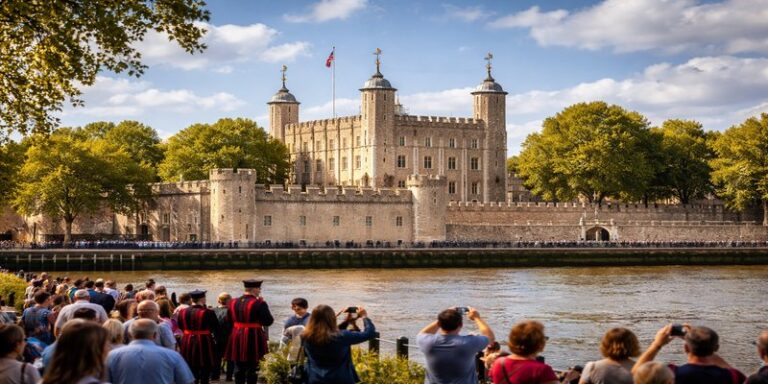
Rising dramatically beside the River Thames, the Tower of London stands as one of the most recognisable and visited heritage attractions in the United Kingdom. For holidaymakers, it represents far more than an ancient fortress: it is a place where nearly a thousand years of English history unfold through architecture, storytelling, and spectacle. As a UNESCO World Heritage Site, the Tower plays a central role in London’s tourism offer, combining royal pageantry, dark history, and immersive visitor experiences that continue to captivate millions of visitors each year.
1.0 Origins: Power, Conquest and the Birth of a Landmark
The Tower of London was constructed in the late eleventh century following William the Conqueror’s victory at the Battle of Hastings in 1066. The original White Tower was designed as a visible symbol of Norman authority and control over a newly conquered population (Impey & Parnell, 2000). Strategically positioned near the Thames, it dominated both the city and key trade routes.
From a tourism perspective, this origin story is fundamental to the Tower’s appeal. Heritage scholars argue that visitors are drawn to sites that embody turning points in national history, particularly moments of conquest and transformation (Boniface & Fowler, 2002). The Tower’s architecture still communicates power and intimidation, allowing visitors to physically experience the legacy of medieval rule.
2.0 A Multifunctional Fortress and Royal Residence
Across the centuries, the Tower evolved into a complex institution serving multiple roles: royal palace, fortress, treasury, mint, menagerie, prison, and execution site. This layered history enhances its value as a tourism attraction, offering diverse narratives that appeal to a wide range of visitor motivations.
Notable historical figures such as Anne Boleyn, Sir Thomas More, and Lady Jane Grey are closely associated with the Tower, having been imprisoned or executed within its walls. According to Poria, Butler and Airey (2004), heritage tourists are often motivated by personal emotional connections to historical stories, rather than abstract facts. The Tower’s association with betrayal, ambition, and tragedy creates a powerful emotional resonance that deepens visitor engagement.
3.0 The Tower of London as a Heritage Visitor Experience
Today, the Tower of London functions as a carefully managed heritage tourism site, welcoming over two million visitors annually (Historic Royal Palaces, 2024). The visitor experience is structured around a combination of authentic historic spaces, interpretive exhibitions, and guided storytelling.
The Yeoman Warders, popularly known as the Beefeaters, play a crucial role in this experience. Their guided tours blend historical accuracy with humour and theatricality, exemplifying what Selby (2016) describes as the importance of interpretation in cultural heritage tourism. For many visitors, these tours transform static buildings into living history.
In addition, exhibitions addressing themes of imprisonment, punishment, and power reflect contemporary approaches to inclusive and critical heritage interpretation (MacLeod et al., 2014). This ensures the Tower remains relevant to modern audiences while maintaining historical integrity.
4.0 The Crown Jewels and Royal Tourism
One of the Tower’s strongest tourism draws is the Crown Jewels, a collection of regalia still used in royal ceremonies. These objects symbolise continuity, authority, and national identity, making them central to Britain’s global image.
Baxendale (2007) notes that royal tourism has long been a key component of Britain’s visitor economy, with monarchy-linked sites attracting international travellers seeking tradition and spectacle. The Crown Jewels offer a rare opportunity for visitors to encounter living heritage—artefacts that remain part of contemporary state rituals.
The display of the jewels also demonstrates how heritage attractions balance security, conservation, and visitor access, a challenge faced by many high-profile cultural sites worldwide.
5.0 Economic Importance and London’s Tourism Landscape
The Tower of London is a cornerstone of London’s cultural tourism economy, supporting employment, local businesses, and associated attractions. Its riverside location encourages wider exploration of the city, linking visits to nearby landmarks such as Tower Bridge, St Katharine Docks, and the South Bank.
Maitland (2007) argues that iconic heritage sites act as anchors within urban tourism, shaping visitor movement and length of stay. The Tower’s global recognition enhances London’s destination image, reinforcing the city’s reputation as a centre of history, culture, and tradition.
Moreover, its year-round appeal supports tourism beyond peak seasons, contributing to the sustainability of the urban visitor economy (Smith, 2019).
6.0 UNESCO Status and Sustainable Heritage Tourism
The Tower’s designation as a UNESCO World Heritage Site highlights its outstanding universal value, but also brings responsibilities. Managing high visitor numbers while preserving fragile structures is an ongoing challenge.
Waterton (2013) emphasises that heritage tourism increasingly prioritises sustainability, accessibility, and inclusive interpretation. Recent initiatives at the Tower have focused on improving physical access, diversifying historical narratives, and enhancing digital interpretation, ensuring the site remains welcoming to a broad visitor demographic (Historic Royal Palaces, 2024).
For tourists, these efforts enhance the quality of the experience while reinforcing the Tower’s role as a responsible heritage destination.
7.0 Enduring Appeal for the Modern Traveller
The enduring popularity of the Tower of London lies in its ability to combine spectacle, storytelling, and authenticity. It appeals equally to first-time visitors seeking iconic sights and repeat travellers interested in deeper historical understanding.
As Gilbert and Henderson (2002) observe, London’s tourist imagination is shaped by places where history feels tangible and immediate. The Tower offers precisely this experience—an encounter with the past that is dramatic, unsettling, and unforgettable.
For holidaymakers, the Tower of London is not merely a place to visit, but a journey through England’s political, cultural, and royal past, making it one of the most compelling heritage attractions in the world.
References
Baxendale, J. (2007) The Construction of the Past and the Origins of Royal Tourism in Britain. London: Palgrave.
Boniface, P. & Fowler, P. (2002) Heritage and Tourism in the Global Village. London: Routledge.
Gilbert, D. & Henderson, F. (2002) London and the Tourist Imagination. London: Continuum.
Historic Royal Palaces (2024) Tower of London. Available at: https://www.hrp.org.uk/tower-of-london/.
Impey, E. & Parnell, G. (2000) The Tower of London: The Official Illustrated History. London: Merrell.
MacLeod, S., Sandell, R., Dodd, J., Duncan, T. & Jones, C. (2014) Prisoners, Punishment and Torture at the Tower of London. Leicester: University of Leicester.
Maitland, R. (2007) Cultural tourism and the development of new tourism areas in London. In: Cultural Tourism: Global and Local Perspectives. London: Routledge.
Poria, Y., Butler, R. & Airey, D. (2004) Links between tourists, heritage and reasons for visiting heritage sites. Journal of Travel Research, 43(1), pp. 19–28.
Selby, M. (2016) People–place–past: the visitor experience of cultural heritage. In: Culture, Heritage and Representation. London: Routledge.
Smith, A. (2019) Destination London: The Expansion of the Visitor Economy. London: University of Westminster Press.
Waterton, E. (2013) Heritage Tourism and Its Representations. London: Routledge.
UNESCO (2024) Tower of London World Heritage Site. Available at: https://whc.unesco.org.