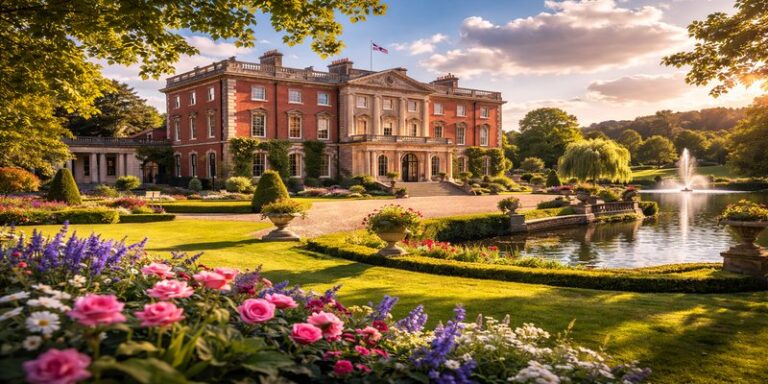
Set amid rolling parkland in the village of Hillsborough, County Down, Hillsborough Castle and Gardens stands as one of the most distinctive historic residences in the United Kingdom. Though often referred to as a “castle”, it is in fact an elegant eighteenth-century Georgian country house, whose dignified façade and sweeping gardens conceal a rich and complex history. From its origins as a private aristocratic home to its transformation into a royal residence in the 1920s, Hillsborough Castle has evolved into a place where monarchy, governance and diplomacy intersect. In the context of Northern Ireland’s turbulent modern history, it has become a powerful symbol of political dialogue and reconciliation (Historic Royal Palaces, 2024).
For visitors today, Hillsborough offers a rare opportunity to explore a living political residence that is also an accessible heritage site — where statecraft and serenity exist side by side.
1.0 From Georgian Elegance to Royal Residence
Hillsborough Castle was constructed in the 1770s for the Hill family, Marquesses of Downshire. Designed in the restrained yet refined Georgian architectural style, the house reflected the values of symmetry, proportion and classical influence that characterised eighteenth-century Britain and Ireland (Summerson, 1993). Its red-brick exterior, sash windows and Palladian-inspired proportions evoke the confidence of the Enlightenment era.
In 1922, following the partition of Ireland and the establishment of Northern Ireland, the British government purchased the property to serve as the official residence of the Governor of Northern Ireland. Later, it became the official residence of the Secretary of State for Northern Ireland and remains the monarch’s residence when visiting the region.
This transition from private estate to official state residence highlights how architecture adapts to political change. As Ashworth and Tunbridge (2000) observe, historic buildings frequently acquire new symbolic meanings over time, reflecting shifting social and constitutional contexts.
2.0 A Stage for Political Diplomacy
Few heritage sites in the United Kingdom are as closely linked to contemporary political history as Hillsborough Castle. During the late twentieth century, particularly throughout the Northern Ireland peace process, the castle served as a venue for negotiations, discussions and diplomatic engagement.
Notably, it hosted key meetings leading to the Anglo-Irish Agreement of 1985 and later discussions associated with the Good Friday Agreement of 1998, a landmark accord that significantly reduced sectarian violence and established a framework for devolved government (Tonge, 2006). Within its drawing rooms and conference spaces, political leaders debated issues of sovereignty, identity and peace.
The symbolic importance of such a setting cannot be overstated. Heritage scholars argue that the physical environment of negotiations can influence perception and legitimacy (Waterton and Watson, 2015). Hillsborough’s dignified yet domestic setting offered a neutral and prestigious backdrop conducive to dialogue.
For visitors, this political dimension adds gravitas. Walking through rooms once occupied by diplomats and heads of state fosters a sense of immediacy and relevance that bridges past and present.
3.0 The Monarchy and Reconciliation
Hillsborough Castle also embodies the monarchy’s evolving role in Northern Ireland. During periods of conflict, royal visits were often politically sensitive. However, in recent decades, the monarchy has played a visible role in promoting reconciliation.
One significant moment occurred in 2012, when Queen Elizabeth II met former IRA commander Martin McGuinness, then Deputy First Minister of Northern Ireland. Their handshake at Belfast’s Lyric Theatre symbolised a willingness to move beyond decades of division. While not held directly within Hillsborough Castle, such gestures reinforce the broader narrative of royal engagement in peace-building.
The castle thus represents more than administrative authority; it symbolises the monarchy’s constitutional adaptability. As Colley (1992) suggests, the British monarchy has historically survived by evolving in response to political and social transformation.
4.0 Interiors of State and Hospitality
Inside, Hillsborough Castle balances ceremonial splendour with domestic warmth. State rooms are adorned with portraits, antique furnishings and decorative arts that reflect the building’s Georgian origins. These rooms host official receptions, diplomatic meetings and investitures.
Yet the residence also contains private spaces used by visiting members of the royal family. This blending of public and private underscores a recurring theme in royal heritage: the coexistence of governance and domesticity. Cooper et al. (2018) note that heritage attractions linked to governance often resonate strongly with visitors when they reveal both formal and human dimensions.
Interpretative displays curated by Historic Royal Palaces offer context for both political events and architectural heritage, enhancing educational value.
5.0 The Gardens: Tranquillity and Transformation
Beyond the house itself, the 100-acre gardens constitute a major attraction. Landscaped parkland, ornamental lakes, woodlands and formal terraces create a setting of remarkable tranquillity. The gardens include the picturesque Lady Alice Temple, built in the nineteenth century, and extensive tree collections reflecting botanical traditions similar to those found at Kew.
Gardens contribute significantly to visitor wellbeing and aesthetic appreciation. According to Hall and Page (2014), landscaped heritage environments foster restorative experiences within tourism contexts. At Hillsborough, the gardens soften the political gravitas of the residence, offering visitors a peaceful counterpoint to its diplomatic history.
Seasonal events, exhibitions and horticultural displays attract families, reinforcing the site’s multifaceted appeal.
6.0 Tourism, Identity and Economic Impact
Tourism plays an increasingly important role in Northern Ireland’s economy. Following the peace process, the region experienced substantial growth in visitor numbers, as improved stability enhanced its international image (NISRA, 2023). Hillsborough Castle contributes to this positive narrative, showcasing a heritage site that embodies reconciliation rather than conflict.
From a destination management perspective, such sites strengthen regional branding. Page (2019) emphasises that tourism can support place identity and post-conflict regeneration. Hillsborough Castle demonstrates how heritage can transform from a symbol of governance into a catalyst for shared cultural understanding.
7.0 Heritage Management and Accessibility
Since 2014, Hillsborough Castle has been managed by Historic Royal Palaces, an independent charity responsible for several unoccupied royal residences. Conservation efforts balance the building’s role as a working political residence with public accessibility (Historic Royal Palaces, 2024).
Interactive exhibitions, guided tours and educational programmes ensure that visitors engage with both architectural and political narratives. This aligns with contemporary heritage practices that emphasise interpretation, inclusivity and sustainability (Timothy and Boyd, 2003).
8.0 A Living Symbol of Dialogue
Hillsborough Castle and Gardens stands as a testament to the power of place in shaping political and cultural history. From its eighteenth-century Georgian origins to its central role in the Northern Ireland peace process, it reflects the evolving relationship between monarchy, governance and society.
For travellers exploring Northern Ireland, Hillsborough offers more than architectural beauty. It provides insight into constitutional development, diplomatic negotiation and reconciliation. Its gardens invite reflection, while its state rooms recall moments of historic decision-making.
In an era when heritage tourism increasingly values authenticity and relevance, Hillsborough Castle demonstrates how a royal residence can remain both a working centre of governance and an accessible cultural landmark. It is, above all, a living symbol of dialogue — where history, politics and hope converge.
References
Ashworth, G.J. and Tunbridge, J.E. (2000) The Tourist-Historic City. London: Routledge.
Colley, L. (1992) Britons: Forging the Nation 1707–1837. London: Pimlico.
Cooper, C., Fletcher, J., Fyall, A., Gilbert, D. and Wanhill, S. (2018) Tourism: Principles and Practice. 6th edn. Harlow: Pearson.
Hall, C.M. and Page, S.J. (2014) The Geography of Tourism and Recreation. 4th edn. London: Routledge.
Historic Royal Palaces (2024) Hillsborough Castle and Gardens. Available at: https://www.hrp.org.uk.
NISRA (2023) Northern Ireland Tourism Statistics. Northern Ireland Statistics and Research Agency. Available at: https://www.nisra.gov.uk.
Page, S.J. (2019) Tourism Management. 6th edn. London: Routledge.
Summerson, J. (1993) Architecture in Britain 1530–1830. New Haven: Yale University Press.
Timothy, D.J. and Boyd, S.W. (2003) Heritage Tourism. Harlow: Pearson Education.
Tonge, J. (2006) Northern Ireland: Conflict and Change. 2nd edn. Harlow: Pearson Education.
Waterton, E. and Watson, S. (2015) The Palgrave Handbook of Contemporary Heritage Research. London: Palgrave Macmillan.