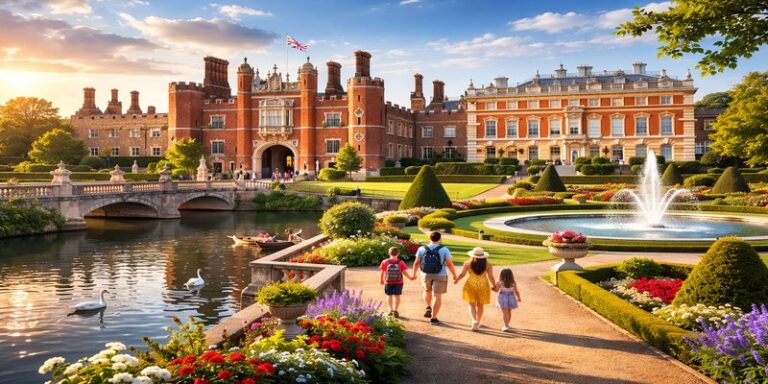
Standing majestically on the banks of the River Thames, Hampton Court Palace is far more than a historic building; it is a vivid stage upon which centuries of English monarchy unfolded. From its dramatic Tudor origins under Cardinal Thomas Wolsey to its sweeping Baroque transformation under William III and Mary II, the palace offers visitors a rare opportunity to explore two contrasting architectural and political eras beneath one roof. As historian Simon Thurley (2003) observes, Hampton Court is “a monument not simply to kingship, but to the changing face of monarchy itself”. Today, it remains one of Britain’s most compelling heritage attractions, blending political intrigue, architectural grandeur and immersive visitor experiences.
1.0 The Rise and Fall of Cardinal Wolsey
Hampton Court Palace began life in the early sixteenth century as the ambitious project of Cardinal Thomas Wolsey, chief minister to King Henry VIII. Wolsey envisioned a residence that would rival any in Europe, reflecting both his ecclesiastical authority and political influence. According to Thurley (2003), Wolsey spared no expense, employing hundreds of craftsmen to create richly decorated state rooms, elaborate tapestries and impressive courtyards.
However, in the volatile world of Tudor politics, proximity to power could quickly become perilous. When Wolsey failed to secure Henry VIII’s annulment from Catherine of Aragon, he fell dramatically from royal favour. In 1529, Hampton Court was seized by the King. This transfer of ownership transformed the palace into the epicentre of Tudor court life, hosting magnificent banquets, diplomatic receptions and royal celebrations.
2.0 Hampton Court Under Henry VIII: Power and Intrigue
Under Henry VIII, Hampton Court became synonymous with Tudor magnificence and political drama. The Great Hall, completed in 1535, remains one of the finest surviving medieval halls in England. Its soaring hammerbeam roof and heraldic decorations symbolised royal authority. Visitors today can almost imagine the spectacle of courtiers gathering beneath glittering chandeliers while musicians performed from the Minstrels’ Gallery.
Yet beneath the splendour lay tension and intrigue. Hampton Court witnessed pivotal moments in England’s religious transformation. It was here that Henry’s marriages unfolded, including those to Jane Seymour and Catherine Howard, whose tragic fate reflected the instability of court politics. As Loades (2012) notes, the Tudor court was a theatre of ambition where favour could mean advancement and disfavour could mean execution.
For modern visitors, this dramatic history enhances the palace’s appeal. According to heritage tourism theory, travellers are often drawn to sites that offer emotional resonance and storytelling (Timothy and Boyd, 2003). Hampton Court excels in this regard, using costumed interpreters and reconstructed kitchens to animate Tudor life for contemporary audiences.
3.0 Baroque Transformation: William III and Mary II
In the late seventeenth century, Hampton Court entered a new phase. William III and Mary II, inspired by the grandeur of Versailles, sought to modernise the ageing Tudor palace. They commissioned the architect Sir Christopher Wren to redesign large sections in the fashionable Baroque style. The result was a striking juxtaposition: red-brick Tudor courtyards standing alongside symmetrical Baroque façades.
This architectural layering makes Hampton Court unique. As architectural historians observe, few royal residences preserve such visible evidence of stylistic transition (Summerson, 1993). The Baroque State Apartments, with their formal layout and decorative ceilings, contrast sharply with the intimacy of Tudor chambers. The palace thus becomes a living textbook of architectural evolution.
From a tourism perspective, this dual identity enhances visitor engagement. Heritage scholars argue that sites embodying multiple historical narratives tend to attract broader audiences, as they offer diverse interpretative possibilities (Ashworth and Tunbridge, 2000). Hampton Court’s Tudor kitchens, Baroque gardens and Georgian additions collectively form a multidimensional heritage landscape.
4.0 Gardens, Mazes and Outdoor Splendour
Beyond its interiors, Hampton Court’s grounds are among its greatest treasures. The formal gardens, redesigned in the seventeenth century, feature geometric layouts and sweeping vistas. The Great Fountain Garden and the celebrated Hampton Court Maze, planted in the late seventeenth century, continue to delight families and visitors of all ages.
Gardens play a crucial role in heritage tourism, offering sensory experiences that complement historical interpretation. According to Hall and Page (2014), landscapes contribute to a destination’s aesthetic value and emotional impact. At Hampton Court, seasonal flower displays and open-air events create a dynamic visitor experience that evolves throughout the year.
5.0 Experiencing Heritage in the Modern Age
Today, Hampton Court Palace is managed by Historic Royal Palaces, an independent charity responsible for several unoccupied royal residences. The organisation prioritises conservation while enhancing accessibility through exhibitions, digital guides and interactive programming (Historic Royal Palaces, 2024).
Events such as the annual Hampton Court Palace Festival and Tudor reenactments attract thousands of visitors, blending heritage with contemporary entertainment. Pine and Gilmore’s (2011) concept of the Experience Economy is particularly relevant here; modern tourists increasingly seek immersive encounters rather than passive observation. Hampton Court’s interpretative strategies reflect this shift, transforming historical knowledge into engaging narratives.
6.0 Cultural and Economic Significance
Heritage sites contribute significantly to national identity and economic vitality. The UK’s heritage tourism sector generates billions annually and supports thousands of jobs (VisitBritain, 2023). Hampton Court Palace plays a vital role in sustaining this cultural economy, drawing international visitors eager to explore Britain’s royal past.
Moreover, the palace fosters educational engagement. School groups frequently visit to study Tudor history, architecture and political change. As Cooper et al. (2018) emphasise, successful tourist attractions balance educational value, entertainment and economic sustainability. Hampton Court exemplifies this balance.
7.0 A Living Chronicle of English History
Ultimately, Hampton Court Palace is more than a monument to royal ambition. It is a living chronicle of English history, reflecting shifts in religion, governance, architectural taste and cultural expression. From Wolsey’s ecclesiastical grandeur to Henry VIII’s dramatic reign and William III’s Baroque aspirations, the palace encapsulates centuries of transformation.
Walking through its courtyards, visitors encounter echoes of power struggles, whispered conspiracies and royal celebrations. The fusion of Tudor brickwork and Baroque elegance creates an atmosphere that is at once majestic and intimate. As Thurley (2003) suggests, Hampton Court endures because it embodies the human dimensions of monarchy — ambition, love, rivalry and reinvention.
For travellers seeking an enriching holiday experience near London, Hampton Court Palace offers not merely sightseeing but immersion in the pageantry, politics and artistry that shaped Britain. Its enduring appeal lies in its ability to bridge past and present, inviting each generation to rediscover the drama and splendour of royal history.
References
Ashworth, G.J. and Tunbridge, J.E. (2000) The Tourist-Historic City. London: Routledge.
Cooper, C., Fletcher, J., Fyall, A., Gilbert, D. and Wanhill, S. (2018) Tourism: Principles and Practice. 6th edn. Harlow: Pearson.
Hall, C.M. and Page, S.J. (2014) The Geography of Tourism and Recreation. 4th edn. London: Routledge.
Historic Royal Palaces (2024) Hampton Court Palace. Available at: https://www.hrp.org.uk.
Loades, D. (2012) Henry VIII: Court, Church and Conflict. London: The National Archives.
Pine, B.J. and Gilmore, J.H. (2011) The Experience Economy. Boston: Harvard Business Review Press.
Summerson, J. (1993) Architecture in Britain 1530–1830. New Haven: Yale University Press.
Thurley, S. (2003) Hampton Court: A Social and Architectural History. New Haven: Yale University Press.
Timothy, D.J. and Boyd, S.W. (2003) Heritage Tourism. Harlow: Pearson Education.
VisitBritain (2023) Inbound Tourism Performance Report. Available at: https://www.visitbritain.org.