Step onto England’s soil and you step into a story that has been unfolding for centuries. The chime of Big Ben, the scent of sea air along the Jurassic Coast, the hush inside a medieval cathedral, the warmth of a countryside inn—England offers atmosphere in abundance.
For overseas visitors, England is not simply a destination; it is an experience shaped by royal pageantry, literary legacy, coastal nostalgia and modern creativity. Few countries balance ancient castles and cutting-edge cities so seamlessly. Scholars have long described Britain’s tourism appeal as rooted in a distinctive blend of heritage, leisure culture and urban vitality (Middleton and Lickorish, 2007; Walton, 2009).
England, in particular, encapsulates this richness. Compact yet diverse, it allows travellers to breakfast in London, stroll through Shakespeare’s Stratford by afternoon, and watch the sun set over a Cornish beach by evening. This is a land where history is lived rather than displayed, and where every region has its own voice.
1.0 Brief Background and History
Tourism in England has evolved over centuries. The eighteenth-century Grand Tour introduced elite travellers to classical and cultural landmarks, while the nineteenth century witnessed the rise of the seaside resort, made accessible by railways (Walton, 2009; Gray, 2006). Towns such as Brighton, Blackpool and Morecambe became symbols of leisure and social change (Jarratt, 2019).
The development of coastal tourism shaped local economies and cultural identity (Romeril, 1988; Dawson, 2007). Simultaneously, England’s royal palaces and historic towns emerged as central pillars of heritage tourism, reinforcing national identity (Palmer, 1998).
In the twentieth and twenty-first centuries, England diversified further, embracing urban regeneration, cultural festivals, wellness tourism and creative industries (Morrison and Maxim, 2021; Palmer and Tivers, 2018). Today, England’s tourism offering reflects both tradition and reinvention.
2.0 Accommodation: Character at Every Corner
England’s accommodation landscape mirrors its historical and geographical variety.
2.1 Luxury and Historic Hotels
London’s grand establishments—The Savoy, The Ritz—evoke Edwardian elegance. Across the country, visitors can stay in converted castles, manor houses and coaching inns, blending heritage with modern comfort.
2.2 Boutique Urban Stays
Cities such as Manchester and Bristol offer stylish, design-led hotels reflecting post-industrial regeneration.
2.3 Seaside Guesthouses
Traditional B&Bs remain integral to coastal towns, preserving the charm of England’s classic seaside holiday (Gray, 2006).
2.4 Countryside Retreats
The Lake District, Cotswolds and Peak District provide cottages and farm stays ideal for tranquil escapes.
Holloway and Humphreys (2022) emphasise that England’s accommodation sector has adapted to contemporary expectations, integrating sustainability, wellness facilities and experiential elements.
3.0 Food & Drink: From Roast Dinners to Michelin Stars
English cuisine today is both rooted in tradition and globally inspired.
- Classic Fare: Roast beef with Yorkshire pudding; fish and chips by the sea; Cornish pasties.
- Afternoon Tea: A ritual of scones, clotted cream and fine china.
- Regional Produce: Cheddar cheese, Kentish apples, Lincolnshire sausages.
- Modern Gastronomy: London boasts multiple Michelin-starred restaurants.
- Beverages: Real ales, English sparkling wines and artisan gins.
Food tourism forms an increasingly important component of the visitor economy (Palmer and Tivers, 2018), reinforcing local identity and sustainability.
4.0 Things to Do
4.1 Historic Royal Places
England’s monarchy shapes its global image. Visit Buckingham Palace, the Tower of London, Hampton Court Palace and Windsor Castle. Such attractions represent what scholars describe as heritage sites central to symbolic national capital (Palmer, 1998).
4.2 Beaches & Coastal Resorts
From the lively pier at Brighton to the dramatic cliffs of Dover, England’s coast remains iconic. Seaside towns historically fostered leisure innovation and social mobility (Walton, 2009). The Heritage Coast programme highlights conservation alongside tourism (Romeril, 1988).
4.3 Cities & Urban Breaks
London’s cosmopolitan dynamism contrasts with York’s medieval streets or Liverpool’s maritime heritage. Urban tourism studies highlight how cities combine culture, regeneration and events to attract global visitors (Morrison and Maxim, 2021).
4.4 Island Breaks
The Isle of Wight offers sandy beaches and sailing culture, while the Isles of Scilly provide subtropical beauty and serenity.
4.4 Landmarks & Iconic Attractions
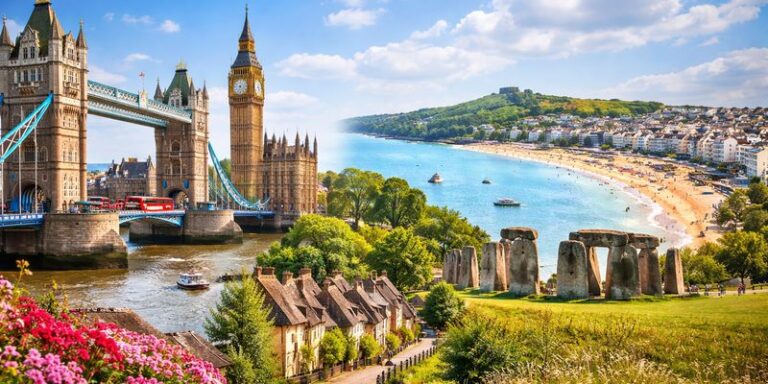
Stonehenge, Hadrian’s Wall, the Lake District and Canterbury Cathedral symbolise England’s layered past. In London, world-renowned attractions such as The British Museum, Tower Bridge, The London Eye and Madame Tussauds further enrich the visitor experience. Together, these landmarks blend ancient heritage with modern spectacle, shaping international perceptions of English identity and cultural prestige (Palmer, 1998).
4.4.1 Theme Parks & Family Attractions
Alton Towers, LEGOLAND Windsor and Blackpool Pleasure Beach continue England’s tradition of leisure entertainment (Walton and Wood, 2008). Such attractions diversify regional economies and extend visitor stays.
4.4.2 Shopping Destinations
Oxford Street and Covent Garden in London, the Bullring in Birmingham and independent boutiques in Brighton combine heritage architecture with contemporary retail culture.
4.4.3 Countryside & Villages
The Cotswolds’ honey-coloured cottages, the Yorkshire Dales’ rolling hills and the Peak District’s walking trails provide restorative rural experiences.
4.4.4 Cultural & Historic Towns
Bath’s Roman Baths and Georgian terraces, Stratford-upon-Avon’s Shakespearean legacy and Durham’s cathedral illustrate England’s architectural continuity.
4.4.5 Events & Festival Destinations
England thrives on events. The Notting Hill Carnival, Wimbledon Championships, Glastonbury Festival and countless heritage open days reflect what Middleton and Lickorish (2007) describe as the growth of event-led tourism.
4.4.6 Wellness & Retreat Destinations
Spa towns such as Bath and Harrogate have offered therapeutic waters for centuries. Contemporary wellness initiatives in coastal towns demonstrate renewed emphasis on health and wellbeing (Chamekh, 2019; Urošević, 2020).
5.0 When to Visit
England offers year-round appeal.
- Spring (March–May): Gardens bloom; temperatures mild.
- Summer (June–August): Festivals flourish; coastal resorts lively.
- Autumn (September–November): Countryside glows with autumn colour.
- Winter (December–February): Christmas markets, festive lights and cosy pubs.
Seasonality remains significant for seaside resorts (Walton, 2009), yet diversification into events and wellness has extended the tourism calendar.
6.0 Sample 10-Day Itinerary
Day 1–3: London
Explore Westminster, Buckingham Palace, the British Museum and West End theatre.
Day 4: Windsor & Oxford
Royal heritage and academic splendour.
Day 5–6: Bath & the Cotswolds
Roman Baths, spa relaxation and picturesque villages.
Day 7: Stratford-upon-Avon
Shakespeare’s birthplace and riverside charm.
Day 8: York
York Minster and medieval Shambles.
Day 9: Lake District
Scenic hikes and literary connections to Wordsworth.
Day 10: Manchester or Liverpool
Industrial heritage, music history and modern regeneration.
7.0 Travel Tips
- Transport: England’s rail network is extensive; pre-book tickets for savings.
- Driving: Vehicles drive on the left.
- Weather: Pack layers; rain showers can occur year-round.
- Currency: Pound sterling (£).
- Tipping: 10–12.5% in restaurants if service not included.
- Cultural Etiquette: Queueing is customary; politeness valued.
8.0 Why England Is Worth Visiting
England’s strength lies in its extraordinary balance of continuity and change. It preserves medieval cathedrals and royal palaces while nurturing contemporary art, gastronomy and innovation. Its coastline carries the nostalgia of Victorian holidays; its cities pulse with twenty-first-century creativity.
Academic analyses consistently highlight England’s ability to adapt—revitalising seaside towns, investing in heritage conservation and expanding event tourism (Walton and Wood, 2008; Morrison and Maxim, 2021).
For overseas travellers, England offers more than landmarks. It offers atmosphere, narrative and emotional resonance. It is a place where you can trace centuries of history in a single afternoon, then share a modern culinary experience by evening.
In short, England rewards curiosity. It invites exploration, reflection and delight—and once visited, it rarely fades from memory.
References
Chamekh, M. (2019) ‘The interplay of health, pleasure and wellness in British seaside resorts’, Revue Française de Civilisation Britannique, 24(2), pp. 1–15.
Dawson, S. (2007) ‘The battle for Beachlands: Hayling Island and the development of coastal leisure in Britain 1820–1960’, International Journal of Regional and Local Studies, 3(1), pp. 56–75.
Gray, F. (2006) Designing the seaside: Architecture, society and nature. London: Reaktion Books.
Holloway, J.C. and Humphreys, C. (2022) The business of tourism. Harlow: Pearson.
Jarratt, D. (2019) ‘The development and decline of Morecambe in the nineteenth and twentieth centuries’, Journal of Tourism History, 11(3), pp. 1–20.
Middleton, V.T.C. and Lickorish, L.J. (2007) British tourism: The remarkable story of growth. Oxford: Butterworth-Heinemann.
Morrison, A.M. and Maxim, C. (2021) World tourism cities: A systematic approach to urban tourism. London: Routledge.
Palmer, C. (1998) Heritage tourism and English national identity. London: London Metropolitan University.
Palmer, C. and Tivers, J. (2018) Creating heritage for tourism. London: Routledge.
Romeril, M. (1988) ‘Coastal tourism and the Heritage Coast programme in England and Wales’, Tourism Recreation Research, 13(1), pp. 13–18.
Urošević, N. (2020) ‘The spa and seaside resort in the development of Euro-Mediterranean travel and tourism’, International Journal of Euro-Mediterranean Studies, 13(1), pp. 45–60.
Walton, J.K. (2009) ‘Seaside tourism on a global stage’, Journal of Tourism History, 1(1), pp. 7–20.
Walton, J.K. and Wood, J. (2008) ‘The seaside resort as world heritage site? The case of Blackpool’, Archaeology International, pp. 1–15.