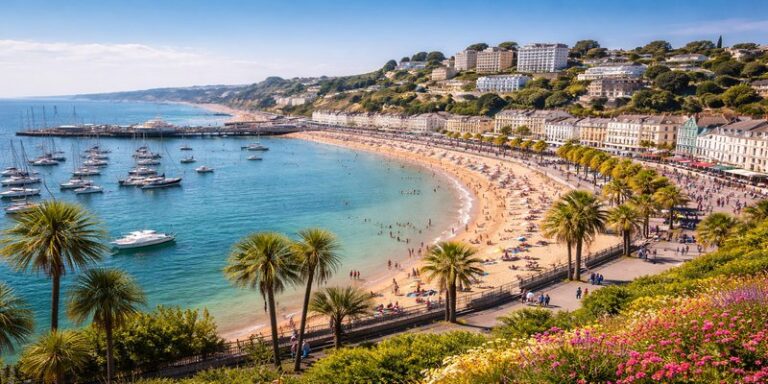
There is a moment, standing on the palm-lined promenade of Torquay, when the sunlight glints across the calm waters of Tor Bay and it feels almost Mediterranean. Yachts sway gently in the harbour, pastel façades reflect in the sea, and the scent of salt and fresh coffee drifts through the warm air. This is the English Riviera, a stretch of South Devon coastline encompassing Torquay, Paignton and Brixham, where gentle beaches meet maritime heritage and relaxed refinement.
Unlike the exuberant spectacle of some northern resorts, the English Riviera exudes a quieter confidence. It is a destination shaped by elegant promenades, sheltered coves and family traditions, where grandparents return with grandchildren to recreate cherished memories. As Morgan and Pritchard (1999) suggest, regional branding and identity play a powerful role in shaping visitor perception. Few places demonstrate this more clearly than Devon’s coastal resorts, whose enduring image continues to evoke nostalgia, warmth and belonging.
1.0 Brief Background and History
The English Riviera’s rise began in the nineteenth century, when improved transport links brought affluent Victorian travellers to Devon’s mild coastal climate. Torquay, in particular, developed as a fashionable retreat for those seeking sea air and genteel surroundings. Grand villas, manicured gardens and ornate hotels reinforced its status as a refined holiday destination.
The expansion of the railway further broadened access, welcoming middle-class families eager for restorative seaside breaks (Walton, 2000). Paignton emerged as a more family-oriented resort, while Brixham retained its identity as a working fishing port.
Throughout the twentieth century, the region balanced tourism with maritime tradition. Fishing fleets continued to operate alongside pleasure cruises, creating a unique blend of authenticity and leisure. Butler’s (1980) Tourism Area Life Cycle model helps explain how Devon’s resorts have evolved while maintaining core appeal through adaptation and investment.
2.0 Accommodation: Coastal Comfort with Character
Accommodation across the English Riviera reflects its diverse character. In Torquay, historic seafront hotels offer Victorian elegance, many renovated with contemporary comforts. Boutique guesthouses perched on hillsides provide panoramic views over the bay, blending intimacy with charm.
Paignton caters particularly well to families, with holiday parks, self-catering apartments and traditional bed-and-breakfasts near the beach. Meanwhile, Brixham features cosy cottages and harbour-side inns that reflect its fishing heritage.
According to Cooper et al. (2018), diversified accommodation supports destination resilience by appealing to multiple market segments. The English Riviera’s range — from heritage hotels to caravan parks — ensures accessibility for varied budgets and travel styles.
Sustainable tourism initiatives are also evident. Many establishments promote local sourcing and energy-efficient practices, aligning with growing environmental expectations (Hall and Page, 2014).
3.0 Food and Drink: Fresh from the Sea
Devon’s culinary identity is rooted in its maritime setting. Brixham, one of England’s busiest fishing ports, supplies restaurants with fresh crab, scallops and mackerel. Harbour-front eateries serve seafood platters overlooking colourful trawlers, creating a direct connection between ocean and plate.
No visit would be complete without sampling a traditional Devon cream tea — scones topped with clotted cream and jam (in that order, according to local custom). The region’s culinary offerings reflect the increasing importance of food tourism, where local produce enhances destination authenticity (Ellis et al., 2018).
Independent cafés, coastal pubs and vineyard tours across South Devon further enrich the gastronomic experience. Food and drink become not merely sustenance but expressions of place.
4.0 Things to Do: From Beaches to Boat Trips
The English Riviera’s beaches are central to its appeal. Paignton Sands offers gently shelving waters ideal for children, while Goodrington Beach provides colourful huts and water sports. Torquay’s Meadfoot Beach combines pebbles and sand with dramatic cliffs.
For history enthusiasts, the region boasts sites such as Kents Cavern, a prehistoric cave system revealing human occupation dating back thousands of years. Maritime museums in Brixham celebrate naval heritage and the town’s connection to William of Orange’s 1688 landing.
Boat excursions across Tor Bay allow visitors to appreciate the coastline from the sea, reinforcing the maritime atmosphere. Walking enthusiasts can explore segments of the South West Coast Path, which weaves through dramatic headlands and hidden coves.
Jennings (2004) highlights the growing demand for experiential tourism, where participation enhances engagement. Whether paddleboarding, sailing or coastal walking, the English Riviera offers immersive opportunities beyond passive sunbathing.
5.0 When to Visit: Seasons of Serenity
Summer remains the most popular time to visit, when warm weather and school holidays fill beaches with laughter and colour. Events such as the English Riviera Airshow attract additional visitors, extending the festive atmosphere.
Spring and early autumn offer milder temperatures and fewer crowds, ideal for walking and sightseeing. Butler (1980) suggests that destinations capable of diversifying seasonal appeal sustain longer-term vitality. Devon’s mild climate allows for extended visitation, particularly among retirees and short-break travellers.
Winter, though quieter, reveals a contemplative beauty — stormy seas and empty promenades offering restorative tranquillity.
6.0 Sample Three-Day Itinerary
Day One – Torquay Elegance
Morning: Stroll along the palm-lined promenade and visit Kents Cavern.
Afternoon: Relax at Meadfoot Beach.
Evening: Harbour-side seafood dinner.
Day Two – Paignton Family Fun
Morning: Beach time at Paignton Sands.
Afternoon: Visit Paignton Zoo or enjoy paddleboarding.
Evening: Traditional cream tea followed by a sunset walk.
Day Three – Brixham Heritage
Morning: Explore Brixham Harbour and Maritime Museum.
Afternoon: Coastal walk along the South West Coast Path.
Evening: Boat cruise across Tor Bay.
This itinerary blends heritage, leisure and coastal exploration, encapsulating the Riviera’s multi-generational appeal.
7.0 Travel Tips
- Getting There: Trains connect London to Torquay in approximately three hours.
- Local Transport: Buses link the three towns efficiently; walking paths provide scenic alternatives.
- Weather Preparedness: Even in summer, bring light layers for sea breezes.
- Sustainability: Support local fisheries and independent businesses to strengthen the regional economy.
7.0 Why the English Riviera Is Worth Visiting
The English Riviera endures because it embodies balance. It offers gentle beaches without losing maritime authenticity, elegance without exclusivity and heritage without stagnation. As Morgan and Pritchard (1999) emphasise, regional identity shapes emotional attachment. Devon’s Riviera succeeds by evoking familiarity while accommodating contemporary travel expectations.
For multi-generational families seeking shared memories, couples desiring scenic tranquillity or solo travellers pursuing coastal walks and fresh seafood, the English Riviera delivers a uniquely British blend of charm and comfort.
In its palm-lined promenades, fishing harbours and golden sands, Devon’s coastline reminds visitors why the British seaside continues to captivate hearts — not through spectacle alone, but through enduring atmosphere and authentic connection.
References
Butler, R.W. (1980) ‘The concept of a tourist area cycle of evolution’, Canadian Geographer, 24(1), pp. 5–12.
Cooper, C., Fletcher, J., Fyall, A., Gilbert, D. and Wanhill, S. (2018) Tourism: Principles and Practice. 6th edn. Harlow: Pearson.
Ellis, A., Park, E., Kim, S. and Yeoman, I. (2018) ‘What is food tourism?’, Tourism Management, 68, pp. 250–263.
Hall, C.M. and Page, S.J. (2014) The Geography of Tourism and Recreation. 4th edn. London: Routledge.
Jennings, G. (2004) Adventure Tourism. Oxford: Elsevier Butterworth-Heinemann.
Morgan, N. and Pritchard, A. (1999) Tourism Promotion and Power. Chichester: Wiley.
VisitBritain (2023) Domestic Tourism Trends Report. Available at: https://www.visitbritain.org.
Walton, J.K. (2000) The British Seaside: Holidays and Resorts in the Twentieth Century. Manchester: Manchester University Press.