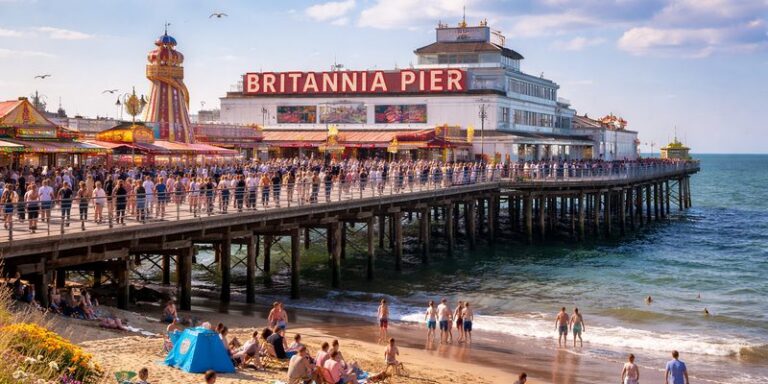
There is a particular moment, just as the afternoon sun begins to soften over the North Sea, when Britannia Pier seems to glow. The laughter from the arcades mingles with the cries of gulls overhead, the scent of salt air blends with freshly fried doughnuts, and the wooden boards beneath your feet echo with generations of holidaymakers.
To walk along Britannia Pier in Great Yarmouth is to step into a living theatre of British seaside culture. It is both nostalgic and immediate — a place where the rituals of the traditional seaside holiday continue, yet constantly adapt to modern tastes. As scholars of coastal tourism observe, seaside piers are not merely structures extending into the sea; they are symbols of leisure, regeneration, and cultural identity (Gray, 2020; Borsay & Walton, 2011).
Britannia Pier, rebuilt and reinvented over time, stands as one of the defining icons of the English coast.
1.0 Brief Background/History
Opened in 1858 and rebuilt in 1902 after storm damage, Britannia Pier emerged during the golden age of Victorian seaside expansion (Borsay & Walton, 2011). Between 1860 and 1905, some 85 seaside piers were constructed around England, reflecting the explosive growth of rail travel and mass tourism (Light & Chapman, 2022).
Great Yarmouth, already a prosperous fishing port, embraced the new leisure economy. The pier quickly became central to the town’s identity, offering promenading, entertainment and spectacular sea views. As Gray (2020) argues in her study of British seaside architecture, piers represented hope, modernity and civic pride — engineering marvels projecting confidence into the sea.
However, like many coastal towns, Great Yarmouth faced economic decline in the late twentieth century as foreign package holidays grew in popularity (Gale, 2001). Visitor numbers fell, and ageing infrastructure struggled to compete. Yet recent decades have seen renewed interest in heritage-led regeneration, with piers repositioned as valuable cultural assets (Houghton, 2023; Chapman, Richards & Blake, 2020).
Britannia Pier today blends traditional amusements with live entertainment, embodying the adaptability scholars identify as essential for seaside survival (Chapman, Light & Richards, 2021).
2.0 Accommodation
A visit to Britannia Pier is often paired with a stay along Great Yarmouth’s famed Golden Mile. Accommodation options range from Victorian guesthouses and B&Bs to contemporary hotels and holiday parks.
Historically, seaside lodging reflected social class distinctions, with grand hotels offering sea views and modest boarding houses catering to working families (Averby, 2018). Today, this diversity remains a strength. Families may opt for caravan parks near the coast, while couples might choose boutique hotels overlooking the promenade.
Research highlights how upgrading accommodation stock forms a key element of regeneration strategies in coastal towns (Houghton, 2023). Improvements in quality and diversification of offerings help destinations remain competitive in a crowded tourism market.
Staying within walking distance of Britannia Pier ensures easy access to evening performances and early-morning seaside strolls.
3.0 Food & Drink
No British pier experience would be complete without indulging in classic seaside fare. Around Britannia Pier, visitors will find fish and chips, candyfloss, doughnuts, and ice cream — staples of the coastal holiday tradition.
Food has long been central to the seaside ritual. Middleton and Lickorish (2007) argue that the sensory pleasures of eating by the sea enhance the overall tourist experience, creating emotional attachment to place.
Yet the culinary scene has broadened. Modern cafés, pubs and restaurants offer international cuisine, reflecting broader social and demographic change (Barnard & Costello, 2023). Whether enjoying a traditional plate of seafood or a contemporary brunch overlooking the waves, food remains part of the pier’s enduring appeal.
Eating here is not simply sustenance — it is participation in a shared cultural ritual.
4.0 Things to Do
Britannia Pier is first and foremost an entertainment venue. Its theatre hosts live music, comedy shows and seasonal performances, continuing the tradition of seaside variety entertainment (Hayler, 1999).
Beyond the theatre:
- Amusement arcades offering classic penny-slot nostalgia and modern gaming.
- Seafront promenading, a Victorian pastime still enjoyed today.
- Nearby attractions including the Time and Tide Museum and Sea Life Centre.
Chapman, Light and Richards (2021) note that successful piers diversify their offer, combining heritage value with contemporary attractions. Britannia Pier exemplifies this approach — preserving its historic character while evolving its entertainment programme.
The experience is as much about atmosphere as activity: the wind, the horizon, the shared laughter of families gathered along the railings.
5.0 Sample Itinerary
5.1 Day 1:
Morning beach walk → Lunch on the promenade → Afternoon exploring arcades → Evening show at Britannia Pier theatre.
5.2 Day 2:
Visit local museums → Harbour stroll → Boat trip on the Norfolk Broads → Sunset drink overlooking the pier lights.
5.3 Day 3:
Relaxed brunch → Shopping along Regent Road → Final promenade walk before departure.
These itinerary balances heritage, relaxation and entertainment, reflecting the multi-layered seaside experience.
6.0 When to Visit
The peak season runs from June to September, when school holidays and warmer weather bring lively crowds. Summer evenings are particularly atmospheric, as pier lights shimmer across the water.
However, off-season visits offer quieter beaches and reduced accommodation rates. As research on coastal regeneration indicates, extending the tourism season is vital for economic sustainability (Houghton, 2023). Spring and early autumn therefore present attractive alternatives.
Weather can be changeable, so visitors should be prepared for brisk coastal winds even in summer.
7.0 Travel Tips
- Transport: Great Yarmouth is accessible via rail from Norwich and by road along the A47.
- Tickets: Pre-book theatre performances at Britannia Pier during peak season.
- Clothing: Bring layers and comfortable walking shoes.
- Explore Wider Heritage: Visit historic South Quay to appreciate the maritime context that predates the pier (Gilchrist, 2017).
Understanding the wider socio-economic history of the English seaside enriches the experience (Light & Chapman, 2022).
8.0 Why It’s Worth Visiting
Britannia Pier is more than an attraction — it is a living emblem of British seaside culture. It captures the optimism of the Victorian age, the resilience of coastal communities, and the adaptability required in a changing tourism landscape.
As Borsay and Walton (2011) argue, seaside resorts form part of Europe’s shared leisure heritage. Britannia Pier continues to play its part, balancing tradition with renewal.
To visit is to join a story stretching back over 160 years — to stand where countless others have stood, gazing at the horizon, wrapped in sea air and possibility.
It remains, in every sense, a pier of memories — and new beginnings.
References
Averby, K. (2018) Seaside Hotels. Bristol: Channel View Publications.
Barnard, C. & Costello, F. (2023) ‘When (EU) migration came to Great Yarmouth’, Contemporary Social Science. Available at: https://www.tandfonline.com/doi/abs/10.1080/21582041.2023.2188486.
Borsay, P. & Walton, J.K. (2011) Resorts and Ports: European Seaside Towns since 1700. Bristol: Channel View Publications.
Chapman, A., Light, D. & Richards, S. (2021) ‘Heritage attractions, competitive pressures and adaptation: the case of the British seaside pier’, Journal of Heritage Tourism. Available at: https://www.tandfonline.com/doi/abs/10.1080/1743873X.2020.1806288.
Chapman, A., Richards, S. & Blake, A. (2020) Pier Review: Sustainability Toolkit for British Seaside Piers. Bournemouth University. Available at: http://eprints.bournemouth.ac.uk/33859/.
Gale, T.J. (2001) Late twentieth century cultural change and the decline and attempted rejuvenation of the British seaside resort. Cardiff Metropolitan University.
Gilchrist, P. (2017) ‘Where do heritage trails go to die? Stepping out at the British seaside’, in Heritage and Tourism in Britain and Ireland. London: Palgrave Macmillan.
Gray, F. (2020) The Architecture of British Seaside Piers. London: Lund Humphries.
Hayler, S. (1999) ‘Live entertainment at the seaside’, Cultural Trends, 9(36), pp. 1–26.
Houghton, J.P. (2023) ‘Solving the riddle of the sands: How to regenerate England’s struggling seaside towns’, Journal of Urban Regeneration & Renewal.
Light, D. & Chapman, A. (2022) ‘The neglected heritage of the English seaside holiday’, Coastal Studies & Society.