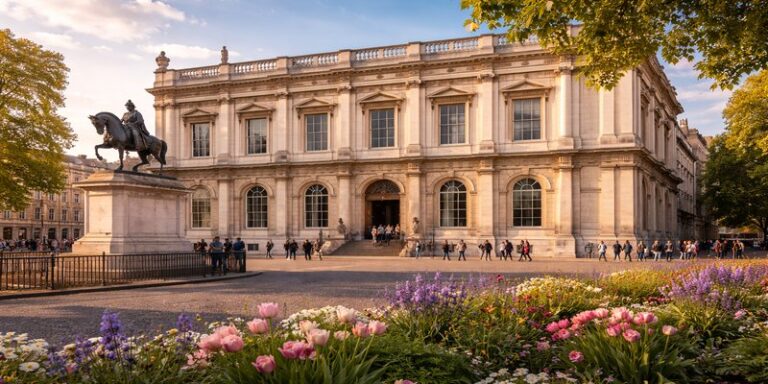
Standing with dignified restraint along Whitehall in central London, the Banqueting House is a building of paradoxes. Elegant yet austere, celebratory yet tragic, it represents both the height of Stuart royal ambition and one of the most dramatic turning points in British history. As the sole surviving fragment of the once-magnificent Whitehall Palace, it carries within its walls the echoes of courtly entertainments, artistic innovation and constitutional revolution. Designed by Inigo Jones and completed in 1622, the Banqueting House introduced Palladian architecture to England and marked a decisive shift towards Renaissance ideals (Summerson, 1993). Yet it is equally remembered as the site of King Charles I’s execution in 1649, a moment that reshaped the British monarchy forever.
Today, managed by Historic Royal Palaces, the Banqueting House stands not merely as an architectural landmark but as a compelling destination for visitors interested in the interplay of art, politics and power. For holidaymakers exploring London’s rich historical landscape, it offers a concentrated and deeply symbolic experience.
1.0 A Fragment of Lost Grandeur
To understand the Banqueting House, one must imagine the vast complex of Whitehall Palace, which once stretched from present-day Trafalgar Square to the River Thames. Following Henry VIII’s acquisition of the property in 1530, Whitehall became the principal royal residence, surpassing even the Tower of London in scale and splendour (Thurley, 1999). Fires in 1698 destroyed most of the palace, leaving the Banqueting House as the sole architectural survivor.
This survival enhances its significance. As Ashworth and Tunbridge (2000) argue, fragments of historic sites often carry heightened symbolic value because they serve as tangible reminders of vanished worlds. The Banqueting House, standing alone amid modern government buildings, evokes the grandeur of a lost royal court.
2.0 Inigo Jones and the Arrival of Palladianism
Commissioned by James I and completed under Charles I, the Banqueting House was designed by Inigo Jones, England’s first significant classical architect. Having travelled extensively in Italy, Jones was inspired by the work of Andrea Palladio and the principles of Renaissance symmetry, proportion and harmony.
The Banqueting House thus introduced Palladian architecture to England, marking a cultural turning point. Summerson (1993) describes it as “a manifesto of classical design”, with its restrained façade and mathematically balanced proportions. In a country still dominated by Gothic traditions, this architectural statement signalled England’s engagement with continental humanism and Renaissance thought.
For visitors today, the building’s simplicity contrasts sharply with the ornate Gothic architecture found elsewhere in London. This stylistic clarity enhances its educational value, illustrating architectural transition in a single, elegant structure.
3.0 The Rubens Ceiling: Art and Political Messaging
Inside, the Banqueting House reveals its most extraordinary treasure: the ceiling paintings by Sir Peter Paul Rubens. Commissioned by Charles I and installed in 1636, the canvases celebrate the reign of James I and promote the doctrine of the divine right of kings. Allegorical figures depict peace, prosperity and monarchical authority descending from heaven.
The irony is striking. Just thirteen years after the ceiling’s completion, Charles I was executed outside this very building. As cultural historians observe, the juxtaposition of triumphant imagery and political downfall underscores the fragility of royal power (Strong, 1999).
From a tourism perspective, such dramatic contrasts enhance interpretative richness. Pine and Gilmore’s (2011) concept of the Experience Economy suggests that emotionally charged narratives deepen visitor engagement. The Rubens ceiling is not merely art; it is a visual testament to ambition, ideology and eventual tragedy.
4.0 The Execution of Charles I: A Constitutional Watershed
On 30 January 1649, King Charles I stepped through a window of the Banqueting House onto a scaffold erected outside. There, before a silent and stunned crowd, he was executed for treason against his own people. This event marked the temporary abolition of the monarchy and the establishment of the English Commonwealth under Oliver Cromwell.
Few historic sites in Britain can claim association with such a defining constitutional moment. As Kishlansky (2002) notes, the execution represented a radical assertion that sovereignty ultimately derived from the people rather than divine authority. The Banqueting House thus stands at the crossroads of monarchy and modern parliamentary democracy.
For visitors, standing in the hall where Charles I spent his final hours provides a powerful sense of immediacy. Heritage scholars argue that places associated with transformative events often evoke profound emotional responses (Timothy and Boyd, 2003). The Banqueting House exemplifies this phenomenon.
5.0 A Stage for Masques and Courtly Spectacle
Before its association with revolution, the Banqueting House functioned as a venue for court masques — elaborate performances combining music, dance and allegory. These spectacles reinforced royal authority and celebrated dynastic achievements. Designed with a high ceiling and open interior space, the building was ideally suited for theatrical display.
Such performances illustrate how architecture can serve political ends. The building’s grandeur provided a backdrop for ritual and symbolism, projecting monarchical strength. Cooper et al. (2018) observe that historic sites often reflect broader socio-political functions beyond their physical form. The Banqueting House is both theatre and throne room.
6.0 Tourism, Education and Modern Interpretation
Today, the Banqueting House welcomes thousands of visitors annually. Managed by Historic Royal Palaces, it offers guided tours, multimedia exhibits and educational programmes for schools. Audio guides recount the drama of Charles I’s execution and the artistic significance of the Rubens ceiling (Historic Royal Palaces, 2024).
Its relatively compact scale makes it an ideal addition to a broader London itinerary. Situated near Westminster Abbey and the Houses of Parliament, it forms part of a concentrated corridor of constitutional heritage. VisitBritain (2023) notes that heritage tourism remains a key driver of international travel to the UK, with royal and political landmarks holding particular appeal.
7.0 Architecture as Memory
The Banqueting House embodies the idea that buildings can function as repositories of collective memory. Though Whitehall Palace vanished centuries ago, this surviving fragment continues to narrate stories of ambition, ideology and transformation. Its classical façade and painted ceiling preserve the aspirations of Stuart kings, while its association with regicide symbolises the limits of absolute power.
As Hall and Page (2014) argue, urban heritage sites contribute significantly to place identity and cultural continuity. The Banqueting House, framed by modern government offices, reminds Londoners and visitors alike of the turbulent journey towards constitutional monarchy.
8.0 Elegance and Irony in the Heart of London
The Banqueting House stands as a monument to both splendour and sacrifice. Designed as a celebration of divine monarchy, it became the stage upon which that very doctrine was challenged and dismantled. Its Palladian elegance, Rubens ceiling and association with Charles I’s execution combine to create a site of profound historical resonance.
For holidaymakers exploring London, the Banqueting House offers more than architectural appreciation. It provides a deeply human narrative of power, belief and change — a reminder that history is not merely recorded in books but inscribed upon the very stones of the city. In its quiet dignity, this surviving fragment of Whitehall Palace continues to invite reflection on the enduring tension between authority and accountability that defines British constitutional history.
References
Ashworth, G.J. and Tunbridge, J.E. (2000) The Tourist-Historic City. London: Routledge.
Cooper, C., Fletcher, J., Fyall, A., Gilbert, D. and Wanhill, S. (2018) Tourism: Principles and Practice. 6th edn. Harlow: Pearson.
Hall, C.M. and Page, S.J. (2014) The Geography of Tourism and Recreation. 4th edn. London: Routledge.
Historic Royal Palaces (2024) Banqueting House. Available at: https://www.hrp.org.uk.
Kishlansky, M. (2002) A Monarchy Transformed: Britain 1603–1714. London: Penguin.
Strong, R. (1999) The Spirit of Britain: A Narrative History of the Arts. London: Pimlico.
Summerson, J. (1993) Architecture in Britain 1530–1830. New Haven: Yale University Press.
Thurley, S. (1999) Whitehall Palace: An Architectural History of the Royal Apartments 1240–1698. New Haven: Yale University Press.
Timothy, D.J. and Boyd, S.W. (2003) Heritage Tourism. Harlow: Pearson Education.
VisitBritain (2023) Inbound Tourism Performance Report. Available at: https://www.visitbritain.org.