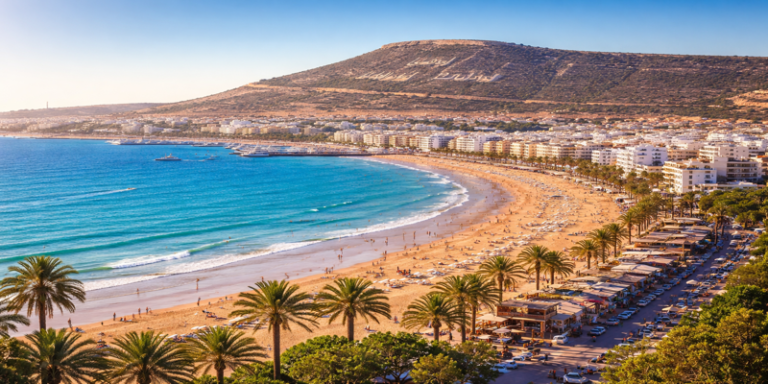
There is something instantly soothing about Agadir. The Atlantic breeze rolls in gently, the promenade hums with evening life, and the city’s long crescent of golden sand seems to stretch without hurry. Unlike the maze-like intensity of Marrakech or the medieval grandeur of Fes, Agadir offers a different side of Morocco: sunny, spacious, modern, and deeply rooted in Amazigh culture. It is a place where beach days meet mountain excursions, where grilled sardines and mint tea become part of the rhythm of travel, and where a city once devastated by tragedy has reinvented itself with remarkable confidence. For travellers seeking a destination that combines relaxation, history, food, and coastal charm, Agadir deserves far more attention than it often receives.
1.0 Brief Background/History
Agadir’s modern identity is inseparable from the devastating 1960 earthquake, which destroyed much of the city and caused immense loss of life. Rather than reconstructing the settlement exactly as it had been, Moroccan authorities rebuilt it slightly to the south, creating a city defined by wide avenues, open urban planning, and a modern seafront layout (Caffyn and Jobbins, 2003; Almeida-García, 2018). This gave Agadir a very different character from older Moroccan cities, many of which are centred around historic medinas.
The rebuilding of Agadir also reflected Morocco’s post-independence ambitions. The city became a symbol of renewal, resilience, and tourism-led development, especially as coastal tourism gained increasing importance in national planning (Adeniyi and Folarin, 2021). Today, Agadir stands not simply as a beach resort, but as a city whose past has shaped a distinct and forward-looking identity.
2.0 Accommodation
One of Agadir’s strongest appeals lies in its range of accommodation. Whether travellers are after luxury, comfort, or affordability, the city has options to suit most budgets and travel styles. Along the beachfront and marina area, visitors will find upscale resorts such as Sofitel Agadir Royal Bay Resort, known for its private beach setting and elegant design. Boutique choices such as Riad Villa Blanche offer a more intimate stay, often appealing to couples seeking quiet surroundings and spa facilities.
For families and mid-range travellers, centrally located hotels such as Kenzi Europa provide easy access to the beach, restaurants, and city attractions. Budget-conscious visitors, especially surfers and backpackers, often favour hostels and surf lodges in and around Agadir, including options near Taghazout, just north of the city. Eco-oriented stays are also becoming more visible in the region, reflecting a broader move towards sustainable tourism (Chakouk et al., 2025). Accommodation in Agadir therefore mirrors the city itself: accessible, varied, and tourism-friendly.
3.0 Food & Drink
Food is one of the great pleasures of any visit to Agadir. Thanks to its Atlantic location, the city is especially known for fresh seafood, from grilled sardines to delicate fish tagines. Moroccan gastronomy has long been recognised as a major part of the country’s tourism appeal, and Agadir showcases this particularly well through a blend of coastal flavours and Souss regional traditions (El Hafid et al., 2017).
Travellers should look out for fish tagine with preserved lemon and olives, sardine meatballs, and harira, the comforting tomato-based soup often eaten in the evening. Another regional favourite is amlou, a rich spread made from almonds, honey, and argan oil, reflecting the agricultural heritage of the wider Souss area. Meals are often rounded off with mint tea, which is as much a social ritual as a drink.
Popular dining spots include seafood restaurants near the marina and local eateries serving grilled fish at more modest prices. Souk El Had is also a useful place to experience the aromas and ingredients that define local cuisine. In Agadir, eating is not just about sustenance; it is part of the city’s warm, unhurried lifestyle.
4.0 Things to Do
Agadir offers far more than just a beach holiday. Its famous seafront promenade is ideal for walking, cycling, or simply watching the sunset. The beach itself remains the city’s main attraction, with opportunities for swimming, sunbathing, and watersports.
For culture, Souk El Had is essential. With thousands of stalls, it offers spices, leather goods, ceramics, textiles, and a vivid introduction to everyday commercial life. La Médina d’Agadir, reconstructed by architect Coco Polizzi, gives visitors a stylised but attractive sense of traditional Moroccan and Amazigh architecture. The Agadir Oufella hilltop area, linked to the city’s past, also provides sweeping views and a reminder of the earthquake’s legacy.
Nature lovers can explore the nearby Souss-Massa National Park, known for its wetlands, dunes, and birdlife. The wider region also opens the door to desert excursions, mountain villages, and surfing communities such as Taghazout. This mix of urban comfort, natural beauty, and cultural depth is what makes Agadir more layered than many travellers expect.
5.0 Sample Itinerary
A three-day stay works well for first-time visitors. On Day One, begin with a relaxed morning on the beach, followed by lunch at the marina. In the afternoon, visit Souk El Had for shopping and local colour, then enjoy a sunset walk along the promenade.
On Day Two, spend the morning exploring La Médina d’Agadir and the Oufella viewpoint. In the afternoon, sample regional dishes at a traditional restaurant and perhaps visit a local argan cooperative to learn about one of the region’s best-known products.
On Day Three, take a day trip to Souss-Massa National Park or north to Taghazout for surfing, cafés, and coastal scenery. This balance of leisure, heritage, and nature captures the essence of Agadir.
6.0 When to Visit
Agadir is attractive for much of the year thanks to its mild coastal climate. Spring and autumn are especially pleasant, with warm temperatures and fewer crowds. Summer is popular for beach tourism, though it can be busier, particularly during holiday periods. Winter is also appealing compared with much of Europe, making Agadir a strong choice for travellers seeking sunshine outside the peak summer season. Its year-round accessibility has been one of the reasons for its success as an international tourism destination (Dobruszkes and Mondou, 2013).
7.0 Travel Tips
Visitors should dress lightly but respectfully, especially when moving away from resort areas. Learning a few French or Arabic phrases can be helpful, though tourism staff often speak English. Taxis are widely available, but it is wise to agree on the fare in advance when meters are not used. The sun can be strong even in cooler months, so sun protection and hydration are essential. Travellers should also leave time for the region beyond the beachfront, because some of Agadir’s greatest rewards lie in its Amazigh culture, markets, landscapes, and food traditions.
8.0 Why It’s Worth Visiting
Agadir is worth visiting because it offers a side of Morocco that feels both easy-going and meaningful. It has the comforts of a modern resort city, yet it also carries a powerful story of recovery and reinvention. Its beaches are beautiful, its food is memorable, and its location makes it an ideal base for exploring southern Morocco. More importantly, Agadir challenges the narrow idea that it is “just” a seaside destination. As scholars have noted, the city’s cultural, ecological, and social dimensions deserve greater recognition (Bougroudi, 2024; Selkani, 2024). For travellers who want sun, substance, and a gentler pace, Agadir truly is the Pearl of the South.
References
Adeniyi, O. and Folarin, O. (2021) Managing Tourism for Economic Development in Africa. Cham: Springer.
Almeida-García, F. (2018) ‘Analysis of tourism policy in a developing country: The case of Morocco’, Journal of Policy Research in Tourism, Leisure and Events. Available at: https://doi.org/10.1080/19407963.2017.1312420.
Bougroudi, Z. (2024) Tourist Image of Southern Backcountry Morocco Through Online Narratives. Cham: Springer.
Caffyn, A. and Jobbins, G. (2003) ‘Governance capacity and stakeholder interactions in the development and management of coastal tourism’, Journal of Sustainable Tourism. Available at: https://doi.org/10.1080/09669580308667204.
Chakouk, S. et al. (2025) ‘Ecotourism and cultural tourism in Morocco’, Cogent Social Sciences. Available at: https://doi.org/10.1080/23311886.2025.2551096.
Dobruszkes, F. and Mondou, V. (2013) ‘Aviation liberalization as a means to promote international tourism: The EU–Morocco case’, Journal of Air Transport Management. Available at: https://doi.org/10.1016/j.jairtraman.2013.01.011.
El Hafid, M. et al. (2017) ‘Moroccan gastronomy as a key factor of tourism attractiveness’, in Tourism, Culture and Heritage in a Smart Economy. Cham: Springer.
Moumni, O. (2024) ‘Decolonising Moroccan tourism’, International Journal of African Renaissance Studies.
Selkani, I. (2024) Culture and Tourism in Morocco. Cham: Springer.
UNESCO (no date) Argan, practices and know-how concerning the argan tree. Available at: https://ich.unesco.org (Accessed: 12 March 2026).
ONMT (Moroccan National Tourist Office) (no date) Agadir destination guide. Available at: https://www.visitmorocco.com (Accessed: 12 March 2026).