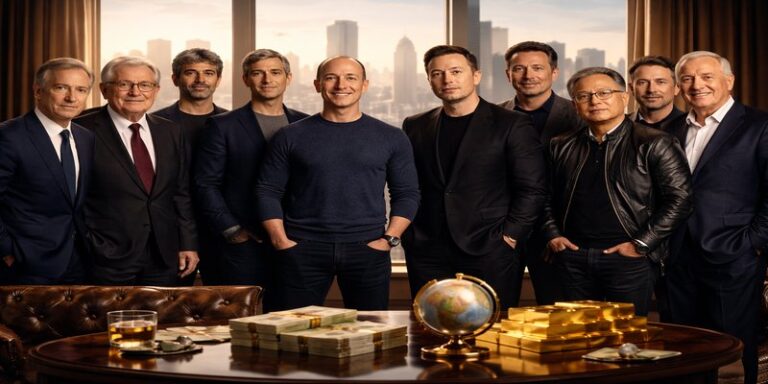
In March 2026, the global billionaire rankings once again reveal the extraordinary concentration of wealth at the very summit of the economic system. According to Forbes (2026), the top ten richest people in the world represent the pinnacle of global capitalism, with fortunes rooted in technology, luxury goods, investment, retail and enterprise software.
These individuals are not merely wealthy; they symbolise the structural forces shaping the twenty-first-century economy — digital transformation, financialisation, platform dominance, global consumerism, and capital market expansion. Their combined wealth reflects both entrepreneurial innovation and deeper institutional dynamics that influence how value is created and distributed worldwide.
This article explores who these ten individuals are, how they built their fortunes, and what their wealth reveals about the evolving architecture of global economic power.
Overview of the 2026 Rankings
According to Forbes’ March 2026 ranking, the top ten richest people in the world are:
- Elon Musk
- Larry Page
- Sergey Brin
- Jeff Bezos
- Mark Zuckerberg
- Larry Ellison
- Bernard Arnault
- Jensen Huang
- Warren Buffett (up from No. 10)
- Amancio Ortega (down from No. 9)
(Forbes, 2026)
Although net worth figures fluctuate daily due to market volatility, these individuals consistently dominate the upper echelons of global wealth rankings. As Investopedia (2026) observes, the list remains heavily weighted towards technology founders, reflecting the enduring power of digital platforms and artificial intelligence.
The Technology Titans
1.0 Elon Musk: Industrial Disruption at Scale
At the top of the list stands Elon Musk, whose fortune is primarily linked to Tesla, SpaceX and xAI. His wealth reflects investor confidence in electric vehicles, renewable energy systems, space exploration and artificial intelligence.
Musk’s trajectory exemplifies what Mazzucato (2013) describes as the “entrepreneurial state” dynamic — where public sector research and private risk-taking intersect to generate transformative innovation. Tesla’s valuation aligns with global decarbonisation goals (IEA, 2025), while SpaceX underscores the increasing commercialisation of space technology.
2.0 & 3.0 Larry Page and Sergey Brin: Masters of the Algorithmic Economy
Google co-founders Larry Page and Sergey Brin continue to derive immense wealth from Alphabet’s dominance in search engines, targeted advertising, cloud computing and AI systems.
Srnicek (2017) characterises firms like Alphabet as “platform capitalists”, extracting value through data accumulation and network effects. Their business model has transformed information into a monetisable commodity, underpinning one of the most profitable enterprises in history.
4.0 Mark Zuckerberg: Social Connectivity and Data Power
Meta’s founder Mark Zuckerberg remains firmly in the top five. While advertising revenue from Facebook and Instagram remains central, Meta’s heavy investments in virtual reality, AI-driven content systems and immersive digital environments continue to influence its valuation.
Zuboff (2019) describes such firms as central actors in “surveillance capitalism”, monetising behavioural data at scale. Zuckerberg’s fortune illustrates both the economic power and ethical complexity of social media platforms.
5.0 Jensen Huang: Architect of the AI Boom
The rapid rise of Jensen Huang, CEO of Nvidia, highlights the extraordinary value generated by the global AI hardware revolution. Nvidia’s graphics processing units (GPUs) underpin machine learning systems worldwide.
Brynjolfsson and McAfee (2014) predicted that digital technologies would create “superstar firms” with outsized returns. Nvidia’s dominance in AI chip production exemplifies this phenomenon.
E-Commerce and Enterprise Infrastructure
6.0 Jeff Bezos: The Infrastructure of Modern Commerce
Although he stepped down as CEO, Jeff Bezos remains one of the wealthiest individuals globally. Amazon’s integrated ecosystem — spanning e-commerce, cloud computing (AWS), logistics networks and streaming services — continues to generate immense shareholder value.
Piketty (2014) argues that when returns on capital exceed economic growth, wealth becomes increasingly concentrated. Amazon’s global reach demonstrates this structural dynamic.
7.0 Larry Ellison: The Power Behind Enterprise Systems
Larry Ellison, co-founder of Oracle, represents the profitability of enterprise software and cloud-based data management systems. As firms digitise operations, demand for database and cloud infrastructure services has expanded dramatically.
Durand (2017) suggests that contemporary capitalism is increasingly driven by intangible and financialised assets, a pattern reflected in Oracle’s valuation.
Luxury, Investment and Global Retail
8.0 Bernard Arnault: The Resilience of Luxury Capital
Unlike the predominantly tech-oriented billionaires, Bernard Arnault, chairman of LVMH, built his wealth in luxury goods and premium branding.
Kapferer and Bastien (2012) explain that luxury brands derive value from scarcity, heritage and symbolic capital. Despite economic turbulence, global demand for high-end goods remains strong, particularly among affluent consumers in emerging markets.
9.0 Warren Buffett: The Discipline of Long-Term Investment
Often referred to as the “Oracle of Omaha”, Warren Buffett represents a different pathway to wealth — disciplined, long-term value investing through Berkshire Hathaway.
Buffett’s fortune stems from diversified holdings across insurance, railways, consumer goods and energy. His investment philosophy reflects traditional principles of compound growth and capital allocation, standing in contrast to the high-volatility technology sector.
10.0 Amancio Ortega: Global Retail Empire
Amancio Ortega, founder of Inditex and the Zara fashion brand, rounds out the top ten. His wealth derives from pioneering the fast-fashion supply chain model, enabling rapid design-to-retail cycles.
The scalability of Inditex demonstrates the power of efficient logistics, vertical integration and global consumer responsiveness. Even amid sustainability debates surrounding fast fashion, Ortega’s global footprint continues to generate significant returns.
What These Fortunes Reveal?
Wealth Concentration and Inequality
The persistence of such concentrated wealth reflects broader structural trends. The World Inequality Report (Chancel et al., 2022) shows that the top 1% have captured a disproportionate share of wealth growth globally.
Atkinson (2015) argues that inequality is shaped by policy choices, taxation systems and institutional design, rather than being economically inevitable.
The Rise of Intangible Capital
Haskel and Westlake (2018) observe that modern wealth is increasingly derived from intangible assets — data, intellectual property, algorithms and brand equity. This shift explains why technology founders dominate the rankings.
Market Volatility and Wealth Fluidity
It is important to recognise that billionaire wealth largely reflects share valuations. As markets fluctuate, so too do rankings. Geopolitical shifts, regulatory interventions or technological disruption can rapidly alter personal net worth.
The top ten richest people in the world in 2026, as identified by Forbes, represent more than individual success stories. They embody the defining forces of the contemporary global economy: digital platforms, artificial intelligence, financial markets, luxury branding, investment capital and global retail logistics.
While their fortunes showcase innovation and entrepreneurial drive, they also raise enduring questions about economic power, wealth distribution and democratic accountability. As technological change accelerates and markets evolve, the names on the list may shift — but the structural debates surrounding extreme wealth are unlikely to disappear.
References
Atkinson, A.B. (2015) Inequality: What Can Be Done? Cambridge, MA: Harvard University Press.
Brynjolfsson, E. and McAfee, A. (2014) The Second Machine Age. New York: W.W. Norton.
Chancel, L. et al. (2022) World Inequality Report 2022. World Inequality Lab. Available at: https://wir2022.wid.world/.
Durand, C. (2017) Fictitious Capital. London: Verso.
Forbes (2026) The Top 10 Richest People in the World | March 2026. Available at: https://www.forbes.com/sites/forbeswealthteam/article/the-top-ten-richest-people-in-the-world/.
Haskel, J. and Westlake, S. (2018) Capitalism without Capital. Princeton: Princeton University Press.
IEA (2025) Global EV Outlook 2025. International Energy Agency. Available at: https://www.iea.org/.
Investopedia (2026) The 10 Richest People in the World. Available at: https://www.investopedia.com/articles/investing/012715/5-richest-people-world.asp.
Kapferer, J.-N. and Bastien, V. (2012) The Luxury Strategy. London: Kogan Page.
Mazzucato, M. (2013) The Entrepreneurial State. London: Anthem Press.
Piketty, T. (2014) Capital in the Twenty-First Century. Cambridge, MA: Harvard University Press.
Srnicek, N. (2017) Platform Capitalism. Cambridge: Polity Press.
Stiglitz, J.E. (2012) The Price of Inequality. New York: W.W. Norton.
Zuboff, S. (2019) The Age of Surveillance Capitalism. London: Profile Books.
Zucman, G. (2015) The Hidden Wealth of Nations. Chicago: University of Chicago Press.