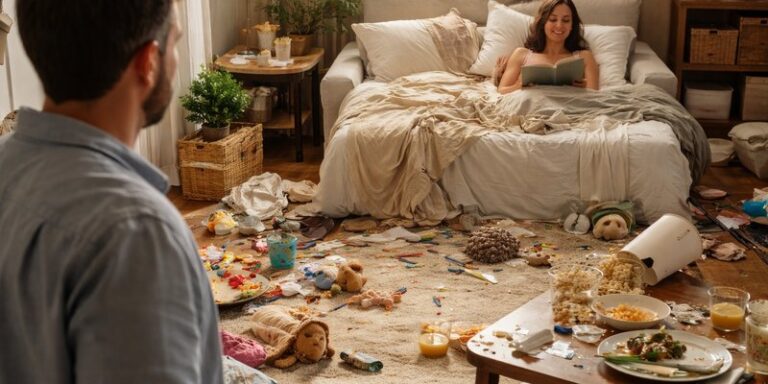
The Day Nothing Was Done
When Noam returned home that late afternoon, he expected the usual calm routine — the comforting smell of dinner beginning to cook, the distant chatter of his children, perhaps his wife Maya humming softly somewhere in the house. Instead, what he encountered was something closer to utter chaos.
The front gate was ajar. Their two children were outside in the garden, still dressed in their nightclothes, faces streaked with mud, laughing wildly while splashing in puddles. Around them lay scattered boxes, broken twigs, toys, and overturned plant pots. It looked less like a family garden and more like the aftermath of a small storm.
Noam paused, confused. The children hadn’t even changed clothes since morning. That alone felt strange. But the mess suggested something far more unusual.
As he stepped closer to the house, he noticed the main door wide open, household items oddly placed near the entrance — shoes, a bag of groceries, even a cushion. His heartbeat quickened.
Something wasn’t right.
Inside the House
The moment he stepped into the sitting room, Noam froze.
A table lamp lay shattered on the floor, shards of glass reflecting the fading daylight. The carpet was stained with juice, water, and what looked like leftover food. A cartoon blared from the television at an almost unbearable volume, though nobody seemed to be watching.
Books, toys, pencils, and clothes were strewn everywhere — under tables, across chairs, even along the hallway.
He called out, “Maya?”
No reply.
Now anxiety crept in. Was she ill? Had something happened?
The Kitchen Scene
Noam headed towards the kitchen and immediately wished he hadn’t.
The sink overflowed with dirty dishes — plates crusted with food, glasses half-filled with cloudy liquid, pans stacked precariously. Breakfast remnants still sat on the dining table. Worse yet, the refrigerator door stood open, ice melting steadily into puddles across the kitchen floor.
The smell of stale food lingered unpleasantly.
Noam swallowed hard.
“Maya! Are you alright?” he called again.
Still nothing.
Climbing the Stairs
Concern turning into genuine fear, Noam began climbing the stairs. Toys and heaps of laundry littered every step. Halfway up, he nearly tripped over a stuffed animal.
At the bathroom doorway, disaster struck — he slipped on soapy water mixed with shampoo and toothpaste. Regaining balance with difficulty, he glanced inside.
The bathroom looked like a child’s experiment gone wrong:
- Wet towels tossed everywhere
- Toothpaste smeared on mirrors and walls
- Shampoo puddles on the floor
- Toilet paper unravelled and decorated with blobs of soap
Noam stared in disbelief.
Surely something serious had happened.
A Surprising Discovery
Finally, he rushed into the bedroom.
There was Maya.
Not injured. Not distressed.
Simply reclining comfortably in bed, still in her nightdress, wrapped in a quilt, calmly reading a novel. She looked peaceful — even cheerful.
She glanced up and smiled.
“Oh, you’re home already. How was your day at the office?”
Noam blinked repeatedly.
“How was my day?” he echoed. “What on earth happened here today? The house looks like a disaster zone!”
The Wife’s Explanation
Maya closed her book gently and sat up.
Her smile widened slightly.
“You know,” she said softly, “every evening you ask me the same question: ‘You stay at home all day — what do you even do?’”
Noam shifted uncomfortably.
“Yes… I suppose I do.”
“Well,” Maya replied, “today I simply didn’t do those things.”
Silence filled the room.
Realisation Dawns
At first, Noam didn’t fully grasp her meaning. But slowly, images connected:
- The children still in pyjamas because no one had dressed them
- Meals unfinished because no one prepared or cleaned
- Toys scattered because no one tidied
- Laundry undone, dishes unwashed, floors uncleaned
All the invisible daily tasks — the countless small efforts that kept their lives running smoothly — had simply stopped for one day.
And the result was chaos.
The Invisible Work
Maya spoke gently, not accusingly:
“Running a home isn’t just chores. It’s planning, caring, organising, remembering, comforting. It’s making sure everyone is fed, safe, clean, and happy. Most of it goes unnoticed because it’s done quietly.”
Noam listened.
For years he had assumed staying at home meant free time, relaxation, perhaps even ease. He had never considered the constant mental effort — the emotional labour, the multitasking, the patience.
Now he saw it clearly.
A Change of Perspective
He sat beside her.
“I’m sorry,” he said sincerely. “I didn’t realise how much you actually do every day. I took it for granted.”
Maya smiled again, softer this time.
“That’s all I wanted you to understand.”
Putting Things Right
That evening turned into an unusual but meaningful experience:
- Noam helped clean the kitchen
- The children bathed and changed
- They tidied the sitting room together
- Dinner became a shared effort rather than a solitary task
It took hours, but the atmosphere changed.
Instead of frustration, there was laughter. Instead of assumption, appreciation.
A New Understanding
From that day onward, Noam’s question changed.
Instead of “What did you do all day?” he asked:
“How can I help?”
And sometimes the answer was simple:
- Watching the children
- Folding laundry
- Cooking together
- Or just listening
Their relationship grew stronger, built on respect, empathy, and partnership.
The Bigger Lesson
The experience taught them both an important truth:
Unseen work is still real work.
Caregiving deserves recognition.
Partnership means sharing responsibility.
And perhaps most importantly:
Appreciation strengthens love far more than criticism ever can.
Closing Thought
Sometimes, understanding arrives not through lectures or arguments but through experience. One day without effort revealed the immense value of everyday care.
And in that messy, chaotic house, a clearer vision of love, respect, and equality quietly emerged.