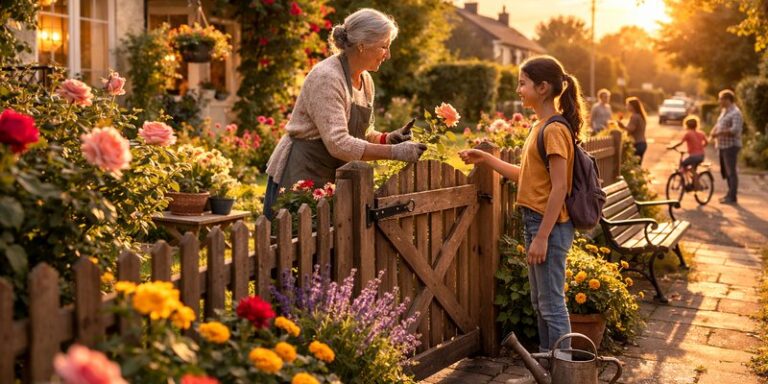
When Mrs Edith Harrow first planted her front garden, she did not intend to make a statement. She merely wished to fill the silence left by widowhood.
Her cottage stood at the bend of Bramble Lane, where the pavement narrowed and the hedgerows leaned in as if sharing gossip. The house itself was unremarkable—cream render, slate roof, two bow windows—but the soil in front was unusually rich. “It’s good earth,” her late husband had said. “Treat it kindly.”
So, she did.
By early spring, neat rows of daffodils nodded like polite guests. In summer came roses—deep crimson and soft apricot—climbing a trellis that Arthur had once built. Lavender bordered the path, releasing scent whenever the postman’s boots brushed past. By autumn, marigolds blazed stubbornly against the cooling air.
Edith tended her garden with what neighbours first described as devotion and later as ritual. She rose early, tied a faded blue scarf around her silver hair, and stepped outside with secateurs in one hand and a wicker basket in the other. She spoke to the plants—not in madness, but in familiarity.
“You’re leaning,” she’d murmur, adjusting a stem.
“Too crowded here,” she’d note, thinning seedlings.
Passers-by paused. Some admired from a distance; others leaned over the low gate. Edith, seeing their interest, began cutting small bouquets.
“Take these,” she would say, pressing roses into uncertain hands. “They’re happier shared.”
At first, the lane responded with gratitude. Children carried posies home to their mothers. The grocer displayed a vase by the till with a note: From Mrs Harrow’s garden. Even the bus driver, who stopped twice daily at the corner, once tipped his cap and called out, “Brightens the route, that does!”
It was, in those early months, a quiet example of what people like to believe about themselves—that generosity begets kindness, and that beauty multiplies when given away.
Yet generosity, like soil, requires careful tending.
The change was gradual. A snapped tulip here. A trampled border there. Edith noticed petals scattered on the pavement, blooms taken without so much as a knock at the door.
“They’d give them anyway,” she overheard one afternoon—a teenager shrugging as he plucked a rose for his girlfriend.
Another day she found three boys shaking the lavender bush, laughing as purple dust rose into the air.
She told herself it was harmless. Children will be children. Young lovers will be foolish. But as weeks passed, the garden thinned prematurely. Buds vanished before opening. Whole stems were stripped bare.
What had begun as shared abundance drifted towards careless taking.
Edith did not scold. She did not confront. Instead, she experimented with hope. She placed a small wooden sign by the gate:
Please knock. I’m happy to share.
For a few days, it worked. Then the sign disappeared.
The following Sunday, she stood at her window and watched a woman she recognised—someone who had once thanked her warmly—snip three roses and hurry away, glancing only once over her shoulder.
It is a peculiar sorrow to discover that your kindness has become an expectation.
The garden, once a point of connection, now stirred unease. Edith found herself glancing up from her pruning at every footstep. She no longer left the gate unlatched.
One evening, her neighbour Mr Singh paused as she gathered fallen petals.
“You’ve done more for this street than any council scheme,” he said gently. “But people forget that flowers cost effort.”
She smiled, though her hands trembled slightly. “I thought they understood.”
“Understanding,” he replied, “needs reminding.”
That winter was harsher than usual. Frost silvered the soil. Edith spent more time indoors, cataloguing seed packets and sketching plans for spring. Yet alongside drawings of foxgloves and sweet peas, she found herself calculating something else: how to protect what she loved without hardening her heart.
When the first crocuses pushed through in March, carpenters arrived.
The fence was not ostentatious—simply tall, wooden, and solid. It followed the line of the pavement and enclosed the once-open patch entirely. A narrow gate remained, fitted with a brass latch.
The reaction was swift.
“Well, that’s unfriendly,” muttered a passer-by.
“Shame,” said another. “Used to brighten the walk.”
Edith heard these comments as she watered seedlings behind the new boundary. She felt a sting of accusation. Had she betrayed the lane’s easy charm? Had she allowed bitterness to root?
Yet something curious happened.
With the fence in place, she found her mornings peaceful again. She tended roses without watchful anxiety. The blooms, no longer plucked prematurely, flourished. Bees returned in greater number. The garden regained its fullness.
One afternoon, there came a knock.
It was the teenage boy she had once overheard. He shifted awkwardly from foot to foot.
“I was wondering,” he began, not meeting her eyes, “if I might buy some flowers? It’s my mum’s birthday.”
Edith regarded him for a moment. “You may have them,” she said, opening the gate. “But you must help me cut them properly.”
They worked side by side. She showed him where to snip, how to angle the blade, why leaving a node mattered. He listened—truly listened.
As he left, bouquet in hand, he said quietly, “I didn’t realise it took so much.”
“Most good things do,” she replied.
Word spread—not of free picking, but of ringing the bell. People began knocking again. Some brought jam in exchange. Others offered seedlings of their own. Mr Singh installed a bench outside the fence, facing the blooms.
The boundary, it turned out, had not ended community. It had redefined it.
By summer, Bramble Lane felt subtly different. Children still paused to admire butterflies, but they did so from the bench. Adults lingered, chatting over the gate. The garden was no longer an unattended common; it was a tended gift, shared deliberately.
Edith stood one evening amid roses at their peak. The air carried lavender and warm earth. She understood now that kindness does not mean surrendering what one cherishes. Nor does protection require cruelty.
A garden, like a community, thrives on reciprocity rather than assumption. It needs both openness and care, both welcome and boundary.
She clipped a perfect apricot bloom and placed it in a jar by the gate, beneath a new sign:
Knock, and we shall choose one together.
And so, they did.
Key Takeaways:
- The moral of the story is that kindness should be balanced with boundaries.
- Generosity should not mean self-sacrifice without limits.
- Respect sustains kindness.
- Healthy boundaries protect what we value without destroying community.