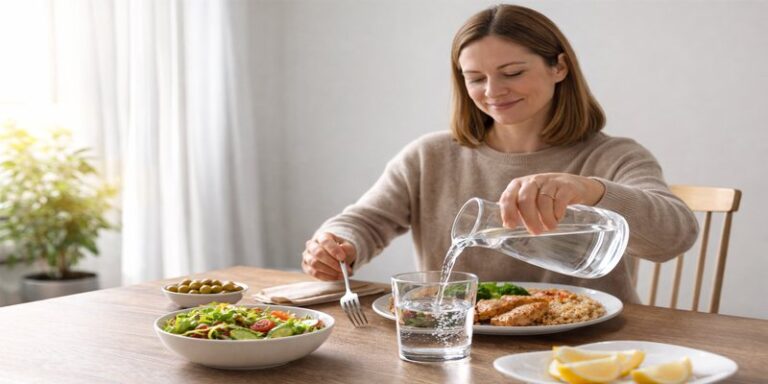
A common health belief says that drinking water during meals is bad because it supposedly dilutes stomach acid, weakens digestive enzymes and slows the breakdown of food. It is a popular claim, but the scientific picture is more nuanced. For most healthy people, drinking water with a meal is not harmful and is generally a normal part of eating. In fact, water can help with chewing, swallowing, the formation of chyme in the stomach, and overall hydration, all of which support normal digestion (Mahan and Raymond, 2020; Granger, Morris and Kvietys, 2018). Research on gastric emptying also shows that liquids and solids are handled differently in the stomach, but this does not mean that water is damaging; rather, it becomes one factor among many that influence the pace of digestion, alongside meal size, food texture, fat content and hydration status (Hellström, Grybäck and Jacobsson, 2006; Boland, 2016). This article examines whether drinking water during meals is genuinely bad for health or digestion, and explains when it may help, when it may occasionally be uncomfortable, and why the idea is often misunderstood.
1.0 Understanding How Digestion Works
1.1 Digestion is Not a Fragile Process
Human digestion is a highly regulated biological system. The stomach does not simply fill with food and then stop working if water is added. Instead, it adjusts continuously through acid secretion, enzyme activity, muscular contractions and controlled emptying into the small intestine (Hunt, 1959; Hellström, Grybäck and Jacobsson, 2006). This means that digestion is not easily “switched off” by drinking a glass of water.
Textbooks on nutrition and digestive physiology explain that food entering the stomach is mixed, hydrated and broken down mechanically and chemically before moving onward for absorption (Mahan and Raymond, 2020; Granger, Morris and Kvietys, 2018). Water is part of that process rather than an enemy of it.
1.2 What Water Actually Does in a Meal
Water can make food easier to chew and swallow, especially dry foods such as bread, rice or meat. It also contributes to the moisture needed for forming a manageable food bolus and later a semi-liquid stomach mixture. A simple example is eating crackers without a drink: many people find this uncomfortable, while a small amount of water makes swallowing easier. In this sense, water may support digestion from the very first stage.
2.0 Does Water Dilute Stomach Acid Too Much?
2.1 The Popular Claim
The idea that water “washes away” or “dilutes” stomach acid sounds plausible, but it oversimplifies how the stomach works. The stomach is not a fixed beaker of acid. It is a living organ that responds to the amount and composition of a meal by adjusting its secretions (Hunt, 1959).
2.2 What the Evidence Suggests
Physiological research indicates that gastric secretion changes dynamically during digestion, including in response to meal volume and hydration status (Hunt, 1959). This means that although water may temporarily change the concentration of stomach contents, the stomach continues secreting acid and enzymes as needed. There is no strong evidence that moderate water intake with meals causes harmful “acid dilution” in healthy people. Reviews of digestion and gastric emptying emphasise the complexity of the process and do not identify normal water intake during meals as inherently dangerous (Boland, 2016; Hellström, Grybäck and Jacobsson, 2006).
3.0 Water and Gastric Emptying
3.1 Liquids and Solids Behave Differently
One reason the myth persists is that liquids often leave the stomach faster than solids. This is true, but it does not mean water disrupts digestion. Instead, the stomach sorts and processes materials according to their physical properties. Studies of gastric emptying show that meal structure, hydration and the combination of solid and liquid components can change how quickly stomach contents move onward (Hellström, Grybäck and Jacobsson, 2006; Marciani et al., 2012).
For example, Marciani et al. (2012) found that the form of a meal matters: blending solids with liquid can alter gastric behaviour and feelings of fullness. Similarly, Boland (2016) explains that the nature of the meal and fluid ingested influences digestive processing. That is not a sign of harm. It simply shows that digestion is responsive.
3.2 Does Slower or Faster Emptying Mean Worse Digestion?
Not necessarily. Faster liquid emptying may reduce fullness for some meals, while thicker or more viscous meals may remain in the stomach longer. Neither pattern is automatically unhealthy. In everyday life, soup, tea and water all interact differently with food, but healthy digestion can accommodate that range.
4.0 Possible Benefits of Drinking Water During Meals
4.1 Better Hydration
One obvious benefit is improved hydration. The NHS notes that drinking enough fluids helps digestion by encouraging the passage of waste through the digestive system and helping prevent constipation (NHS, n.d.). Although that advice is not limited to mealtimes, meals are one of the easiest times for people to drink regularly.
4.2 Easier Swallowing and Eating Comfort
Water may be especially useful for older adults, people who eat quickly, and anyone consuming dry, fibrous or salty foods. A sip of water during a meal can reduce discomfort and make eating smoother. In practical terms, water with a meal of roast chicken and potatoes may feel far more comfortable than eating the same meal without fluids.
4.3 Fullness and Portion Control
Some people also find that drinking water with meals increases satiety, or feelings of fullness. This is not proof that water harms digestion; if anything, it may sometimes help people avoid overeating. Meal texture and liquid content can influence satiation, though the effect varies by meal type and individual response (Marciani et al., 2012).
5.0 When Water with Meals May Feel Unhelpful
5.1 Reflux, Bloating or Functional Dyspepsia
Although water is not generally harmful, some people with acid reflux, bloating or functional dyspepsia may feel more comfortable avoiding large volumes of fluid all at once with meals. This is usually because the issue is stomach distension or overall meal volume, rather than water itself. Reputable clinical guidance often recommends smaller meals when indigestion is a problem, because a larger stomach load can worsen symptoms (Mayo Clinic, n.d.; Cleveland Clinic, n.d.).
For example, someone who already gets heartburn after large meals may feel worse after eating a heavy curry and drinking two large glasses of water quickly. In that case, the problem is likely the size and combination of the meal rather than ordinary water consumption itself.
5.2 Special Medical Situations
There are also specific conditions where fluid timing matters more, such as after some bariatric surgery procedures or in certain swallowing disorders. In those situations, patients should follow personalised clinical advice. That is very different from claiming that water during meals is generally bad for everyone.
6.0 Overall Judgement
6.1 For Most People, the Answer is No
Taken together, the evidence suggests that drinking water during meals is not bad for health or digestion for most healthy people. Digestion is adaptable, and the stomach continues to regulate acid secretion, mixing and emptying even when water is consumed with food (Hunt, 1959; Hellström, Grybäck and Jacobsson, 2006).
6.2 Context Matters
The more sensible question is not “Is water during meals bad?” but “How much feels comfortable for me?” A small or moderate amount of water is usually perfectly normal. Very large volumes, especially with a heavy meal, may leave some people feeling overly full, bloated or reflux-prone. That is a matter of comfort and individual tolerance, not proof of digestive harm.
The belief that drinking water during meals is harmful is not well supported by mainstream digestive science. For most people, water does not stop digestion, ruin stomach acid or prevent food from being broken down properly. On the contrary, it can aid swallowing, contribute to hydration, and fit naturally into healthy eating patterns. Research on gastric emptying shows that fluids do influence digestive timing, but this is part of normal physiology rather than evidence of danger. The main exceptions involve people with certain digestive symptoms or medical conditions, who may prefer smaller drinks or more personalised advice. In everyday terms, having a glass of water with lunch or dinner is usually a normal and healthy habit, not a digestive mistake.
References
Boland, M. (2016) ‘Human digestion – a processing perspective’, Journal of the Science of Food and Agriculture, 96(7), pp. 2275–2284. Available at: https://scijournals.onlinelibrary.wiley.com/doi/abs/10.1002/jsfa.7601.
Cleveland Clinic (n.d.) Indigestion (Dyspepsia): What It Is, Symptoms & Causes. Available at: https://my.clevelandclinic.org/health/symptoms/7316-indigestion-dyspepsia (Accessed: 12 March 2026).
Granger, D.N., Morris, J.D. and Kvietys, P.R. (2018) Physiology and Pathophysiology of Digestion. Cham: Springer. Available at: https://books.google.com/books?id=r8p1DwAAQBAJ.
Hellström, P.M., Grybäck, P. and Jacobsson, H. (2006) ‘The physiology of gastric emptying’, Best Practice & Research Clinical Anaesthesiology, 20(3), pp. 397–407. Available at: https://www.sciencedirect.com/science/article/pii/S152168960600019X.
Hunt, J.N. (1959) ‘Gastric emptying and secretion in man’, Physiological Reviews, 39(3), pp. 491–533. Available at: https://journals.physiology.org/doi/full/10.1152/physrev.1959.39.3.491.
Mahan, L.K. and Raymond, J.L. (2020) Krause and Mahan’s Food and the Nutrition Care Process. 15th edn. St Louis, MO: Elsevier. Available at: https://books.google.com/books?id=MRrhDwAAQBAJ.
Marciani, L., Hall, N., Pritchard, S.E., Cox, E.F., Totman, J.J., Lad, M., Hoad, C.L., Foster, T.J. and Spiller, R.C. (2012) ‘Preventing gastric sieving by blending a solid/water meal enhances satiation in healthy humans’, The Journal of Nutrition, 142(7), pp. 1253–1258. Available at: https://academic.oup.com/jn/article-pdf/142/7/1253/29589527/1253.pdf.
Mayo Clinic (n.d.) Functional dyspepsia – Diagnosis and treatment. Available at: https://www.mayoclinic.org/diseases-conditions/functional-dyspepsia/diagnosis-treatment/drc-20375715 (Accessed: 12 March 2026).
Mudie, D.M., Murray, K., Hoad, C.L., Pritchard, S.E., Garnett, M.C., Amidon, G.L., Gowland, P.A. and Spiller, R.C. (2014) ‘Quantification of gastrointestinal liquid volumes and distribution following a 240 mL dose of water in the fasted state’, Molecular Pharmaceutics, 11(9), pp. 3039–3047. Available at: https://pubs.acs.org/doi/abs/10.1021/mp500210c.
NHS (n.d.) Good foods to help your digestion. Available at: https://www.nhs.uk/live-well/eat-well/digestive-health/good-foods-to-help-your-digestion/ (Accessed: 12 March 2026).
Ryan, A.J., Lambert, G.P., Shi, X., Chang, R.T., Summers, R.W. and Gisolfi, C.V. (1998) ‘Effect of hypohydration on gastric emptying and intestinal absorption during exercise’, Journal of Applied Physiology, 84(5), pp. 1581–1588. Available at: https://journals.physiology.org/doi/abs/10.1152/jappl.1998.84.5.1581.