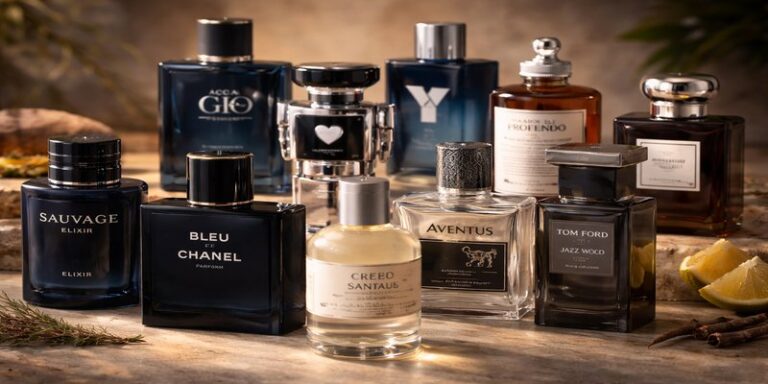
The male fragrance market in 2026 reflects a dynamic intersection of luxury branding, identity construction, sustainability and digital innovation. Perfume is no longer simply a grooming product; it functions as a symbolic extension of the self, communicating taste, social positioning and emotional intent (Mensing, 2023). Contemporary men engage with fragrance as part of broader lifestyle narratives shaped by inclusivity, wellness and ethical awareness.
Industry reports indicate that the global men’s fragrance sector continues to expand, driven by demand for premiumisation, niche craftsmanship and refillable formats (Euromonitor International, 2025). Simultaneously, academic research highlights that scent operates as a powerful psychological trigger, reinforcing memory, attraction and self-perception (Herz, 2016). This updated 2026 review explores the Top 10 Male Perfumes, examining their cultural resonance, marketing strategies and sensory profiles.
1.0 Dior Sauvage Elixir
Fragrance Profile: Lavender, cinnamon, nutmeg, sandalwood
Dior Sauvage Elixir remains a dominant force in the premium segment. Its intensified concentration offers remarkable longevity and projection. The fragrance balances aromatic freshness with warm spice, reflecting what Stewart and Carey (2019) describe as “heritage masculinity reframed for modern audiences.”
Celebrity endorsement continues to play a strategic role. Aliyev (2025) demonstrates through McCracken’s Meaning Transfer Model that brand ambassadors function as cultural intermediaries, transferring traits such as rebellion or sophistication onto the product. Sauvage’s branding fuses wilderness imagery with refined luxury, sustaining its relevance in 2026.
2.0 Bleu de Chanel Parfum
Fragrance Profile: Amber, cedarwood, grapefruit
Bleu de Chanel Parfum exemplifies understated elegance and urban professionalism. Its blend of woody and citrus accords aligns with findings by Diaconu-Cerceloiu and Cerceloiu (2025), who argue that luxury fragrance consumption often serves as a symbolic self-extension for aspirational professionals.
Chanel’s minimalist packaging also illustrates the concept of masstige consumption—a blend of prestige and accessibility (Roy et al., 2025). In 2026, Bleu de Chanel continues to appeal to men seeking timeless versatility rather than trend-driven novelty.
3.0 Creed Aventus
Fragrance Profile: Pineapple, birch, musk
Creed Aventus retains cult status among fragrance enthusiasts. Its fruity-smoky composition evokes ambition and success. Mensing (2023) describes such scents as embodying “olfactory authority”, appealing to individuals who associate fragrance with leadership and power.
As a niche house with artisanal heritage, Creed appeals to consumers seeking exclusivity and craftsmanship, reflecting broader luxury market shifts towards differentiation over mass appeal (Euromonitor International, 2025).
4.0 Tom Ford Oud Wood
Fragrance Profile: Oud, cardamom, vetiver
Oud Wood continues to symbolise cross-cultural sophistication, merging Middle Eastern agarwood traditions with Western minimalism. Arora, Desai and Gawai (2025) observe that oud-based fragrances represent a fusion of heritage and globalised luxury.
The scent’s refined smokiness appeals to consumers seeking boldness without ostentation. In 2026, oud remains a central pillar of premium men’s perfumery.
5.0 Yves Saint Laurent Y Eau de Parfum Intense
Fragrance Profile: Sage, ambergris, geranium
YSL’s Y Intense resonates strongly with Gen Z and millennial consumers. Its aromatic freshness conveys ambition and creativity. According to Rahimi et al. (2025), packaging and colour palettes significantly influence male purchase intentions, particularly among digitally engaged consumers.
YSL’s sleek bottle and social media campaigns align with contemporary notions of self-branding and entrepreneurial masculinity.
6.0 Giorgio Armani Acqua di Giò Profondo
Fragrance Profile: Marine accords, patchouli, bergamot
Profondo builds upon the iconic aquatic DNA of Acqua di Giò while incorporating deeper mineral notes. Essiz, Senyuz and Yurteri (2025) highlight the effectiveness of emotional minimalism in luxury advertising, a strategy Armani employs through serene ocean imagery.
The fragrance aligns with sustainability narratives, as Armani has introduced refill initiatives in select markets, reflecting eco-conscious consumer values.
7.0 Paco Rabanne Phantom Intense
Fragrance Profile: Lavender, vanilla, vetiver
Phantom Intense reflects the convergence of technology and perfumery. Earlier versions integrated NFC chips and interactive packaging (Ponomareva and Nozdrenko, 2021). This digital-forward positioning continues to attract tech-oriented consumers.
Its sweet-aromatic balance reflects evolving masculine preferences, moving beyond strictly woody profiles towards playful warmth.
8.0 Le Labo Santal 33
Fragrance Profile: Sandalwood, cardamom, leather
Santal 33 remains emblematic of gender-fluid perfumery and artisanal authenticity. Kim, Cho and Park (2022) note that younger consumers increasingly reject rigid gender distinctions in fashion and beauty.
Le Labo’s personalised labelling and minimalist aesthetic reinforce notions of individuality and authenticity—qualities highly valued in 2026.
9.0 Maison Margiela Replica Jazz Club
Fragrance Profile: Rum, tobacco, vanilla
Jazz Club exemplifies experiential and memory-driven luxury. Chen (2025) argues that ambient scent significantly influences emotional perception and behavioural response. Jazz Club leverages nostalgia—evoking intimate jazz venues and vintage ambience.
Such storytelling aligns with Mensing’s (2023) assertion that perfume operates as an emotional narrative device rather than merely a functional product.
10.0 Jo Malone Myrrh & Tonka Cologne Intense
Fragrance Profile: Myrrh, tonka bean, vanilla
Jo Malone’s layering philosophy encourages consumers to construct personalised scent combinations. Mathew and Sood (2023) emphasise the growing importance of eco-luxury and ingredient transparency, trends reflected in Jo Malone’s recyclable packaging and responsibly sourced materials.
The fragrance’s warm resinous depth appeals to men seeking sensual subtlety rather than overpowering projection.
Consumer Psychology and Emerging Trends (2026)
1.0 Identity and Self-Extension
Perfume functions as a social signal, conveying class, lifestyle and even romantic intent (Mensing, 2023). Diaconu-Cerceloiu and Cerceloiu (2025) confirm that luxury fragrance purchases often represent symbolic aspirations.
2.0 Gender Fluidity
Research by Kim, Cho and Park (2022) demonstrates that younger consumers increasingly favour inclusive scent marketing, challenging binary classifications.
3.0 Sustainability and Ethical Sourcing
Mathew and Sood (2023) highlight growing scrutiny regarding essential oil extraction and environmental impact. Brands adopting refillable bottles and transparent sourcing gain competitive advantage.
4.0 Digital Influence and Packaging
Rahimi et al. (2025) show that packaging aesthetics significantly shape male purchasing decisions, particularly darker colour schemes and minimalist typography.
5.0 Emotional Branding
Aliyev (2025) reinforces the role of celebrity endorsement as a meaning-transfer mechanism, strengthening brand identity and aspirational appeal.
The Top 10 Male Perfumes of 2026 illustrate a fragrance landscape shaped by heritage, inclusivity, digital innovation and sustainability consciousness. Modern masculinity is no longer confined to traditional woody-spicy archetypes; it embraces emotional nuance, cross-cultural influence and personal storytelling.
As Mensing (2023) suggests, perfume acts as an “emotional trademark”—an invisible yet powerful extension of identity. In 2026, male perfumery continues to evolve beyond scent alone, becoming a sophisticated expression of values, aspiration and self-awareness.
References
Aliyev, T. (2025) ‘Understanding McCracken’s Meaning Transfer Model in Celebrity and Influencer Perfume Advertisements’, Italian Journal of Marketing. Springer.
Arora, R., Desai, M. and Gawai, N. (2025) Revitalising a Fragrant Legacy: Creative Branding of Attars. Springer.
Chen, Y.C. (2025) ‘Intangible cues in hospitality: Emotional and behavioural effects of ambient scents’, International Journal of Hospitality Management. Elsevier.
Diaconu-Cerceloiu, V.I. and Cerceloiu, M.L. (2025) Consumer Buying Behaviour Through the Lens of Luxury Brands. Springer.
Essiz, O., Senyuz, A. and Yurteri, S. (2025) ‘The dark side of a big smile: Luxury brand advertising effectiveness’, Psychology & Marketing. Wiley.
Euromonitor International (2025) Fragrances Market Report. Available at: https://www.euromonitor.com (Accessed: 15 February 2026).
Herz, R. (2016) ‘The role of odour-evoked memory in psychological and physiological health’, Brain Sciences, 6(3).
Kim, H., Cho, I. and Park, M. (2022) ‘Genderless fashion trends of consumers’ perceptions on social media’, Fashion and Textiles, 9(1), pp.1–22.
Mathew, D. and Sood, A. (2023) Scents and Senses: Environmental and Health Considerations of Scented Fragrance. Springer.
Mensing, J. (2023) SCENT: The Magical Effect of Perfume on Well-Being. Springer.
Ponomareva, E. and Nozdrenko, E. (2021) ‘Digital transformation in luxury packaging’, Journal of Brand Strategy.
Rahimi, Z., Hasnat, M.A. and Rana, M.S. (2025) ‘Product packaging and consumer purchase intentions in the perfume market’, Cogent Business & Management. Taylor & Francis.
Roy, A., Das, M., Lim, W.M. and Kalai, A. (2025) ‘Masstige consumption: A motivation–desire–outcome framework’, Journal of Global Marketing. Taylor & Francis.
Stewart, A. and Carey, L. (2019) ‘Luxury perfume brands and millennial consumers’, in Luxury Fashion: From Emotions to Brand Building. Springer.