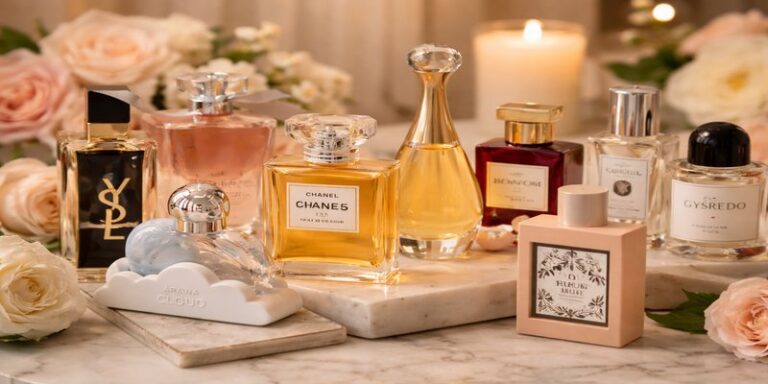
Perfume is far more than a cosmetic accessory; it is a powerful expression of identity, memory and emotion. As Classen, Howes and Synnott (1994) argue in Aroma: The Cultural History of Smell, scent operates as a deeply embedded cultural signal, shaping perceptions of femininity, status and desire. In 2026, the fragrance market reflects broader consumer shifts towards sustainability, individuality, heritage craftsmanship and experiential luxury (Euromonitor International, 2025).
This article explores the Top 10 female perfumes shaping the current market, drawing upon industry analysis, academic insight and reputable fragrance reporting. Selections reflect popularity, innovation, longevity and cultural influence rather than fleeting hype.
1.0 Chanel No. 5 (Chanel)
Fragrance Family: Floral Aldehyde
Few perfumes hold the cultural capital of Chanel No. 5. First launched in 1921, it remains a benchmark of timeless femininity and olfactory abstraction. According to Turin and Sanchez (2008), its aldehydic structure revolutionised perfumery by prioritising atmosphere over literal floral imitation.
Its continued popularity in 2026 illustrates the enduring appeal of heritage luxury. Consumers seeking elegance without overt trend alignment gravitate towards its powdery rose, jasmine and sandalwood base.
2.0 Dior J’adore (Dior)
Fragrance Family: Floral Fruity
Dior J’adore embodies modern glamour and luminous sensuality. Built around ylang-ylang, jasmine and rose, it offers accessibility without sacrificing refinement.
Mintel (2025) reports that floral fragrances remain dominant in women’s perfume sales due to their familiarity and emotional resonance. J’adore balances recognisable florals with smooth fruit accords, making it both aspirational and wearable.
3.0 Yves Saint Laurent Libre (YSL)
Fragrance Family: Floral Oriental
Libre represents a shift towards bold femininity and gender fluidity. Lavender—traditionally associated with masculine fragrances—is blended with orange blossom and vanilla.
Solomon (2020) notes that contemporary consumers favour products that reflect self-definition rather than rigid gender codes. Libre’s success reflects this evolution.
4.0 Maison Francis Kurkdjian Baccarat Rouge 540
Fragrance Family: Amber Floral
Often described as a cult phenomenon, Baccarat Rouge 540 exemplifies niche luxury entering mainstream consciousness. With saffron, amberwood and cedar, it offers a sweet yet mineral warmth.
According to the Fragrance Foundation (2025), niche brands have grown significantly as consumers seek distinctive olfactory signatures. Baccarat Rouge 540’s projection and longevity make it a status scent.
5.0 Lancôme La Vie Est Belle
Fragrance Family: Gourmand
La Vie Est Belle remains a bestseller due to its comforting blend of iris, praline and vanilla. Gourmand fragrances—those evoking edible sweetness—continue to perform strongly in European markets (Euromonitor International, 2025).
Its appeal lies in what Herz (2016) describes as the emotional power of scent memory. Sweet notes often evoke warmth, reassurance and optimism.
6.0 Gucci Bloom (Gucci)
Fragrance Family: White Floral
Gucci Bloom focuses on naturalistic tuberose and jasmine, aligning with the consumer desire for authentic botanical compositions.
In The Essence of Perfume, Stamelman (2006) emphasises how florals are historically linked with notions of purity and romanticism. Bloom modernises this narrative through contemporary packaging and branding.
7.0 Jo Malone Peony & Blush Suede
Fragrance Family: Floral
Jo Malone’s minimalist approach resonates with the quiet luxury movement. Peony & Blush Suede combines crisp apple, peony and soft suede notes, offering elegance without intensity.
Vogue Business (2025) highlights a growing preference for subtle, layerable scents that support personal fragrance wardrobes rather than singular signature perfumes.
8.0 Tom Ford Black Orchid
Fragrance Family: Oriental Floral
Black Orchid embodies opulence and sensual drama. Rich with black truffle, ylang-ylang and patchouli, it contrasts sharply with minimalist florals.
According to Classen et al. (1994), scent is often used to construct narratives of power and mystique. Black Orchid’s dark composition appeals to consumers seeking evening sophistication.
9.0 Ariana Grande Cloud
Fragrance Family: Gourmand
Celebrity fragrances have matured beyond novelty status. Cloud’s blend of lavender blossom, coconut and whipped cream demonstrates the rise of affordable luxury with strong online visibility.
Mintel (2025) notes that younger consumers engage heavily with fragrance content on TikTok and Instagram, driving viral sales. Cloud’s popularity exemplifies the influence of digital culture on perfume trends.
10.0 Byredo Gypsy Water
Fragrance Family: Woody Aromatic
Byredo represents the continued rise of Scandinavian minimalism in perfumery. Gypsy Water blends bergamot, juniper, incense and sandalwood, offering understated sophistication.
The Business of Fashion (2025) identifies niche fragrance houses as key players in the premium beauty market, appealing to consumers seeking exclusivity and storytelling.
Key Trends in Female Perfumery (2026)
1.0 Sustainability and Transparency
Consumers increasingly scrutinise ingredient sourcing and environmental impact. Brands are adopting refillable bottles and responsibly sourced raw materials (Euromonitor International, 2025).
2.0 Niche and Personalisation
There is a clear movement towards individualised scent identities, supported by layering and bespoke fragrance services.
3.0 Emotional Branding
Herz (2016) highlights how scent strongly connects to memory and mood. Successful perfumes tap into narratives of empowerment, nostalgia or romance.
4.0 Digital Influence
Social media platforms accelerate fragrance discovery, reshaping purchasing behaviour (Mintel, 2025).
The top female perfumes of 2026 illustrate the interplay between heritage craftsmanship, niche innovation, sustainability and digital culture. From the timeless elegance of Chanel No. 5 to the contemporary cult appeal of Baccarat Rouge 540, fragrance remains a powerful medium of self-expression and emotional resonance.
Ultimately, the most suitable perfume is not defined by ranking but by personal chemistry and identity alignment. As Stamelman (2006) suggests, perfume is an invisible art form—one that lingers long after first impression.
References
Business of Fashion (2025) The State of Fashion: Beauty and Fragrance Insights. Available at: https://www.businessoffashion.com (Accessed: 10 February 2026).
Classen, C., Howes, D. and Synnott, A. (1994) Aroma: The Cultural History of Smell. London: Routledge.
Euromonitor International (2025) Fragrances in Western Europe: Market Report. Available at: https://www.euromonitor.com (Accessed: 10 February 2026).
Fragrance Foundation (2025) Fragrance Consumer Trends Report. Available at: https://www.fragrancefoundation.org (Accessed: 10 February 2026).
Herz, R. (2016) The Role of Odour-Evoked Memory in Psychological and Physiological Health. Brain Sciences, 6(3), pp. 1–15.
Mintel (2025) UK Fragrance Market Report. Available at: https://www.mintel.com (Accessed: 10 February 2026).
Solomon, M. (2020) Consumer Behaviour: Buying, Having and Being. 13th edn. Harlow: Pearson.
Stamelman, R. (2006) The Essence of Perfume. Philadelphia: Temple University Press.
Turin, L. and Sanchez, T. (2008) Perfumes: The Guide. London: Profile Books.
Vogue Business (2025) ‘The evolution of luxury fragrance consumption’. Available at: https://www.voguebusiness.com (Accessed: 10 February 2026).