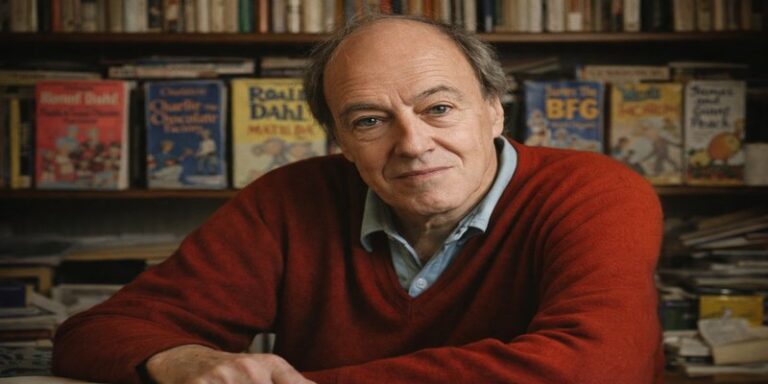
Roald Dahl (1916–1990) is widely regarded as one of the most influential writers in twentieth-century children’s literature. His stories combine fantasy, dark humour, moral clarity and memorable characters, creating books that appeal to both children and adults. Scholars and literary critics frequently highlight his ability to balance imaginative storytelling with deeper themes about authority, justice and childhood experience (Britannica, 2025; Treglown, 1994). This discussion examines Dahl’s life, literary style, controversies, educational impact and enduring legacy, drawing on reputable academic and reference sources.
1.0 Early Life and Formative Influences
Roald Dahl was born on 13 September 1916 in Llandaff, Wales, to Norwegian parents, Harald Dahl and Sofie Hesselberg. His family maintained strong connections with Norway, and childhood holidays there exposed him to Scandinavian folklore, storytelling traditions and cultural duality. These experiences later influenced the imaginative tone of his fiction (Britannica, 2025; Dahl, 1984).
Dahl’s childhood was also marked by hardship. His father died when Dahl was only four, and his schooling included strict discipline, particularly at Repton School, where corporal punishment was common. These experiences contributed to his recurring literary theme of suspicion towards authoritarian adults, often portrayed as unfair or oppressive figures in his stories (Treglown, 1994; Royer, 1998).
Rather than attending university, Dahl pursued adventure, working for Shell Oil in East Africa before joining the Royal Air Force during the Second World War. A serious plane crash in Libya left him injured, but he later served in Washington, D.C., where author C. S. Forester encouraged him to write about wartime experiences. These early writings developed his distinctive narrative voice, often blending humour with darker undertones (Britannica, 2025; Treglown, 1994).
2.0 Literary Career: Style, Themes and Major Works
Dahl’s writing career can broadly be divided into adult fiction and children’s literature, although elements of macabre humour appear in both. His children’s books are especially noted for:
- Young protagonists confronting adversity
- Clear moral contrasts between good and evil
- Highly imaginative or surreal settings
- Exaggerated adult villains
For example, Matilda (1988) portrays a gifted child overcoming neglectful parents and a tyrannical headmistress, emphasising intelligence, resilience and moral courage. Similarly, The BFG (1982) features a child protagonist cooperating with a benevolent giant to defeat harmful forces, highlighting friendship and ethical responsibility (Royer, 1998).
Dahl’s imaginative premises are another defining characteristic. James and the Giant Peach (1961) presents a magical adventure involving anthropomorphic insects, while Charlie and the Chocolate Factory (1964) explores themes of greed, kindness and imagination through the fantastical inventions of Willy Wonka. These narratives demonstrate Dahl’s ability to combine fantasy with social commentary (Britannica, 2025).
Critics often note his distinctive linguistic playfulness, including invented words, rhythmic phrasing and exaggerated descriptions. Such stylistic features help engage young readers while reinforcing the whimsical tone of his stories.
3.0 Critical Reception and Controversies
Despite immense popularity, Dahl’s work has attracted scholarly debate. Some critics argue his portrayal of adults can be overly simplistic, depicting authority figures as caricatured villains rather than nuanced individuals. Royer (1998) suggests this reflects a broader scepticism towards institutions and societal norms.
Another significant discussion concerns gender representation. Certain analyses, including studies of The Witches, argue that female antagonists may reinforce negative stereotypes, though others contend the text operates within fairy-tale traditions rather than realistic gender commentary (Gender Stereotypes Article, 2023).
More recently, editorial revisions to Dahl’s books generated public debate. Publishers introduced language changes aimed at improving inclusivity, prompting contrasting responses. Some readers supported updating language for contemporary audiences, while others emphasised the importance of preserving original literary texts (Britannica, 2025).
4.0 Personal Life and Medical Contributions
Dahl’s personal life included both tragedy and creativity beyond literature. The death of his daughter Olivia deeply affected him, influencing emotional themes in some works. Additionally, after his son Theo suffered a serious head injury, Dahl collaborated with medical professionals to develop the Wade-Dahl-Till valve, a device used in treating hydrocephalus. This involvement demonstrates his practical engagement with science and medicine (Solomon, 2016; Lokody, 2017).
Medical experiences also appear metaphorically in his stories, where themes of vulnerability, recovery and resilience are often present. Scholars argue these aspects add emotional depth to otherwise fantastical narratives.
His autobiographical books, particularly Boy: Tales of Childhood and Going Solo, provide insight into how real experiences shaped his storytelling imagination (Dahl, 1984; Royer, 1998).
5.0 Educational and Psychological Significance
Dahl’s works are frequently studied within education, psychology and childhood studies. Researchers note that his protagonists often face issues relevant to young readers, including identity formation, autonomy and moral decision-making (Royer, 1998).
For instance:
- Matilda illustrates intellectual independence and ethical courage.
- Charlie Bucket demonstrates humility and kindness amid material temptation.
- Sophie in The BFG models empathy and cooperation.
These characters align with psychological frameworks such as Erikson’s psychosocial development theory, where children navigate stages of competence and self-confidence.
Humour plays a particularly important role. Dahl’s often grotesque or absurd comedy allows difficult topics—neglect, injustice or fear—to be explored in ways that remain accessible and engaging for younger readers.
6.0 Cultural Impact and Legacy
Roald Dahl’s influence extends far beyond literature. His books have inspired:
- Films and stage adaptations, including major musical productions of Matilda.
- Educational curricula, where his texts are used to teach creative writing, ethics and narrative structure.
- Ongoing scholarly research, particularly in children’s literature studies.
Many textbooks describe him as a central figure in modern children’s fiction, citing his imaginative originality and ability to address complex emotional themes within entertaining narratives (Britannica, 2025; Royer, 1998).
Furthermore, works such as Tom Solomon’s Roald Dahl’s Marvellous Medicine explore how Dahl’s medical experiences intersected with his creativity, highlighting interdisciplinary relevance in both literature and medical humanities (Solomon, 2016; Lokody, 2017).
Roald Dahl remains a towering presence in children’s literature, recognised for his inventive storytelling, moral themes and distinctive humour. While his works continue to provoke discussion regarding representation, language and characterisation, their enduring popularity demonstrates their cultural significance. His stories encourage imagination, resilience and ethical awareness, ensuring their continued relevance for new generations of readers. Ultimately, Dahl’s legacy lies in his ability to blend fantasy with emotional truth, shaping modern children’s literature in lasting ways.
References
Britannica (2025) Roald Dahl | Biography, Books, Movies, Matilda, The… Encyclopaedia Britannica.
Dahl, R. (1984) Boy: Tales of Childhood. London: Jonathan Cape.
Gender Stereotypes and Representation of Women in Dahl’s Books (2023) JSTOR.
Lokody, I. (2017) ‘Minpins and medicine: the life of Roald Dahl’, The Lancet Neurology, 16(7), pp. 527–528.
Royer, S.E. (1998) ‘Roald Dahl and Sociology 101’, ALAN Review, 26(1), pp. 1–7.
Solomon, T. (2016) Roald Dahl’s Marvellous Medicine. Liverpool: Liverpool University Press.
Treglown, J. (1994) Roald Dahl: A Biography. London: Faber & Faber.