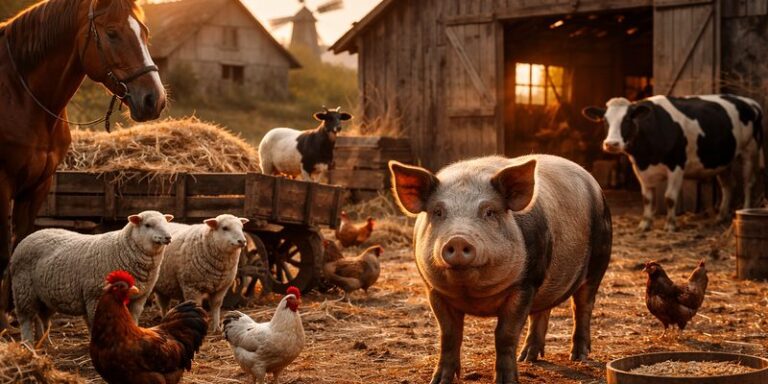
Title and Bibliographic Details
Orwell, George (1945) Animal Farm: A Fairy Story. London: Secker & Warburg. First edition.
✧ First published in 1945, Animal Farm appears deceptively simple: a group of animals overthrow their human owner and attempt to construct a fairer society. Yet Orwell’s subject is far wider than farm life. The novel is a satire of power, a warning about betrayed revolution, and a sharp critique of how political ideals may be distorted into oppression (Britannica, n.d.; The Orwell Foundation, n.d.).
The book’s purpose is not merely to entertain, though it does so with considerable skill. Orwell uses fable, allegory and irony to expose the corruption of political language, the manipulation of truth and the ease with which ordinary people may be controlled. Overall, Animal Farm may be regarded as highly valuable, deeply readable and intellectually forceful. Its apparent simplicity is one of its major strengths, even if that same simplicity occasionally narrows the complexity of its political vision.
1.0 Summary of the Book
At the centre of Animal Farm is a revolution. The animals of Manor Farm, inspired by the hope of freedom from human exploitation, drive out Mr Jones and rename the property Animal Farm. At first, the rebellion appears hopeful. The animals work together, establish rules and believe that a society based on equality is being created.
However, leadership quickly hardens into control. The pigs, especially Napoleon and Snowball, emerge as dominant figures, and conflict between them determines the direction of the farm. Over time, Napoleon consolidates power, rewrites principles, uses fear and propaganda, and transforms the revolution into a regime that closely resembles the oppression it originally promised to destroy. The novel ends with a bleak recognition that the new rulers have become indistinguishable from the former tyrants they replaced.
The central themes are power, corruption, propaganda, class hierarchy, betrayal of ideals and political memory. Although the book is short and structurally straightforward, its moral and political implications are wide-ranging (Rodden, 2007; Gurung, 2024).
2.0 Main Argument of the Book
The principal argument of Animal Farm is that political revolutions may be corrupted from within when power becomes concentrated, language is manipulated and the masses are denied critical thought. Orwell does not simply suggest that leaders become morally flawed. Instead, the novel demonstrates how systems of power are sustained through fear, myth-making, historical revision and habitual obedience.
Most critics interpret the novel as an allegory of the Russian Revolution and the rise of Stalinism, and that interpretation remains persuasive (Britannica, n.d.; Albloly and Nour, 2019). Old Major reflects revolutionary theory, Snowball recalls Trotsky, and Napoleon embodies Stalinist authoritarianism. Yet the force of Orwell’s argument extends beyond one historical episode. The novel’s lasting significance lies in its broader claim that political movements can become oppressive when principles are sacrificed to power.
This is what gives Animal Farm its enduring relevance. Tyranny is not presented as a sudden transformation. It is shown as a gradual distortion. Rules are altered little by little. Language softens brutality. Memory weakens. Privilege becomes ordinary. This steady moral decline is one of the novel’s most unsettling achievements.
3.0 Use of Evidence and Sources
Because Animal Farm is a work of fiction, evidence is not used in the academic sense. Instead, Orwell constructs his argument through allegory, symbolic characterisation, dramatic repetition and carefully staged political episodes. The evidence is therefore narrative: what occurs on the farm, how the characters behave and how language changes over time.
This method proves remarkably effective. Orwell compresses complex historical and political processes into recognisable scenes: debates, confessions, slogans, public ceremonies, scapegoating and the alteration of records. These devices allow the mechanisms of domination to become visible. The animals’ lack of education, their dependence on leaders and their susceptibility to simplified political language make the farm convincing as a miniature political world (Pelissioli, 2008).
Scholars have repeatedly noted that Orwell’s symbolism carries much of the novel’s political force. Albloly and Nour (2019) argue that his symbolic method transforms abstract ideology into memorable images, while Pant (2024) highlights the novel’s continuing warning about the dangers of authoritarian leadership. In this sense, the “sources” of Animal Farm are artistic rather than scholarly, but they remain powerful because they make political theory emotionally and morally intelligible.
4.0 Organisation and Structure
The organisation of Animal Farm is one of its major strengths. The novel is brief, tightly controlled and economically structured. Its narrative arc moves from hope to consolidation of power, then to terror, revisionism and finally recognition. That progression gives the book a relentless momentum.
The short chapters help maintain accessibility, while each stage of the farm’s transformation marks a new phase in political decay. Very little is wasted. There are no unnecessary digressions, and nearly every event contributes to the larger argument about power and betrayal. This structural discipline helps explain why Animal Farm is so frequently taught in schools and universities. It appears manageable in length, yet it opens into large political questions.
Particularly effective is the contrast between the hopeful beginning and the grim ending. The structure ensures that the corruption of the revolution is not merely understood intellectually; it is also felt through irony and narrative reversal. Rodden and Rossi (2012) note that Orwell’s fiction often gains force from its directness, and Animal Farm is a clear example of that method.
5.0 Writing Style and Clarity
Orwell’s style is among the book’s greatest achievements. His prose is clear, controlled and deceptively plain. The language never feels crowded, yet it carries considerable rhetorical force. Orwell’s style is especially suited to his message: it communicates with a moral sharpness that avoids ornament for its own sake.
This clarity matters because the novel addresses complicated political ideas without becoming heavy or inaccessible. Younger readers can follow the surface narrative, while older readers can appreciate its layers of satire, irony and historical resonance. That double readability is rare.
Orwell’s tone also deserves praise. Melodrama is avoided, which makes the horror of the farm’s transformation all the more chilling. Plain narration and symbolic detail are trusted rather than emotional excess. Connelly (2018) observes that Orwell’s literary force often lies in his ability to present political urgency in simple language, and Animal Farm demonstrates that ability brilliantly.
6.0 Strengths
The greatest strength of Animal Farm is its timelessness. Although rooted in a specific political context, the novel continues to speak to debates about authoritarianism, state propaganda, political myth, social inequality and public manipulation. Its lessons can be applied far beyond Soviet history.
A second strength is its symbolic precision. Orwell’s characters remain memorable without becoming entirely flat, and the farm itself functions as a powerful microcosm of political society. The novel is also impressive for its brevity. In a very short space, Orwell creates a story that is readable, teachable and politically provocative.
A third strength lies in its value as both literature and political commentary. Some novels succeed emotionally but not intellectually, while others feel intellectually sharp but emotionally thin. Animal Farm combines narrative simplicity with moral force. Bloom (2009) and Rodden (2007) both treat it as a major modern political satire, and that judgement appears well founded.
7.0 Limitations
Despite its power, Animal Farm has limitations. Its allegorical design can sometimes make the characters seem more representative than psychologically complex. Boxer, for example, is deeply moving and tragic, but is also clearly shaped to embody a social class and a political problem. Readers seeking deeper interiority may find the characterisation somewhat schematic.
A second limitation is that Orwell’s critique can appear overly concentrated on the failure of socialism in practice, sometimes encouraging reductive readings that treat all collective politics as inevitably doomed. Makovi (2016) notes that Orwell’s anti-totalitarian critique is potent, but may also be interpreted in ways that flatten wider ideological debate. The novel is strongest as a critique of authoritarian corruption, rather than as a complete political theory.
Finally, female characters are not strongly developed, and the emotional range of the novel is narrower than its political range. These are not fatal weaknesses, but they do place some limits on its scope.
8.0 Originality and Contribution to the Field
Animal Farm is original because it fuses fable, satire, political allegory and plain style with unusual success. Orwell transforms a farmyard tale into a disturbing study of how political language and institutional power deform moral life. That combination has influenced generations of writers, teachers and critics.
Its contribution to literary and political discussion is considerable. The novel provides a concise model for thinking about propaganda, historical revision, cult leadership and ideological betrayal. It also remains a key text in discussions of dystopian and anti-totalitarian writing (Xhinaku and Pema, 2015; Gurung, 2024).
9.0 Relevance and Audience
Animal Farm is particularly well suited to students, general readers, teachers and researchers interested in political fiction. It is especially useful for courses in English literature, politics, history, media studies and cultural studies, since it invites discussion across disciplinary boundaries.
For students, the novel is accessible and rich in symbolism. For researchers, it remains a useful entry point into debates about allegory, satire and ideology. For general readers, it offers a brief but memorable reading experience. Professionals in politics, media and education may also find it strikingly relevant because of its treatment of persuasion, fear and institutional hypocrisy.
∎ George Orwell’s Animal Farm is a valuable, convincing and remarkably accessible novel. Its brilliance lies in its ability to make a complex political warning feel immediate, readable and unforgettable. Although its allegory sometimes simplifies and its characters are not always psychologically deep, its strengths substantially outweigh its limitations.
Overall, Animal Farm may be strongly recommended to readers interested in literature that is both artistically sharp and politically alert. It is a short novel, yet its warning about power, language and corruption remains immense.
References
Albloly, A.M. and Nour, H.S.M. (2019) ‘The portrayal of political symbolism in George Orwell writings: With reference to Animal Farm and Nineteen Eighty-Four’, The International Journal of Social Sciences and Humanities Invention, 6(9), pp. 5623–5628.
Bloom, H. (2009) George Orwell’s Animal Farm. New York: Bloom’s Literary Criticism.
Britannica (n.d.) Animal Farm. Available at: https://www.britannica.com/topic/Animal-Farm.
Connelly, M. (2018) George Orwell: A Literary Companion. Jefferson, NC: McFarland.
Gurung, G.M. (2024) ‘George Orwell and totalitarianism: A master of political and social commentary’, Interdisciplinary Journal of Management and Social Sciences, 5(1), pp. 130–141.
Makovi, M. (2016) ‘Two opposing literary critiques of socialism: George Orwell versus Eugen Richter and Henry Hazlitt’, International Journal of Pluralism and Economics Education, 7(4), pp. 361–379.
Orwell, G. (1945) Animal Farm: A Fairy Story. London: Secker & Warburg.
Pant, R.P. (2024) ‘Utopia turns into dystopia: Orwell’s critic of Stalinist Marxist innovativeness in Animal Farm’, KMC Journal, 6(1), pp. 1–14.
Pelissioli, M. (2008) From Allegory into Symbol: Revisiting George Orwell’s Animal Farm and Nineteen Eighty-Four in the Light of 21st Century Views of Totalitarianism. Porto Alegre: Federal University of Rio Grande do Sul.
Rodden, J. (ed.) (2007) The Cambridge Companion to George Orwell. Cambridge: Cambridge University Press.
Rodden, J. and Rossi, J. (2012) The Cambridge Introduction to George Orwell. Cambridge: Cambridge University Press.
The Orwell Foundation (n.d.) Animal Farm. Available at: https://www.orwellfoundation.com/the-orwell-foundation/orwell/books-by-orwell/animal-farm/.