Across contemporary nutrition science, public health policy and clinical research, there is broad consensus that sea salt and table salt are nutritionally very similar, and that the primary health concern relates to sodium intake rather than the type of salt consumed. Systematic reviews, textbook analyses and public health reports consistently show that excessive dietary sodium increases the risk of hypertension, stroke and cardiovascular disease, regardless of whether the source is sea salt, table salt or processed foods (Lewis et al., 2019; Thrift et al., 2010; Kovač and Blaznik, 2019).
Although sea salt is often marketed as more “natural” or “mineral-rich”, research indicates that its trace mineral content is nutritionally insignificant when consumed in typical amounts (Parisi, 2024; Peckenpaugh, 2009). From a health perspective, what matters most is total salt consumption, not branding or processing style.
1.0 Chemical Composition: Are They Different?
Both sea salt and table salt are composed primarily of sodium chloride (NaCl). By weight, they contain nearly identical proportions of sodium and chloride (Lewis et al., 2019). The EFSA review on dietary reference values confirms that health outcomes associated with salt intake are driven by sodium content, not its origin (Lewis et al., 2019).
The claim that sea salt contains additional minerals such as magnesium, calcium and potassium is accurate; however, these are present only in trace amounts and do not meaningfully contribute to daily nutrient requirements (Parisi, 2024). To obtain significant quantities of these minerals from sea salt would require consumption levels far exceeding safe sodium intake limits.
For example, Malik, Narayanasamy and Pratyusha (2023) note in their textbook on macrominerals that iodine fortification of salt was introduced to prevent deficiency disorders such as goitre. Sea salt, unless fortified, should not be relied upon as a consistent source of iodine.
2.0 Sodium Intake and Cardiovascular Risk
The primary health issue linked to salt is excessive dietary sodium, which contributes to elevated blood pressure. High blood pressure is a major risk factor for stroke, coronary heart disease and kidney disease (Thrift et al., 2010).
The UK recommendation is that adults should consume no more than 6 g of salt per day (approximately 2.4 g sodium), yet average consumption remains significantly higher. Population-level salt reduction strategies in the UK have demonstrated measurable reductions in hypertension and stroke mortality (Tariq et al., 2016).
Importantly, replacing table salt with sea salt does not lower sodium intake unless the total amount consumed decreases. Greenwood et al. (2024) demonstrate in a systematic review that cardiovascular improvements occur when sodium intake is reduced or partially replaced with potassium-enriched substitutes—not when the salt source merely changes.
Therefore, from a cardiovascular perspective, sea salt offers no intrinsic protective advantage over table salt.
3.0 Processing and Perceived “Naturalness”
Table salt is typically mined from underground deposits and refined to remove impurities. It often contains anti-caking agents and, in many countries including the UK, added iodine (Peckenpaugh, 2009).
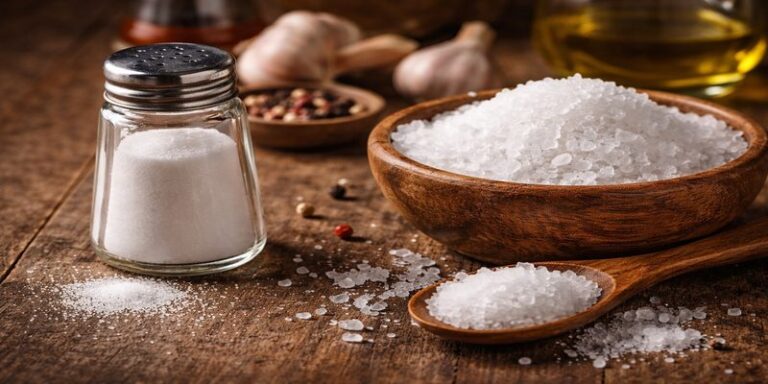
Sea salt, by contrast, is produced through evaporation of seawater and undergoes less processing, retaining small mineral residues that influence flavour and texture (Parisi, 2024). These characteristics may give sea salt a marketing appeal as “natural” or “organic”.
However, from a nutritional standpoint, refinement does not reduce the sodium content in table salt. As Kovač and Blaznik (2019) explain, the health impact of salt is determined by sodium chloride itself, regardless of crystal size, harvesting method or aesthetic properties.
Thus, the perceived superiority of sea salt often reflects culinary preference rather than scientific evidence.
4.0 Iodine Considerations
One area where table salt may offer an advantage is iodine fortification. Iodine deficiency can lead to thyroid dysfunction and developmental problems. Global public health initiatives have long promoted iodised salt as an effective prevention strategy (Sun et al., 2017).
Sea salt does not reliably contain sufficient iodine unless specifically fortified. Although it may contain trace iodine naturally, levels are inconsistent and generally inadequate to meet dietary requirements (Malik et al., 2023).
Consequently, individuals who exclusively consume non-iodised sea salt may be at increased risk of inadequate iodine intake, particularly in regions where dietary iodine sources are limited.
5.0 Salt, Culture and Consumption Patterns
Research into sodium sources shows that the majority of dietary sodium in developed countries comes not from discretionary salt added at the table, but from processed and restaurant foods (Byrd, 2017; Asakura et al., 2016).
For example, Asakura et al. (2016) found that generational differences in sodium intake are largely shaped by processed food consumption rather than salt choice. Similarly, strategies aimed at reducing sodium in manufactured foods have proven more effective than encouraging consumers to switch salt types (Tariq et al., 2016).
This suggests that debates about sea salt versus table salt may distract from the more pressing issue of overall dietary patterns.
6.0 Common Misconceptions
Several misconceptions persist:
6.1 Sea salt is lower in sodium.
False. By weight, sodium content is almost identical (Lewis et al., 2019).
6.2 Sea salt prevents hypertension.
No evidence supports this claim. Hypertension risk relates to total sodium intake (Thrift et al., 2010).
6.3 Trace minerals in sea salt improve health.
While present, these minerals occur in nutritionally insignificant quantities (Parisi, 2024).
6.4 Table salt is “chemical” while sea salt is “natural.”
Both are chemically sodium chloride. All salt is a naturally occurring mineral compound.
7.0 Culinary Differences
Where sea salt may differ meaningfully is in texture and flavour. Larger crystals can create a crunchier mouthfeel, enhancing dishes such as salads or roasted vegetables. Parisi (2024) notes that mineral residues may subtly influence flavour perception when salt is consumed uncooked.
However, when dissolved in cooking, these differences are largely indistinguishable. Nutritionally, crystal size or coarseness does not alter sodium concentration.
Thus, culinary preference is a valid reason to choose sea salt—but not a medical one.
8.0 Public Health Perspective
From a population health standpoint, reducing overall sodium intake is a global priority. High salt consumption remains associated with increased risk of cardiovascular mortality (Kovač and Blaznik, 2019).
Policy efforts such as reformulation of processed foods and public awareness campaigns have proven more impactful than encouraging substitution between salt varieties (Tariq et al., 2016).
In short, whether one sprinkles sea salt or table salt on food matters far less than how much total sodium is consumed.
Scientific evidence from textbooks, clinical studies and public health research demonstrates that sea salt is not inherently healthier than table salt. Both are composed primarily of sodium chloride, and both contribute equally to sodium intake when consumed in comparable quantities.
The main determinants of salt-related health risks are:
- Total sodium consumption
- Dietary patterns
- Presence or absence of iodine fortification
Sea salt may offer culinary benefits—such as texture or flavour complexity—but these do not translate into measurable health advantages. If anything, iodised table salt may provide a small public health benefit in preventing iodine deficiency.
Ultimately, the healthiest choice is not switching salt types but moderating overall intake in line with national dietary guidelines.
References
Asakura, K., Uechi, K., Masayasu, S. and Sasaki, S. (2016) ‘Sodium sources in the Japanese diet: difference between generations and sexes’, Public Health Nutrition, 19(11), pp. 2011–2023.
Greenwood, H., Barnes, K., Clark, J. and Ball, L. (2024) ‘Long-term effect of salt substitution for cardiovascular outcomes: a systematic review and meta-analysis’, Annals of Internal Medicine, 177(1), pp. 23–35.
Kovač, B. and Blaznik, U. (2019) ‘Systematic reduction of excessive salt intake’, in Salt in the Earth. London: IntechOpen.
Lewis, K.A., Madden, A. and Tammam, J. (2019) Final evidence report for dietary reference values for sodium and chloride. EFSA Supporting Publications.
Malik, D., Narayanasamy, N. and Pratyusha, V.A. (2023) ‘Inorganic nutrients: macrominerals’, in Textbook of Nutritional Biochemistry. Singapore: Springer.
Parisi, S. (2024) Nutrition, Chemistry, and Health Effects of Sugar, Salt, and Milkfat. Cham: Springer.
Peckenpaugh, N.J. (2009) Nutrition Essentials and Diet Therapy. 10th edn. St Louis: Saunders.
Sun, D. et al. (2017) ‘Eliminating iodine deficiency in China: achievements, challenges and global implications’, Nutrients, 9(4), 361.
Tariq, M., Rath, S., Mushoriwa, F. and Srinivas, S. (2016) ‘Health and sustainable development challenges of the 21st century: A comparative analysis of salt reduction strategies’, Population Review, 55(1), pp. 1–21.
Thrift, A.G., Srikanth, V. and Fitzgerald, S.M. (2010) ‘Potential roles of high salt intake in the development of hypertension’, Clinical and Experimental Pharmacology and Physiology, 37(1), pp. 30–36.