✧ Orthodox Easter is far more than a date on the Christian calendar. It is a season of waiting, fasting, prayer, sorrow and joy that reaches its emotional peak in the darkness of Holy Saturday night, when churches fill with candlelight and the proclamation rings out: “Christ is risen.” For millions of Orthodox Christians across Greece, Romania, Serbia, Russia, Georgia, the Middle East and the wider diaspora, this feast stands at the very centre of the liturgical year.
What makes Orthodox Easter so compelling is not only its theology, but also its atmosphere. The feast combines ancient ritual, profound symbolism and strong local customs. It connects the story of Christ’s Resurrection with the rhythms of community life, family meals, processions, icons, bells and light. In most Orthodox traditions, Easter is more commonly called Pascha, a term linked to Passover, and that name points to one of the feast’s deepest themes: passage from death to life (Britannica, n.d.; Bradshaw and Hoffman, 2000).
This article explores the meaning of Orthodox Easter, why it is often celebrated on a different date from Western Easter, how Holy Week unfolds, and why its traditions remain spiritually and culturally powerful today.
1.0 The Meaning of Orthodox Easter
At its heart, Orthodox Easter celebrates the Resurrection of Jesus Christ. In Orthodox theology, this is not treated as one feast among many, but as the feast of feasts and the foundation of Christian hope. The Resurrection is understood as Christ’s victory over sin, death and corruption, and therefore as the basis of salvation and renewed life (Britannica, n.d.; Lloyd-Moffett, 2010).
This helps explain why Orthodox worship gives Pascha such exceptional prominence. The liturgical year builds towards it, and the weeks after it continue to reflect its joy. Denysenko (2024) notes that in Orthodoxy, the liturgical year is structured so that Pascha functions as its theological and spiritual centre. Similarly, Streza (2021) argues that the Orthodox liturgical year cannot be understood properly without recognising the centrality of Paschal theology.
In simple terms, Orthodox Easter is not only about remembering a past event. It is about entering a lived experience of renewal. The feast proclaims that death does not have the final word, and that suffering, however real, is not ultimate. That is one reason its language, music and ritual are so charged with joy after endurance.
2.0 Why Orthodox Easter Often Falls on a Different Date
One of the most frequently asked questions about Orthodox Easter concerns its date. Why does it so often fall later than Easter in many Western churches?
The short answer is that the calculation of Easter developed historically and remains tied to ancient calendar systems and canonical traditions. The Council of Nicaea in 325 established the principle that Easter should be observed on the first Sunday after the first full moon following the spring equinox. However, Eastern Orthodox churches traditionally calculate Pascha according to the Julian paschalion, rather than the modern Gregorian reckoning used in much of Western Christianity (Britannica, n.d.; Marcello, 2024).
As a result, Orthodox Easter often occurs later, though in some years the dates coincide. The issue is not merely astronomical; it also reflects centuries of liturgical continuity, ecclesial identity and canonical interpretation. Groen (2011) and Dură (2018) both show that the Easter date remains an important ecumenical and theological question, not simply a matter of convenience.
This calendar difference can sometimes confuse observers, but it also reveals something important: Orthodox Easter is deeply rooted in inherited liturgical tradition. The date is part of a wider understanding of sacred time, not only a scheduling decision.
3.0 Holy Week and Orthodox Easter Worship
To understand Orthodox Easter, it is necessary to understand Holy Week, because the feast emerges from an intense pattern of worship that moves through sorrow into triumph.
Holy Week begins after Palm Sunday and leads believers through the final days of Christ’s earthly ministry, the Last Supper, the Passion, Crucifixion, burial and Resurrection. Orthodox liturgical practice places great emphasis on participation through chant, procession, Gospel readings and symbolic actions. Woolfenden (2007) and Velkovska (2000) both stress that Eastern Christian worship during this period is not merely commemorative; it is immersive and performative.
3.1 Holy Thursday and Good Friday
On Holy Thursday, the Church recalls the Mystical Supper and Christ’s self-offering. On Good Friday, the tone becomes solemn and mournful. Services often include the veneration of the epitaphios or burial shroud of Christ, processions and lamentations. The emotional power of these observances lies in their ability to bring worshippers into close contact with the grief and paradox of the Passion (Velkovska, 2000; Azar, 2015).
3.2 Holy Saturday Night
The emotional turning point comes late on Holy Saturday. Just before midnight, churches are darkened. A single flame is brought forth, and the congregation lights candles from it, passing light from person to person. Then comes the Paschal proclamation and the beginning of the Resurrection service. This moment captures the core meaning of Orthodox Easter: light emerging from darkness, life overcoming death.
The service that follows is triumphant, filled with hymnody, incense, repeated acclamations and visible celebration. In many communities, the worship continues into the early hours before families return home for a festive meal.
4.0 Orthodox Easter Traditions Around the World
Although the theology of Orthodox Easter is shared across many churches, local customs vary widely. This blend of common worship and regional variation is one of the feast’s most distinctive features.
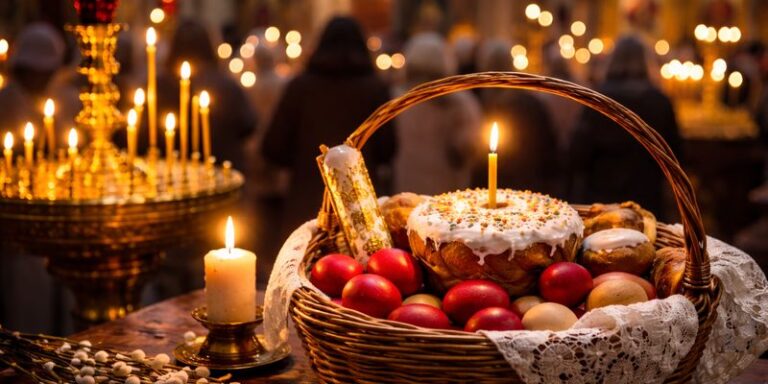
One of the best-known customs is the dyeing of red eggs, symbolising both blood and new life. Eggs are then exchanged, cracked together in greeting, or used at the festive table. In many places, special breads, sweet pastries and lamb dishes also appear after the long Lenten fast. Lloyd-Moffett (2010) notes that Pascha is central not only to Orthodox worship but also to the wider social and domestic culture of Orthodox communities.
In Greece, midnight candlelight processions are especially famous. In Romania and Serbia, churches and households alike prepare carefully for the Paschal night, often with baskets of food to be blessed. In Slavic contexts, the exchange of the Paschal greeting remains deeply significant. While customs differ, the pattern is similar: fasting gives way to feasting, mourning gives way to celebration, and the community gathers in visible unity.
These traditions matter because Orthodox Easter is not experienced only in doctrine or text. It is experienced through sound, taste, gesture, colour and shared memory.
5.0 Fasting, Feasting and the Spiritual Rhythm of Orthodox Easter
Another key to Orthodox Easter is the relationship between Lent and Pascha. The feast is preceded by the Great Fast, a period of repentance, restraint and spiritual preparation. This preparation gives the celebration its depth. Without the fast, the feast would lose much of its contrast and force.
Orthodox spirituality often emphasises that joy is most fully understood after discipline. The movement from fasting to feasting therefore mirrors the larger Christian story of death and resurrection. Moore (2019) and Johnson (2016) both suggest that Paschal worship is inseparable from the wider rhythm of liturgical time, where memory and hope are held together.
This is one reason Orthodox Easter feels so powerful even to many observers who are not Orthodox. It has dramatic shape. It begins in darkness, passes through grief and silence, and ends in light, food, song and blessing. It speaks to something deeply human: the longing for renewal after loss.
6.0 Why Orthodox Easter Still Matters Today
In a fast-moving world, Orthodox Easter continues to matter because it offers both continuity and meaning. It preserves ancient practices, yet it also speaks directly to modern anxieties about death, suffering, fragmentation and hope.
For believers, the feast remains a theological proclamation. For communities, it is a cultural anchor. For scholars, it is a striking example of how liturgy shapes identity across time. Even contemporary debates about the Easter date show that Pascha remains central to questions of unity, tradition and reform (Groen, 2011; Marcello, 2024).
In addition, the feast reminds modern society that ritual still matters. In many places, public life has become more individualised and less ceremonial. Orthodox Easter stands against that trend. It is communal, embodied and historically rooted.
∎ Orthodox Easter is one of Christianity’s most profound and beautiful celebrations. It brings together Resurrection theology, ancient calendar tradition, Holy Week worship and local custom in a way that is both solemn and joyful. From the discipline of Lent to the candlelit cry of Pascha at midnight, the feast tells a story of light after darkness and life after death.
Its enduring significance lies in this combination of depth and immediacy. Orthodox Easter is historical, liturgical, symbolic and deeply human all at once. Whether encountered in a village church, a city cathedral or a family meal after midnight worship, it remains a living testimony to hope.
References
Azar, M.G. (2015) ‘Prophetic matrix and theological paradox: Jews and Judaism in the Holy Week and Pascha observances of the Greek Orthodox Church’, Studies in Christian-Jewish Relations, 10, pp. 1–15. https://ejournals.bc.edu/index.php/scjr/article/download/8658/7784.
Bradshaw, P.F. and Hoffman, L.A. (2000) Passover and Easter: Origin and History to Modern Times. Notre Dame: University of Notre Dame Press. https://books.google.com/books?id=LlkFDgAAQBAJ.
Britannica (n.d.) Easter. Available at: https://www.britannica.com/topic/Easter-holiday.
Denysenko, N. (2024) This Is the Day That the Lord Has Made: The Liturgical Year in Orthodoxy. Rome: Edizioni Orientalia Christiana. https://www.torrossa.com/gs/resourceProxy?an=5780941&publisher=FZ1602.
Dură, N.V. (2018) ‘The celebration of Holy Easter on the same date—an eloquent testimony to our unity in diversity’, Ecumeny and Law, 6, pp. 249–268. https://www.ecumeny-and-law.us.edu.pl/files/Ecumeny-and-Law-Vol-6.pdf#page=249.
Groen, B. (2011) ‘The long way to a common Easter date: a Catholic and ecumenical perspective’, Journal of Eastern Christian Studies, 63(3–4), pp. 353–370. https://brill.com/view/journals/jecs/63/3-4/article-p353_4.xml.
History.com Editors (2025) History of Easter. Available at: https://www.history.com/topics/holidays/history-of-easter.
Lloyd-Moffett, E.R. (2010) ‘Eastern Orthodox Christianity’, in Religion and Everyday Life and Culture. Santa Barbara, CA: ABC-CLIO, pp. 271–292. https://www.lloyd-moffett.com/s/Lloyd-Moffett-Eastern-Orthodoxy-Religion-Everyday-Life-and-Culture-2010.pdf.
Marcello, A. (2024) The Date of Easter: Classical Considerations and Contemporary Challenges. Ottawa: University of Ottawa. https://ruor.uottawa.ca/bitstreams/300383f1-5612-4680-b15a-d4112434713c/download.
Moore, L.E. (2019) From Easter to Holy Week: The Paschal Mystery and Liturgical Renewal in the Twentieth Century. Washington, DC: Catholic University of America Press. https://books.google.com/books?id=DAT1DwAAQBAJ.
Streza, D.A. (2021) ‘The Orthodox liturgical year and its theological structure’, HTS Teologiese Studies / Theological Studies, 77(4), Article 6742. https://www.ajol.info/index.php/hts/article/view/232794/219890.
Velkovska, E.V. (2000) ‘The liturgical year in the East’, in Handbook for Liturgical Studies, Volume V: Liturgical Time and Space. Collegeville, MN: Liturgical Press, pp. 157–182. https://books.google.com/books?id=88A0uYXRqM8C.
Woolfenden, G. (2007) ‘Eastern Christian liturgical traditions: Eastern Orthodox’, in The Blackwell Companion to Eastern Christianity. Oxford: Blackwell, pp. 350–385. http://ndl.ethernet.edu.et/bitstream/123456789/26678/1/30.%20pdf.pdf#page=363.