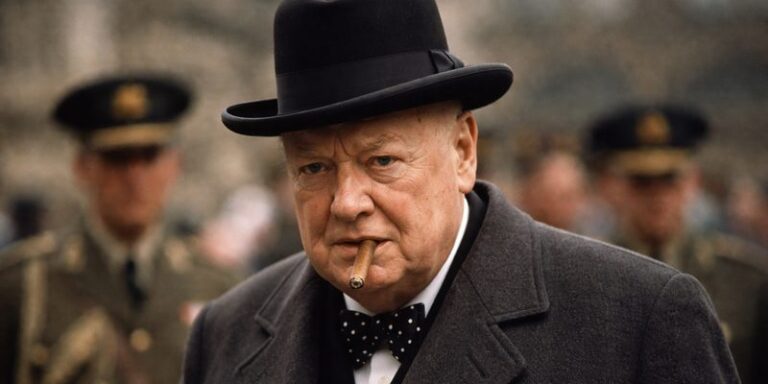
Winston Churchill remains one of the most recognisable figures in modern British history. Best known for leading Britain through the darkest years of the Second World War, he was also a soldier, journalist, historian, orator and Nobel Prize-winning writer. His career stretched across more than six decades and included major roles in imperial policy, social reform, military decision-making and post-war diplomacy. For many people, Winston Churchill symbolises courage, resilience and national determination. Yet his legacy is also debated, particularly in relation to empire, class and race.
This article explores the life, achievements and controversies of Winston Churchill in a balanced way. It examines his early career, wartime leadership, political ideas and enduring place in public memory, using examples to show why he continues to matter in the twenty-first century.
1.0 Winston Churchill: Early Life and Political Rise
Born at Blenheim Palace on 30 November 1874, Winston Churchill came from an aristocratic family. He was the son of Lord Randolph Churchill and Jennie Jerome. After attending Harrow and the Royal Military College, Sandhurst, he began his career in the army and soon gained attention as a war correspondent and author (Jenkins, 2001).
Churchill’s early experiences in Cuba, India, Sudan and South Africa helped shape his public image. During the Boer War, for example, his dramatic escape after being captured made him famous in Britain. This blend of military adventure, journalism and self-promotion became a hallmark of his career.
He entered Parliament in 1900 as a Conservative before switching to the Liberal Party in 1904. This move reflected both principle and ambition. As a Liberal minister, Churchill supported several social reforms, including labour exchanges and aspects of early welfare legislation. According to Pugh (2012), Churchill played a meaningful part in the reforming politics of pre-1914 Britain, even if he is remembered more for war than welfare.
2.0 Winston Churchill and the First World War
Churchill’s reputation suffered badly during the First World War. As First Lord of the Admiralty, he strongly backed the Gallipoli campaign of 1915, an attempt to break the deadlock by attacking the Ottoman Empire through the Dardanelles. The operation ended in failure and heavy loss of life. As a result, Churchill was forced from high office (Gilbert, 1991).
This episode is important because it shows that Winston Churchill was not an infallible leader. He could be imaginative and bold, but also impulsive and overly confident. Even so, he returned to politics and gradually rebuilt his career. By the 1920s he was back in the Conservative Party and held senior posts, including Chancellor of the Exchequer.
3.0 Why Winston Churchill Matters in the Second World War
Churchill became Prime Minister in May 1940, at a moment of extreme danger. Nazi Germany had overrun much of Europe, and Britain stood largely alone. His significance lies not only in strategy or administration, but also in his ability to communicate resolve.
3.1 Oratory and Morale
Churchill’s speeches became central to Britain’s wartime identity. Addresses such as “Blood, toil, tears and sweat”, “We shall fight on the beaches” and “Their finest hour” helped frame the war as a moral struggle for civilisation and freedom (Churchill, 1949). These speeches did not win battles on their own, but they strengthened public morale and political unity.
A clear example of his influence came in 1940 after the fall of France. At a time when some politicians considered negotiation, Churchill argued that Britain must continue fighting. Historians such as Roberts (2018) suggest that this determination was one of his greatest contributions.
3.2 Strategic Leadership
Churchill also played a major role in grand strategy. He worked closely with Franklin D. Roosevelt and later Joseph Stalin, helping to maintain the alliance that defeated Nazi Germany. He was deeply involved in military planning, sometimes to a fault, but his energy and persistence helped keep pressure on both generals and ministers.
However, his record was mixed. Some decisions were controversial, and critics point to failures such as the Norwegian campaign and later tensions over imperial priorities. As Addison (2005) notes, Churchill’s wartime image has sometimes overshadowed the complexity of his decision-making.
4.0 The Wider Legacy of Winston Churchill
4.1 Defender Of Democracy
For many admirers, Winston Churchill stands as a defender of parliamentary democracy against fascism and tyranny. His refusal to accept defeat in 1940 remains one of the defining moments of modern British political history. This is one reason his image is often invoked during national crises.
4.2 Writer and Historian
Churchill was not only a politician. He was also a prolific writer who produced works on history, politics and war. In 1953 he received the Nobel Prize in Literature for his historical and biographical writing and for his mastery of oratory (Nobel Prize, 2024). This unusual combination of statesman and literary figure adds to his lasting reputation.
4.3 Post-War Vision
After losing the 1945 general election, Churchill remained politically influential. In 1946 he delivered the famous “Iron Curtain” speech in Fulton, Missouri, warning of Soviet expansion in Europe. Although controversial at the time, the speech is often seen as an early statement of the Cold War (Best, 2001). He also supported closer European co-operation, even though his vision did not fully align with later European integration.
5.0 Criticisms and Controversies Surrounding Winston Churchill
A balanced article on Winston Churchill must also consider criticism. In recent years, historians and commentators have re-examined his views on empire, race and colonial rule. Churchill was a man of his time in some respects, but that does not remove the need for scrutiny.
One major controversy concerns the Bengal Famine of 1943, in which millions died in British-ruled India. Historians continue to debate the extent of Churchill’s responsibility, but many argue that imperial policy, wartime priorities and racist assumptions worsened the crisis (Mukerjee, 2010; Tharoor, 2017). Others caution against reducing a complex famine solely to Churchill’s personal decisions, pointing instead to crop failures, wartime disruption and administrative failures.
Churchill also opposed Indian self-government for much of his career and held views that today are widely regarded as racist. This has led to arguments over statues, school curricula and national memory. These debates show that Winston Churchill is not simply a heroic figure; he is also a contested symbol of Britain’s imperial past.
6.0 Winston Churchill in Public Memory
Public memory of Churchill is unusually powerful. His image appears in films, documentaries, schoolbooks and political rhetoric. During periods of uncertainty, leaders and commentators often refer back to Churchillian language of perseverance and courage.
Yet memory is selective. The popular version of Winston Churchill often focuses on 1940 and leaves out other parts of his life, including party switching, military misjudgements and imperial attitudes. This selective remembrance explains why he can be both celebrated and criticised at the same time.
For example, in schools he is often taught as the man who inspired Britain during war. In university history courses, however, he is more likely to be studied as a complicated and sometimes contradictory statesman. Both views contain truth.
Winston Churchill remains one of the most important and debated figures in British history. His leadership during the Second World War, especially in 1940, helped shape the survival of Britain and the wider Allied cause. His speeches, political resilience and historical writing gave him an influence that extended far beyond office. At the same time, his failures and views on empire remind us that great leaders are rarely simple.
The enduring significance of Winston Churchill lies in this tension. He was a leader of extraordinary courage and language, but also a product of imperial Britain with deeply controversial beliefs and decisions. Understanding Churchill properly means resisting both uncritical praise and easy dismissal. His life offers a powerful example of how political leadership can inspire nations while still demanding serious moral and historical evaluation.
References
Addison, P. (2005) Churchill: The Unexpected Hero. Oxford: Oxford University Press.
Best, G. (2001) Churchill: A Study in Greatness. London: Hambledon and London.
Churchill, W.S. (1949) The Second World War. Vol. 2: Their Finest Hour. London: Cassell.
Gilbert, M. (1991) Churchill: A Life. London: Heinemann.
Jenkins, R. (2001) Churchill. London: Macmillan.
Mukerjee, M. (2010) Churchill’s Secret War: The British Empire and the Ravaging of India during World War II. New York: Basic Books.
Nobel Prize (2024) ‘The Nobel Prize in Literature 1953’. Available at: https://www.nobelprize.org/prizes/literature/1953/churchill/facts/ (Accessed: 15 March 2026).
Pugh, M. (2012) State and Society: A Social and Political History of Britain Since 1870. 4th edn. London: Bloomsbury.
Roberts, A. (2018) Churchill: Walking with Destiny. London: Allen Lane.
The National Archives (2024) ‘Winston Churchill’. Available at: https://www.nationalarchives.gov.uk/education/resources/churchill/ (Accessed: 15 March 2026).
UK Parliament (2024) ‘Sir Winston Churchill’. Available at: https://www.parliament.uk/about/living-heritage/foundingmoments/transformingsociety/election/timeline/sir-winston-churchill/ (Accessed: 15 March 2026).
Tharoor, S. (2017) Inglorious Empire: What the British Did to India. London: Hurst.