The question of why Britain became Protestant is one of the most compelling in European history because the answer lies at the intersection of religion, politics, dynastic anxiety, and state power. At the centre of the story stands Henry VIII, a king who began his reign as a loyal Catholic and even earned the title ‘Defender of the Faith’ from Pope Leo X in 1521 for writing against Martin Luther (Britannica, 2026a; Church of England, 2023). Yet within little more than a decade, Henry had severed England’s ties with the papacy and declared himself head of the English Church.
However, Britain did not become Protestant simply because Henry wanted a divorce. That explanation is too narrow. His marital crisis was the trigger, but the wider transformation was made possible by long-standing tensions over papal authority, the growth of royal power, parliamentary legislation, and the spread of reforming ideas across Europe. Historians have shown that the English Reformation was both a personal drama and a constitutional revolution (Rex, 2006; Bernard, 2005). This article explains why the break with Rome happened, how it unfolded, and why it mattered so profoundly for Britain’s religious identity.
1.0 Henry VIII’s ‘Great Matter’: The Immediate Cause
The most immediate cause of the break with Rome was Henry VIII’s desperate wish to secure a male heir. His marriage to Catherine of Aragon had produced only one surviving child, Mary, and Henry feared that the absence of a son would plunge the Tudor dynasty into instability. He also became convinced that his marriage was invalid because Catherine had been the widow of his brother, Arthur, which he believed offended divine law, particularly the passage in Leviticus forbidding a man to marry his brother’s wife (Britannica, 2026b).
Henry therefore sought an annulment from Pope Clement VII. Yet the Pope was in an extremely difficult political position. Catherine was the aunt of Charles V, Holy Roman Emperor, whose influence over papal politics was immense, especially after the Sack of Rome in 1527 weakened Clement’s independence (Britannica, 2026c). As a result, the Pope delayed and effectively refused Henry’s request. Catherine herself appealed to Rome against attempts to judge the case in England, which further frustrated the king (Britannica, 2026c).
A useful example here is the contrast between what Henry wanted and what he eventually did. At first, he did not seek to create a new church. He wanted Rome to approve his annulment while leaving England fully Catholic. Only when this failed did he move towards separation. In that sense, the divorce crisis was the spark, not the whole fire.
2.0 The Political Break: From Papal Authority to Royal Supremacy
Once it became clear that Rome would not give him what he wanted, Henry and his advisers, especially Thomas Cromwell and Thomas Cranmer, pursued a legal and political solution inside England. Parliament became the instrument through which the king dismantled papal power step by step.
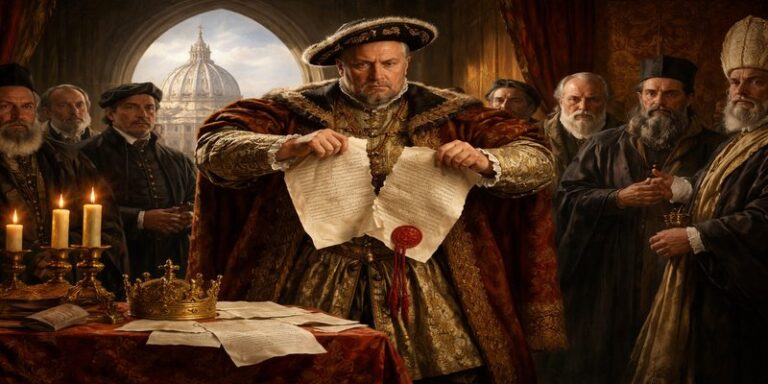
A crucial moment came with the Act in Restraint of Appeals in 1533, which declared that England was an ‘empire’ governed by one supreme head and that legal appeals could no longer be made to Rome. This was revolutionary because it cut off the Pope’s jurisdiction in English ecclesiastical matters (JSTOR, 1994; Parliament UK, n.d.). In practical terms, it allowed Cranmer, now Archbishop of Canterbury, to annul Henry’s marriage to Catherine and validate his marriage to Anne Boleyn.
The next decisive step was the Act of Supremacy in 1534, which recognised Henry as ‘Supreme Head of the Church of England’ (Britannica, 2026d; Parliament UK, n.d.). This was not merely an administrative adjustment. It transferred ultimate spiritual authority in England from the Pope to the Crown. Those who refused to accept this change, such as Sir Thomas More and Bishop John Fisher, were executed. Their fate shows how seriously Henry treated the issue: this was no symbolic quarrel, but a reordering of power.
3.0 Why the Change Was Not Purely Religious at First
An important point is that Henry’s break with Rome did not initially make England Protestant in a fully doctrinal sense. Henry remained conservative in many matters of belief. He rejected papal supremacy, but he did not at once embrace the full theology of Luther or other continental reformers. Indeed, historians often describe Henry’s position as something close to ‘Catholicism without the Pope’ (Bernard, 2016; Rex, 2014).
This distinction matters. The institutional break happened in the 1530s, but the more recognisably Protestant character of English religion developed gradually. Henry authorised some reforms, including the English Bible and changes in church practice, yet he continued to defend several traditional Catholic doctrines (Britannica, 2026e).
For example, many ordinary people in England would not initially have felt that religion had changed completely overnight. As Lehmberg (1986) notes, the first effects of the break with Rome could be uneven and, in some places, surprisingly muted. This helps explain why the English Reformation was often confusing to contemporaries: the king had broken from Rome, but he had not fully embraced Protestantism in the modern sense.
4.0 The Wider Causes: Power, Money and Ideas
Although Henry’s marriage crisis was central, deeper forces also pushed England towards change.
First, there was the growth of royal power. The Tudor monarchy had been strengthening for decades, and the idea that a foreign pope exercised authority within England increasingly grated against notions of national sovereignty. The break with Rome therefore appealed not only as a marital solution but also as a way of asserting that the English Crown should control the English Church (Rex, 2006; Bernard, 2005).
Secondly, there was the issue of wealth. The break enabled the Crown to seize the vast resources of the Church, most dramatically through the Dissolution of the Monasteries. Monastic lands and treasures passed into royal hands and were redistributed to nobles and gentry, creating a powerful class with a vested interest in the Reformation settlement (Britannica, 2026f; Bernard, 2011). Once so much land had changed hands, a return to Rome became politically and economically more difficult.
Thirdly, England was not isolated from the wider European Reformation. Martin Luther’s challenge to Rome had already shaken Christendom, and reforming ideas about scripture, clerical corruption and papal overreach circulated in England. Yet historians such as Duffy (2005) remind us that late medieval English Catholicism was still vigorous and meaningful for many people. England was therefore not simply waiting to become Protestant. Rather, the Reformation was imposed through a mixture of royal policy, elite support and gradual cultural change.
5.0 Why This Became a Turning Point in British History
The break with Rome mattered because it transformed more than religion. It altered the relationship between Church and state, strengthened Parliament’s role in legislating belief, and laid the foundations for a national church under royal control (Parliament UK, n.d.). Later rulers would shape the settlement further: under Edward VI, England moved more clearly in a Protestant direction; under Mary I, Catholicism was briefly restored; and under Elizabeth I, a more lasting Protestant settlement emerged.
In other words, Henry did not complete the whole Protestant transformation by himself, but he made it possible. Without his breach with Rome, the later Protestant identity of Britain would have looked very different. The monarchy’s continuing link with the Church of England is a direct legacy of this sixteenth-century revolution (The Royal Family, n.d.; UK Parliament, 2025).
Britain became Protestant because Henry VIII’s personal dynastic crisis developed into a much broader political and religious revolution. His desire to annul his marriage to Catherine of Aragon triggered the conflict, but the outcome was shaped by larger forces: the assertion of royal sovereignty, frustration with papal authority, the opportunities created by parliamentary legislation, the seizure of church wealth, and the wider intellectual climate of the European Reformation.
The most fascinating feature of the story is its irony. Henry began as a defender of Catholic orthodoxy, yet his struggle with Rome shattered the old religious order in England. He did not intend to become a Protestant reformer in the continental mould, but his actions opened the door to a Protestant future. That is why the break with Rome remains one of the decisive turning points in British and European history: it began with a king’s marriage problem, but it ended by reshaping a nation’s faith.
References
Bernard, G.W. (2005) The King’s Reformation: Henry VIII and the Remaking of the English Church. New Haven: Yale University Press.
Bernard, G.W. (2011) ‘The Dissolution of the Monasteries’, History, available via JSTOR.
Bernard, G.W. (2016) ‘Henry VIII: “Catholicism without the Pope?”’, History, available via JSTOR.
Britannica (2026a) ‘Defender of the faith’. Available at: Encyclopaedia Britannica.
Britannica (2026b) ‘Henry VIII: Loss of popularity’. Available at: Encyclopaedia Britannica.
Britannica (2026c) ‘Clement VII’ and ‘Catherine of Aragon’. Available at: Encyclopaedia Britannica.
Britannica (2026d) ‘Act of Supremacy’. Available at: Encyclopaedia Britannica.
Britannica (2026e) ‘Church of England’. Available at: Encyclopaedia Britannica.
Britannica (2026f) ‘United Kingdom: The break with Rome’. Available at: Encyclopaedia Britannica.
Church of England (2023) ‘Why is the King known as Defender of the Faith?’. Available at: Church of England website.
Duffy, E. (2005) The Stripping of the Altars: Traditional Religion in England, 1400–1580. New Haven: Yale University Press.
JSTOR (1994) Documents of the English Reformation. Available via JSTOR.
Lehmberg, S.E. (1986) ‘Henry VIII, the Reformation, and the Cathedrals’, The Historical Journal, available via JSTOR.
Parliament UK (n.d.) ‘The Reformation’. Available at: UK Parliament website.
Rex, R. (2006) Henry VIII and the English Reformation. Basingstoke: Palgrave Macmillan.
Rex, R. (2014) ‘The religion of Henry VIII’, The Historical Journal, 57(1), pp. 1–32.
The Royal Family (n.d.) ‘The King and Faith’. Available at: the official Royal Family website.
UK Parliament (2025) The relationship between church and state in the United Kingdom. Research Briefing. Available at: UK Parliament website.