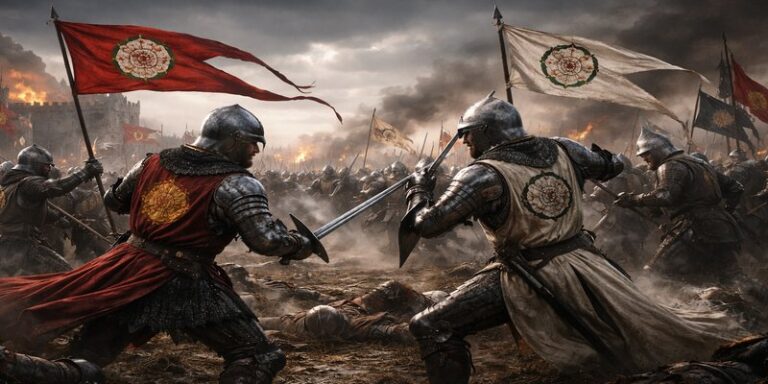
The Wars of the Roses were a series of intermittent civil wars fought in England between 1455 and 1487, primarily between two rival branches of the royal House of Plantagenet: the House of Lancaster and the House of York. The conflict derived its romantic name from the supposed badges of the two houses — the red rose of Lancaster and the white rose of York — though contemporaries rarely used these symbols in the way later tradition suggests (Hicks, 2010).
At its heart, the struggle was about who had the strongest claim to the English throne, but the causes ran deeper than dynastic rivalry alone.
1.0 The Roots of Conflict
The wars developed during the troubled reign of Henry VI (r. 1422–1461; 1470–1471). Henry inherited the throne as an infant during the later stages of the Hundred Years’ War. Unlike his father, Henry V, he lacked political authority and military skill. His reign witnessed the loss of English territories in France and increasing dissatisfaction among powerful nobles (Carpenter, 1997).
Compounding these difficulties, Henry VI suffered bouts of severe mental illness, rendering him incapable of ruling effectively. During one such period of incapacity in 1453, Richard, Duke of York, was appointed Protector of the Realm. York possessed a strong genealogical claim to the throne, descending from Edward III through two lines. Tensions between York and the Lancastrian court faction, led by Queen Margaret of Anjou, escalated rapidly.
In 1455, armed conflict erupted at the First Battle of St Albans, often considered the beginning of the wars. Although relatively small in scale, it set a precedent: political disputes would now be resolved through military force.
2.0 Dynastic Rivalry: Lancaster versus York
The central issue was legitimacy. The House of Lancaster descended from John of Gaunt, son of Edward III, through a line that some considered legally weaker. The House of York, meanwhile, traced descent from both Lionel of Antwerp and Edmund of Langley, arguably strengthening its hereditary claim (Ross, 1981).
However, medieval kingship was not based solely on bloodline. It required military strength, noble support, and effective governance. When Henry VI proved unable to assert authority, rival claimants gained credibility.
In 1460, Richard of York was killed at the Battle of Wakefield, but his son succeeded where he had failed. In 1461, Edward IV, aged just eighteen, decisively defeated Lancastrian forces at the Battle of Towton — one of the bloodiest battles fought on English soil. Edward IV was crowned king, marking a major Yorkist triumph.
3.0 Edward IV and the Fragile Peace
Edward IV’s reign (1461–1470; 1471–1483) initially stabilised England. He secured loyalty through patronage and military success. Yet internal divisions persisted. His controversial marriage to Elizabeth Woodville alienated powerful nobles, including the Earl of Warwick — once his strongest supporter.
Warwick’s rebellion briefly restored Henry VI to the throne in 1470, in what became known as the Readeption. However, Edward IV returned from exile, defeated Warwick at the Battle of Barnet (1471), and crushed Lancastrian resistance at Tewkesbury. Henry VI died soon after, likely murdered.
For over a decade, England enjoyed relative calm. Yet the underlying instability of succession remained unresolved.
4.0 Richard III and the Princes in the Tower
After Edward IV’s sudden death in 1483, his twelve-year-old son became Edward V. However, Edward’s uncle, Richard, Duke of Gloucester, declared the young king illegitimate and assumed the throne as Richard III.
Shortly afterwards, Edward V and his brother disappeared while held in the Tower of London. The fate of the Princes in the Tower remains one of English history’s enduring mysteries. Many contemporaries suspected Richard III of ordering their deaths, though definitive proof is lacking (Hicks, 2010).
Richard’s reign proved short and controversial. His support base was limited, and opposition rallied around a distant Lancastrian claimant: Henry Tudor.
5.0 The Rise of Henry Tudor
Henry Tudor’s claim to the throne derived from his mother, Margaret Beaufort, who descended from the Lancastrian line. Though relatively weak by bloodline standards, Henry represented the final viable Lancastrian alternative.
In 1485, Henry invaded England from France. At the Battle of Bosworth Field, Richard III was killed — the last English king to die in battle. Henry was crowned Henry VII, marking the beginning of the Tudor dynasty.
However, conflict did not end immediately. Yorkist supporters backed pretenders such as Lambert Simnel and Perkin Warbeck. Only after defeating a Yorkist-backed rebellion at the Battle of Stoke Field (1487) did Henry VII firmly secure his rule. Many historians regard Stoke as the final battle of the Wars of the Roses (Pollard, 2000).
6.0 Causes Beyond the Throne
While succession disputes were central, historians emphasise broader structural causes. Carpenter (1997) highlights the weakening of royal authority after the costly Hundred Years’ War. Economic disruption, regional rivalries, and over-mighty magnates created a volatile political environment.
Moreover, late medieval governance depended heavily on personal loyalty networks. When trust in the monarch eroded, nobles pursued private interests, sometimes through violence. The wars therefore reflected deeper tensions within the political culture of fifteenth-century England.
7.0 Consequences and Legacy
The immediate consequence of the Wars of the Roses was the establishment of the Tudor monarchy. Henry VII sought to prevent renewed civil war by strengthening central authority, limiting noble retainers, and promoting dynastic unity through marriage — notably his marriage to Elizabeth of York, symbolically uniting the rival houses.
Longer-term effects included a shift towards stronger, more centralised kingship. According to Hicks (2010), the experience of civil war shaped Tudor suspicion of powerful nobles and influenced the development of early modern governance.
The romantic image of roses and chivalric rivalry owes much to later Tudor and Victorian interpretation. In reality, the wars were brutal, politically complex, and marked by shifting loyalties rather than simple ideological division (Britannica, 2023).
The Wars of the Roses were not merely a colourful dynastic quarrel but a profound crisis of English kingship. Rooted in contested legitimacy, weak governance, and aristocratic rivalry, the conflict reshaped England’s political landscape.
From the instability of Henry VI to the decisive victory of Henry Tudor at Bosworth, the wars demonstrated that medieval monarchy depended as much on strength and support as on bloodline. The eventual triumph of the Tudors marked not only the end of civil war but the beginning of a new chapter in English history — one defined by stronger royal authority and evolving state structures.
References
Britannica (2023) Wars of the Roses. Available at: https://www.britannica.com/event/Wars-of-the-Roses.
Carpenter, C. (1997) The Wars of the Roses: Politics and the Constitution in England, c.1437–1509. Cambridge: Cambridge University Press.
Hicks, M. (2010) The Wars of the Roses. New Haven: Yale University Press.
Pollard, A.J. (2000) The Wars of the Roses. Basingstoke: Macmillan.
Ross, C. (1981) Edward IV. London: Eyre Methuen.