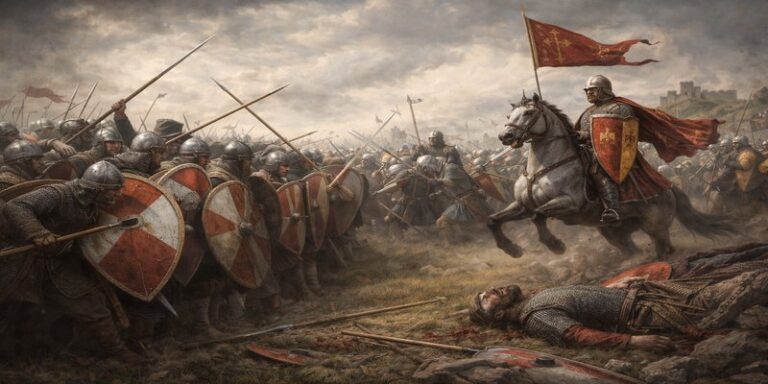
The Norman War of 1066, more commonly known as the Norman Conquest, stands as one of the most decisive military and political events in British history. Culminating in the Battle of Hastings on 14 October 1066, the conflict led to the overthrow of the Anglo-Saxon king Harold Godwinson and the establishment of William, Duke of Normandy, as King of England. More than a single battle, the Norman War represented a transformative invasion whose consequences reshaped England’s political structures, social hierarchy, language, architecture, and culture for centuries.
1.0 Background to the Conflict
The roots of the Norman War lay in a succession crisis following the death of Edward the Confessor in January 1066. Edward died without a direct heir, leaving multiple claimants to the English throne. The most powerful of these was Harold Godwinson, Earl of Wessex, who was crowned king shortly after Edward’s death. However, William of Normandy claimed that Edward had promised him the throne years earlier and that Harold had sworn an oath to support this claim (Huscroft, 2013).
Compounding the instability, Harald Hardrada of Norway also claimed the English crown, leading to a three-way struggle for power. The resulting conflict was therefore not inevitable but emerged from overlapping dynastic claims, political ambition, and military opportunity.
2.0 The Norman Invasion
William carefully prepared for invasion, securing papal support, which framed the campaign as a legitimate and divinely sanctioned war. This endorsement proved crucial, both politically and morally, in rallying Norman nobles and knights (Rex, 2011). In September 1066, William crossed the Channel with a well-organised force composed of infantry, cavalry, and archers, landing at Pevensey on the Sussex coast.
Meanwhile, Harold Godwinson had just defeated the Norwegian invasion at the Battle of Stamford Bridge, over 250 miles to the north. His army, though victorious, was exhausted when forced to march south rapidly to confront the Norman threat (Bradbury, 2021).
3.0 The Battle of Hastings
The decisive engagement took place near Hastings on 14 October 1066. Harold’s army adopted a strong defensive position on Senlac Hill, forming a shield wall of heavily armed infantry. In contrast, William’s forces relied on combined-arms tactics, integrating missile fire, infantry assaults, and cavalry charges.
Early in the battle, Norman attacks were repelled, but William demonstrated remarkable tactical adaptability. Feigned retreats drew sections of the English army out of formation, weakening the shield wall. Later in the day, Harold was killed—traditionally said to be struck in the eye by an arrow—causing the English resistance to collapse (Grehan and Mace, 2013).
The Battle of Hastings was not merely a clash of armies but a turning point in military history, highlighting the growing effectiveness of cavalry and flexible battlefield tactics.
4.0 Consolidation of Norman Power
Victory at Hastings did not immediately secure England for William. Resistance continued in various regions, requiring systematic military campaigns over several years. William employed a combination of force, strategic castle-building, and administrative control to suppress opposition (Golding, 1994).
One of the most notorious episodes was the Harrying of the North (1069–1070), during which Norman forces devastated large areas of northern England to quell rebellion. Contemporary sources describe widespread destruction, famine, and population loss, illustrating the brutal realities of medieval warfare (van Houts, 1999).
5.0 Political and Social Consequences
The Norman War fundamentally altered England’s ruling elite. By 1086, almost all Anglo-Saxon nobles had been replaced by Norman lords. Land was redistributed under a feudal system, binding landholding to military service and loyalty to the crown (Daniell, 2013).
The compilation of the Domesday Book in 1086 exemplifies Norman administrative efficiency. This detailed survey of land and resources enabled effective taxation and governance, reinforcing royal authority and laying foundations for the English state (Rex, 2011).
6.0 Cultural and Linguistic Impact
Culturally, the Norman Conquest introduced profound changes. Norman French became the language of the court, law, and administration, while Old English remained the language of the common people. Over time, this linguistic fusion produced Middle English, dramatically reshaping vocabulary and literary expression (Cartlidge, 2014).
Architecturally, the Normans left an enduring legacy through stone castles, cathedrals, and monasteries. Structures such as the Tower of London symbolised both military dominance and royal authority, transforming the English landscape (Huscroft, 2013).
7.0 Historical Significance
Historians widely regard the Norman War as the last successful foreign conquest of England. Its impact extended far beyond 1066, influencing England’s relationship with continental Europe and shaping the development of monarchy and law. While earlier invasions had altered rulers, the Norman Conquest brought about a comprehensive transformation of society (Edwards, 2002).
Modern scholarship increasingly emphasises the Conquest as a process rather than an event, highlighting regional variation and long-term adaptation rather than sudden rupture (Hansen, 2025).
The Norman War of 1066 was a defining episode in English history. Through military innovation, political strategy, and administrative reform, the Normans reshaped England in ways that remain visible today. From the language we speak to the castles that dominate the skyline, the legacy of the Norman Conquest continues to influence British identity, underscoring its enduring historical importance.
References
Bradbury, J. (2021) The Battle of Hastings: The Fall of the Anglo-Saxons and the Rise of the Normans. London: Yale University Press.
Cartlidge, N. (2014) ‘The Norman Conquest and English literary culture after 1066’, in A Companion to British Literature. Oxford: Wiley, pp. 112–128.
Daniell, C. (2013) From Norman Conquest to Magna Carta: England 1066–1215. London: Routledge.
Edwards, J.C. (2002) ‘Conquest and colonisation: The Normans in Britain, 1066–1100’, Journal of Colonialism and Colonial History, 3(2).
Golding, B. (1994) Conquest and Colonisation: The Normans in Britain, 1066–1100. London: Palgrave Macmillan.
Grehan, J. and Mace, M. (2013) The Battle of Hastings 1066. Barnsley: Pen & Sword.
Hansen, D.K.D. (2025) Conquest 1066: A History of the Norman Invasion of England. Cambridge: Cambridge University Press.
Huscroft, R. (2013) The Norman Conquest: A New Introduction. London: Routledge.
Rex, P. (2011) 1066: A New History of the Norman Conquest. Stroud: Amberley.
van Houts, E. (1999) ‘The memory of the Norman Conquest of England’, in Memory and Gender in Medieval Europe. London: Palgrave, pp. 57–76.