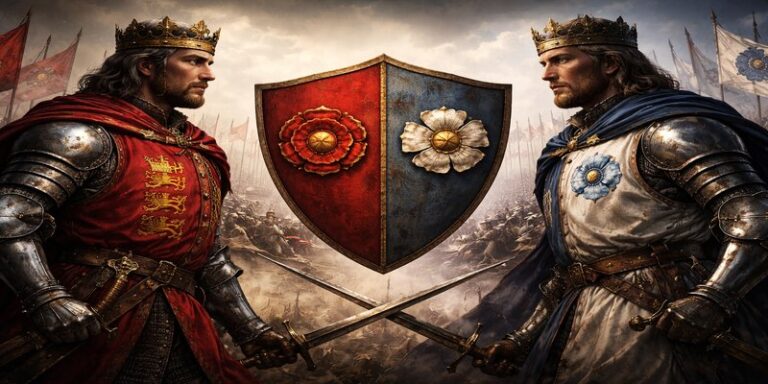
The House of Lancaster and the House of York were rival branches of the royal Plantagenet dynasty, whose struggle for the English throne erupted into the Wars of the Roses (1455–1487). Though often portrayed as a simple clash symbolised by the red and white roses, the conflict was rooted in dynastic legitimacy, aristocratic rivalry, political instability, and weak kingship. The eventual victory of Henry Tudor at the Battle of Bosworth in 1485 ended their rivalry and ushered in the Tudor era. Yet the legacy of Lancaster and York shaped the constitutional and political development of late medieval England (Hicks, 2010; Carpenter, 1997).
1.0 Origins within the Plantagenet Dynasty
Both houses descended from King Edward III (r. 1327–1377). The dispute arose from competing interpretations of hereditary right.
- The House of Lancaster descended from John of Gaunt, Edward III’s third surviving son.
- The House of York descended from Lionel of Antwerp, Edward III’s second surviving son, as well as from Edmund of Langley, another son.
In strict hereditary terms, the Yorkist claim could be seen as stronger because it descended from an elder son. However, political legitimacy in medieval England also depended on military success, parliamentary recognition, and noble support (Ross, 1981).
The Lancastrian line seized the throne in 1399 when Henry Bolingbroke deposed his cousin Richard II and became Henry IV. This act established the Lancastrian dynasty but created a precedent for deposition that would haunt future successions (Given-Wilson, 2016).
2.0 The House of Lancaster
The House of Lancaster was named after the Duchy of Lancaster, centred on the city of Lancaster in north-west England. The Lancastrian line began with: John of Gaunt, Duke of Lancaster (son of King Edward III). John of Gaunt inherited the duchy through his wife, Blanche of Lancaster. Because he was known as the Duke of Lancaster, his descendants became known as the Lancastrians. When his son became King Henry IV in 1399, the Lancastrian branch took the English throne. So: Lancaster meant the land/title held by John of Gaunt and his heirs.
The Lancastrian kings were:
- Henry IV (r. 1399–1413)
- Henry V (r. 1413–1422)
- Henry VI (r. 1422–1461; 1470–1471)
2.1 Henry IV: A Contested Beginning
Henry IV’s reign was marked by rebellions and questions over legitimacy. Having taken the throne by force, he struggled to secure broad acceptance. Nonetheless, his reign stabilised the kingdom sufficiently to allow his son to consolidate power.
2.2 Henry V: Military Glory
Henry V restored royal prestige through his victories in France, most famously at the Battle of Agincourt (1415). His successes strengthened the Lancastrian claim and enhanced England’s international standing (Allmand, 1992). For a brief period, England appeared poised to dominate France.
2.3 Henry VI: Weak Kingship and Crisis
The Lancastrian position collapsed under Henry VI, whose long minority and later mental illness undermined royal authority. The loss of English territories in France and factional disputes among nobles destabilised the realm (Carpenter, 1997).
Henry’s inability to rule effectively allowed Richard, Duke of York, to emerge as a rival claimant. Armed confrontation began in 1455 at the First Battle of St Albans, marking the start of open conflict.
3.0 The House of York
The House of York was named after the Duchy of York, centred on the city of York in northern England. This branch descended from: Edmund of Langley, Duke of York
(another son of Edward III). His descendants became known as the Yorkists. Later, Richard, Duke of York, claimed the throne against the Lancastrian king Henry VI. So: York meant the land/title held by Edmund of Langley and his heirs.
3.1 Richard, Duke of York
Richard initially sought recognition as heir rather than immediate kingship. However, escalating violence led to his death at the Battle of Wakefield (1460).
3.2 Edward IV: Yorkist Ascendancy
Richard’s son, Edward IV (r. 1461–1470; 1471–1483), decisively defeated Lancastrian forces at the Battle of Towton (1461) — one of the bloodiest battles in English history. Crowned king, Edward restored relative stability through strong leadership and strategic alliances (Ross, 1981).
Yet Yorkist unity proved fragile. Internal rivalries, including tensions with the powerful Earl of Warwick, led to temporary Lancastrian restoration in 1470. Edward regained the throne in 1471 after victories at Barnet and Tewkesbury.
3.3 Richard III: Controversy and Collapse
After Edward IV’s death, his brother seized the throne as Richard III (r. 1483–1485). The disappearance of the young Princes in the Tower cast doubt on his legitimacy. Although Richard attempted administrative reforms, his support remained limited (Hicks, 2010).
In 1485, he faced a Lancastrian challenger: Henry Tudor.
4.0 Symbolism: The Red and White Roses
The red rose of Lancaster and white rose of York became enduring symbols of the conflict. However, historians caution that these emblems were not consistently used during the early phases of the wars. Their widespread symbolic meaning developed later, particularly under Tudor historiography (Hicks, 2010).
Henry Tudor adopted the combined Tudor Rose, merging red and white, to symbolise reconciliation and dynastic unity.
5.0 Political and Social Causes of Conflict
Although the rivalry appears dynastic, historians emphasise deeper structural causes:
- Weak central authority, especially under Henry VI
- Over-mighty magnates commanding private armies
- Economic strain from the Hundred Years’ War
- Regional power struggles
Carpenter (1997) argues that late medieval governance relied heavily on personal loyalty networks. When trust in the monarch weakened, aristocratic competition escalated into armed conflict.
The wars were intermittent rather than continuous, marked by shifting alliances. Loyalty often depended more on political advantage than strict dynastic ideology.
6.0 The End of the Rivalry
The conflict concluded with the Battle of Bosworth Field (1485). Richard III was killed in battle, and Henry Tudor was crowned Henry VII. His marriage to Elizabeth of York symbolically united the rival houses.
However, Yorkist resistance did not vanish immediately. Rebellions such as those led by Lambert Simnel (1487) and Perkin Warbeck threatened Tudor stability. Only after defeating these challenges did Henry VII secure lasting peace (Pollard, 2000).
The victory of the Tudors marked the end of Plantagenet rule and the beginning of a more centralised monarchy.
7.0 Legacy of Lancaster and York
The rivalry between Lancaster and York reshaped English political culture. It demonstrated that hereditary right alone was insufficient without political and military support. The trauma of civil war influenced Tudor suspicion of powerful nobles and encouraged policies aimed at strengthening central authority.
Moreover, the conflict contributed to evolving ideas about kingship and governance. The use of Parliament in confirming royal titles and settling succession disputes reflected a gradual shift toward constitutional forms of legitimacy.
Today, the Houses of Lancaster and York remain central to England’s historical memory. Their struggle illustrates the fragile balance between dynastic ambition and political stability in medieval Europe.
The House of Lancaster and the House of York were not merely rival families but competing visions of royal legitimacy within the broader Plantagenet dynasty. Their struggle, fuelled by weak kingship and noble ambition, culminated in the Wars of the Roses — a defining crisis in English history.
The eventual Tudor settlement brought an end to decades of instability, but the lessons of Lancaster and York endured. Their rivalry shaped the development of stronger monarchy, parliamentary involvement in succession, and a lasting awareness of the dangers of factional politics.
References
Allmand, C. (1992) Henry V. London: Methuen.
Carpenter, C. (1997) The Wars of the Roses: Politics and the Constitution in England, c.1437–1509. Cambridge: Cambridge University Press.
Given-Wilson, C. (2016) Henry IV. New Haven: Yale University Press.
Hicks, M. (2010) The Wars of the Roses. New Haven: Yale University Press.
Pollard, A.J. (2000) The Wars of the Roses. Basingstoke: Macmillan.
Ross, C. (1981) Edward IV. London: Eyre Methuen.