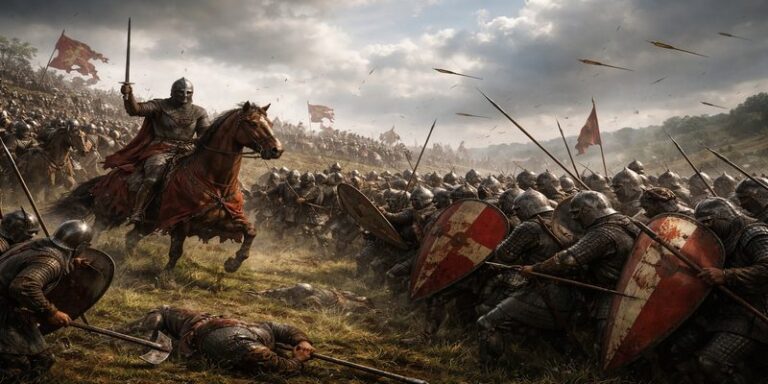
Modern historians broadly agree that the Battle of Hastings (14 October 1066) marked a decisive rupture in English political, social, and cultural development. Synthesising leading scholarship, several themes emerge: the battle was not an isolated clash but the culmination of a complex succession crisis; it reshaped England’s aristocracy and landholding system; it accelerated the integration of England into continental European politics; and it transformed the English language and governance. While earlier nationalist narratives portrayed the event as a simple conquest, contemporary research emphasises cross-Channel connections, administrative continuity alongside disruption, and the sophisticated military organisation of both Anglo-Saxon and Norman forces.
1.0 A Kingdom in Crisis
In January 1066, Edward the Confessor died without an heir. According to the Anglo-Saxon Chronicle (Whitelock, 1979), the leading English nobleman, Harold Godwinson, was swiftly crowned king. Yet across the Channel, William, Duke of Normandy, claimed Edward had promised him the throne. A third claimant, Harald Hardrada of Norway, also asserted rights based on earlier Scandinavian agreements (Douglas, 1964).
The crisis escalated rapidly. Harold defeated Hardrada at the Battle of Stamford Bridge in September 1066, only to march south immediately when William landed at Pevensey. This exhausting forced march—nearly 300 kilometres in days—would prove critical. As historian David Bates (2016) notes, Harold’s army was battle-hardened but depleted and physically strained.
2.0 The Day of Battle
The opposing forces met near Hastings at Senlac Hill. Harold’s army formed a dense shield wall, a traditional Anglo-Saxon defensive formation. William’s troops were more varied, comprising infantry, archers, and cavalry, reflecting continental military evolution (Bennett et al., 2005).
Initial Norman assaults faltered. According to the Bayeux Tapestry—an extraordinary embroidered narrative created shortly after the conquest—rumours even spread that William had been killed. The tapestry famously depicts him lifting his helmet to reveal his face, rallying his men (Wilson, 2004).
A pivotal moment came with the Normans’ use of feigned retreats, luring segments of Harold’s forces downhill and breaking the cohesion of the shield wall. By late afternoon, Harold was dead—traditionally said to have been struck in the eye by an arrow, though historians debate this detail (Lawson, 2012). With his death, English resistance collapsed.
3.0 Why the Normans Won
Historians highlight several factors behind William’s victory:
- Combined arms tactics: The integration of cavalry, archers, and infantry offered flexibility absent in Harold’s largely infantry-based force (Bennett et al., 2005).
- Leadership resilience: William’s visible command presence stabilised morale.
- Strategic patience: William waited for favourable winds before crossing the Channel, ensuring logistical preparedness (Bates, 2016).
- Harold’s exhaustion: His army’s rapid redeployment from Stamford Bridge likely reduced effectiveness.
However, it would be simplistic to attribute victory purely to Norman superiority. As Thomas (2008) argues, Harold’s forces fought tenaciously for most of the day; the outcome was finely balanced.
4.0 Transformation of England
The consequences were profound and enduring.
4.1 Elite Replacement and Feudal Landholding
William systematically replaced the Anglo-Saxon aristocracy with Norman loyalists. The Domesday Book (1086) demonstrates the scale of redistribution: by 1086, nearly all major landholders were Norman (Clanchy, 2013). This introduced a more formalised feudal structure, binding landholding to military service.
4.2 Architectural Revolution
Norman rule brought a wave of Romanesque castle and cathedral building, including the Tower of London and Durham Cathedral. These structures symbolised dominance and administrative control (English Heritage, 2023).
4.3 Language and Culture
Perhaps the most enduring shift occurred in language. Norman French became the language of the ruling elite and administration. Over centuries, this blended with Old English, producing Middle English, enriching vocabulary with legal, culinary, and governmental terms (Crystal, 2004). Words such as court, judge, and beef trace to this period.
4.4 Continental Orientation
England became deeply embedded in continental politics. William remained Duke of Normandy, creating a cross-Channel polity that would influence English foreign policy for centuries, ultimately contributing to conflicts such as the Hundred Years’ War (Carpenter, 1997).
The Bayeux Tapestry: History in Thread
The Bayeux Tapestry remains one of the most remarkable sources for the conquest. Stretching nearly 70 metres, it depicts events leading up to and including Hastings. Scholars caution that it reflects a Norman perspective, yet it provides invaluable insight into eleventh-century warfare, clothing, and ships (Wilson, 2004). It is less propaganda than once believed; its nuanced portrayal suggests complexity rather than crude triumphalism.
Myths and Realities
Popular imagination often frames 1066 as a clean break between “Anglo-Saxon” and “Norman” England. Yet historians emphasise continuity alongside change. Administrative systems such as shires and royal writs persisted (Clanchy, 2013). Moreover, intermarriage and cultural blending softened divisions over time.
Similarly, the image of Harold’s death by arrow may stem from later interpretation. The tapestry’s damaged section leaves ambiguity (Lawson, 2012). Such debates remind us that history is not static but continually reassessed.
Why 1066 Still Matters
Schoolchildren across Britain memorise “1066” as a foundational date. But beyond mnemonic convenience, Hastings represents a rare moment when the trajectory of a nation pivoted dramatically in a single day. It reshaped governance, language, architecture, and identity.
In today’s context of global migration and cultural blending, the Norman Conquest serves as a reminder that national identities are not fixed but forged through encounter, conflict, and adaptation. Modern England—linguistically, legally, and architecturally—bears the imprint of that autumn day in 1066.
References
Bates, D. (2016) William the Conqueror. New Haven: Yale University Press.
Bennett, M., Bradbury, J., DeVries, K., Dickie, I. and Jestice, P. (2005) Fighting Techniques of the Medieval World AD 500–AD 1500. London: Amber Books.
British Broadcasting Corporation (BBC) (2023) The Battle of Hastings. Available at: https://www.bbc.co.uk/history/historic_figures/william_the_conqueror.shtml.
Carpenter, D. (1997) The Struggle for Mastery: Britain 1066–1284. London: Penguin.
Clanchy, M.T. (2013) England and its Rulers 1066–1272. 4th edn. Oxford: Wiley-Blackwell.
Crystal, D. (2004) The Stories of English. London: Penguin.
Douglas, D.C. (1964) William the Conqueror: The Norman Impact upon England. London: Eyre & Spottiswoode.
English Heritage (2023) Norman Castles. Available at: https://www.english-heritage.org.uk/learn/story-of-england/normans/.
Lawson, M.K. (2012) The Battle of Hastings 1066. Stroud: Tempus.
Thomas, H.M. (2008) The Norman Conquest: England after William the Conqueror. Lanham: Rowman & Littlefield.
Whitelock, D. (trans.) (1979) The Anglo-Saxon Chronicle. London: Eyre & Spottiswoode.
Wilson, D.M. (2004) The Bayeux Tapestry. London: Thames & Hudson.