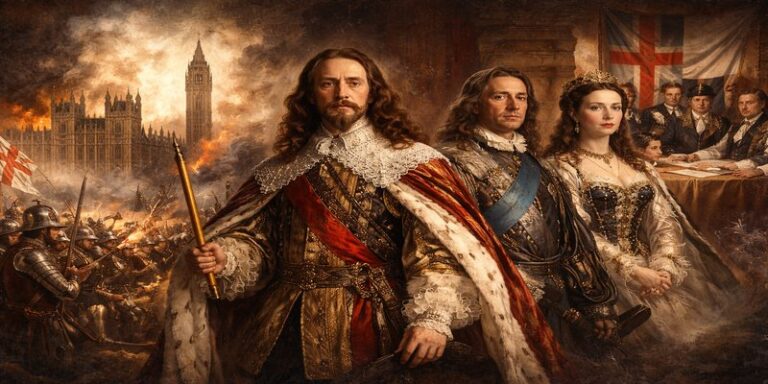
The period between 1603 and 1714 was one of the most transformative in British political history. Known as the era of Stuart rule, it witnessed the union of the English and Scottish crowns, civil war, regicide, republican experiment, revolution and constitutional settlement. By the end of this turbulent century, the foundations of Britain’s modern constitutional monarchy had been firmly established. As Bogdanor (1995) argues, the settlement achieved after 1688 reshaped the balance of power between monarch and Parliament in ways that continue to define British governance today.
1.0 The Union of the Crowns (1603)
The Stuart period began in 1603 with the accession of James VI of Scotland, who became James I of England upon the death of Elizabeth I. The full name of James VI of Scotland was James Charles Stuart. However, in historical usage he is almost always referred to simply as: James VI of Scotland (and later James I of England). James was the son of Mary, Queen of Scots, and the great-grandson of Margaret Tudor, daughter of Henry VII. His accession united the crowns of England and Scotland under one monarch in what became known as the Union of the Crowns (Morrill, 2005).
Although England and Scotland remained separate kingdoms with distinct parliaments and legal systems, James styled himself “King of Great Britain” and promoted the idea of closer union. His vision, however, encountered resistance. English elites were wary of Scottish influence at court, and both kingdoms guarded their institutional independence.
James also believed strongly in the doctrine of divine right monarchy, the idea that kings derived their authority directly from God and were accountable only to Him. In his treatise The True Law of Free Monarchies (1598), he defended royal supremacy. This belief soon brought him into conflict with Parliament.
2.0 Rising Tensions: Charles I and Parliamentary Conflict
James’s son, Charles I (r. 1625–1649), inherited not only the throne but also the growing tensions between Crown and Parliament. Financial disputes lay at the heart of the conflict. Parliament controlled taxation, and Charles’s attempts to raise revenue without parliamentary consent — such as the controversial Ship Money levy — provoked outrage (Russell, 1990).
Religious disagreements further intensified mistrust. Charles’s perceived sympathy for Catholicism and his imposition of religious reforms in Scotland sparked rebellion, leading to the Bishops’ Wars (1639–1640). In 1640, he was forced to recall Parliament to secure funds, initiating what became known as the Long Parliament.
When negotiations broke down, England descended into the English Civil War (1642–1651).
3.0 The English Civil War and Regicide
The Civil War pitted Royalists (supporters of the King) against Parliamentarians (supporters of parliamentary authority). Key battles such as Edgehill (1642) and Naseby (1645) demonstrated the scale and brutality of the conflict.
Under the leadership of Oliver Cromwell and the New Model Army, Parliament eventually prevailed. In a radical and unprecedented act, Charles I was tried for treason against his own people. He was executed in January 1649 — the only English monarch to suffer such a fate.
This event fundamentally challenged the traditional understanding of monarchy. As Kishlansky (1996) notes, the execution symbolised the assertion that the monarch was not above the law.
4.0 The Commonwealth and Protectorate (1649–1660)
Following the king’s execution, England was declared a Commonwealth, abolishing the monarchy and the House of Lords. For the first time, England became a republic.
However, political instability persisted. In 1653, Cromwell assumed the title of Lord Protector, effectively ruling as a military-backed head of state. Though not a king in name, Cromwell exercised substantial authority. His regime combined republican rhetoric with authoritarian control (Morrill, 2005).
After Cromwell’s death in 1658, his son Richard proved unable to maintain power. In 1660, amid political uncertainty, the monarchy was restored under Charles II, son of the executed king.
5.0 The Restoration and Renewed Conflict
The Restoration (1660) reinstated monarchy, but it did not resolve underlying constitutional tensions. Charles II ruled more cautiously than his father, yet disputes persisted over religion and succession.
His brother and successor, James II (r. 1685–1688), openly professed Catholicism in a predominantly Protestant nation. His attempts to suspend laws and promote religious toleration for Catholics alarmed political elites.
Fearing absolutism, leading politicians invited William of Orange, James’s Protestant son-in-law, to intervene.
6.0 The Glorious Revolution (1688)
The Glorious Revolution of 1688 marked a decisive turning point. James II fled to France, and William and his wife Mary were offered the throne jointly as William III and Mary II.
This transition was significant not merely because it replaced one monarch with another, but because it redefined the terms of monarchy itself. In 1689, Parliament enacted the Bill of Rights, which:
- Prohibited the monarch from suspending laws without parliamentary consent
- Forbade taxation without parliamentary approval
- Guaranteed regular parliaments
- Affirmed certain civil liberties
The Bill of Rights firmly established the principle of parliamentary supremacy. As Bogdanor (1995) observes, this constitutional settlement laid the foundations of Britain’s modern system, in which sovereignty resides in Parliament rather than the Crown.
7.0 The Act of Union (1707)
The final major constitutional development of the Stuart era was the Act of Union (1707). Though James I had united the crowns in 1603, England and Scotland remained separate states. Economic pressures and political considerations — including concerns about succession — led to formal union.
The Act united the two kingdoms into the Kingdom of Great Britain, with a single Parliament at Westminster (Colley, 1992). Scotland retained its own legal and educational systems but surrendered its independent parliament.
The union strengthened political integration and laid the groundwork for Britain’s emergence as a major European power in the eighteenth century.
8.0 Legacy of Stuart Rule
By the time the Stuart dynasty ended in 1714 with the accession of George I of Hanover, Britain had undergone profound transformation. The century had witnessed:
- The assertion and testing of divine right monarchy
- Civil war and regicide
- Republican government
- Restoration of monarchy
- Constitutional revolution
- Parliamentary supremacy
- Political union between England and Scotland
The monarchy survived — but in altered form. It was no longer an institution of unchecked royal authority but a constitutional monarchy constrained by law and Parliament.
This balance between tradition and parliamentary governance remains central to Britain’s political system today.
The Stuart era was defined by conflict, experimentation and constitutional change. From the accession of James I in 1603 to the Act of Union in 1707 and the Hanoverian succession in 1714, Britain navigated civil war, revolution and political restructuring.
Out of crisis emerged a new constitutional order — one in which the monarchy endured, but within limits defined by Parliament. As Bogdanor (1995) rightly suggests, the settlement achieved in this period remains foundational to Britain’s political identity.
The story of Stuart rule is therefore not simply one of turmoil, but of transformation — the forging of modern British constitutional governance.
References
Bogdanor, V. (1995) The Monarchy and the Constitution. Oxford: Clarendon Press.
Colley, L. (1992) Britons: Forging the Nation 1707–1837. New Haven: Yale University Press.
Kishlansky, M. (1996) A Monarchy Transformed: Britain 1603–1714. London: Penguin.
Morrill, J. (2005) Stuart Britain: A Very Short Introduction. Oxford: Oxford University Press.
Russell, C. (1990) The Causes of the English Civil War. Oxford: Clarendon Press.