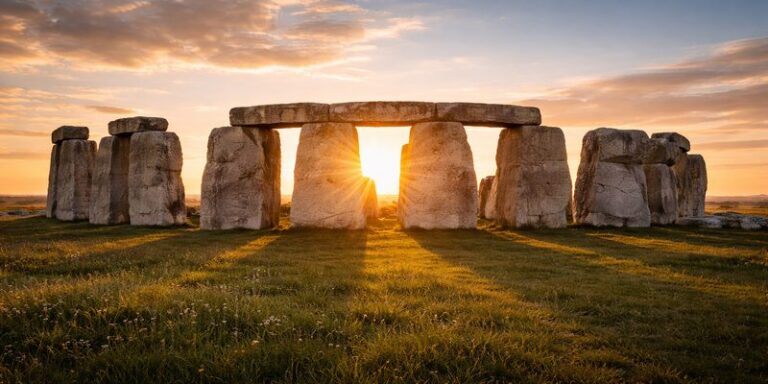
Stonehenge is one of the most iconic prehistoric monuments in the world and a central symbol of Britain’s ancient past. Located on Salisbury Plain in Wiltshire, England, Stonehenge was constructed in multiple phases between approximately 3000 BCE and 1500 BCE, during the Neolithic and Early Bronze Age. Its massive standing stones, circular earthworks and astronomical alignments have long fascinated historians, archaeologists and the public alike. Modern scholarship views Stonehenge not as an isolated structure but as part of a wider ceremonial landscape, reflecting complex patterns of ritual practice, social organisation and technological innovation (Darvill, 2006; Parker Pearson, 2012). This article explores the origins, construction, interpretation and legacy of Stonehenge within its broader prehistoric context.
1.0 Chronology and Construction Phases
Stonehenge was not built in a single moment but developed over several centuries. Archaeological evidence suggests three principal construction phases.
The earliest phase (c. 3000 BCE) involved the creation of a circular earthwork enclosure, consisting of a ditch and bank. Within this enclosure were the so-called Aubrey Holes, which may have held timber posts or stones. Radiocarbon dating indicates that early activity at the site included cremation burials, suggesting that Stonehenge initially functioned as a ceremonial or funerary site (Darvill, 2006).
The second phase (c. 2500 BCE) saw the erection of the famous sarsen stones, some weighing up to 25 tonnes. These stones were transported from the Marlborough Downs, approximately 20 miles away. Smaller stones known as bluestones were brought from the Preseli Hills in Wales, over 150 miles distant. The logistics of moving such stones demonstrate advanced planning and communal cooperation (English Heritage, 2023).
The final phases involved rearrangements of stones and additional construction, refining the monument’s iconic circular layout.
2.0 Engineering and Technological Achievement
The construction of Stonehenge required considerable technical expertise. The sarsens were shaped using stone tools and erected using mortise-and-tenon joints, a technique more commonly associated with woodworking. This indicates a high level of craftsmanship and structural understanding.
According to Parker Pearson (2012), the transportation of bluestones from Wales suggests that Stonehenge was embedded in extensive regional networks of exchange and communication. The scale of labour mobilisation implies a society capable of organising large communal projects, challenging earlier assumptions that Neolithic communities were small and isolated.
Recent archaeological investigations have revealed evidence of feasting and seasonal gatherings at nearby sites such as Durrington Walls, indicating that Stonehenge was part of a broader ritual landscape.
3.0 Astronomical Alignments and Ritual Meaning
One of the most discussed aspects of Stonehenge is its apparent astronomical alignment. The monument aligns with the sunrise at the summer solstice and the sunset at the winter solstice. These alignments suggest that Stonehenge may have functioned as a ceremonial calendar or ritual observatory.
Darvill (2006) argues that solstitial alignments reinforced agricultural cycles and seasonal rituals. However, scholars caution against reducing Stonehenge solely to an astronomical device. Instead, it likely combined cosmological symbolism with social and ceremonial functions.
The presence of human remains indicates that Stonehenge also served as a burial site for elite individuals. Parker Pearson (2012) suggests that it may have symbolised a realm of ancestors, contrasting with timber structures at nearby sites associated with the living.
4.0 Stonehenge in its Wider Landscape
Modern archaeology emphasises that Stonehenge was part of a complex ceremonial landscape including Avenue, Woodhenge and Durrington Walls. This network of monuments indicates that Salisbury Plain was a focal point for ritual activity over centuries.
The River Avon appears to have played a symbolic role, possibly linking different ceremonial sites. According to English Heritage (2023), the broader Stonehenge landscape reflects sophisticated planning and spatial symbolism, reinforcing its importance as a communal centre.
5.0 Interpretations and Changing Perspectives
Interpretations of Stonehenge have evolved over time. In the eighteenth century, antiquarians such as William Stukeley associated the monument with the Druids. Modern scholarship, however, recognises that Stonehenge predates the Iron Age Druids by over a millennium.
In the twentieth century, some scholars emphasised its astronomical significance, while others focused on its funerary role. Contemporary interpretations adopt a more integrated approach, viewing Stonehenge as a multifunctional site combining ritual, burial and social gathering (Parker Pearson, 2012).
Debates also surround the purpose of the bluestones. One theory suggests they were believed to possess healing properties. Darvill (2006) proposes that Stonehenge may have functioned as a prehistoric pilgrimage centre.
6.0 Social Organisation and Identity
The scale of Stonehenge suggests a society capable of collective labour and hierarchical organisation. The ability to mobilise resources over long distances implies structured leadership and shared cultural values.
Colley (2009) notes that monumental architecture often reflects emerging social identities. In the case of Stonehenge, communal construction may have reinforced regional cohesion during a period of agricultural transition and demographic change.
The monument’s enduring significance indicates that it served not merely as a physical structure but as a symbol of collective identity.
7.0 Modern Significance and Heritage
Today, Stonehenge is a UNESCO World Heritage Site and one of Britain’s most visited landmarks. It continues to attract thousands of visitors during the summer and winter solstices.
Conservation efforts have sought to balance preservation with accessibility. The removal of nearby roads and the creation of a visitor centre have enhanced protection of the site (English Heritage, 2023).
Stonehenge has also become a powerful symbol of Britain’s ancient heritage, frequently invoked in cultural and national narratives.
Stonehenge stands as a testament to the ingenuity and organisational capacity of prehistoric communities in Britain. Constructed over centuries, it reflects processes of ritual innovation, technological achievement and social cooperation. Far from being a mysterious anomaly, Stonehenge was embedded in a dynamic ceremonial landscape that linked people, place and cosmology.
Modern scholarship emphasises that Stonehenge cannot be reduced to a single function. It was at once a burial ground, ritual centre and symbol of communal identity. Its enduring presence continues to shape interpretations of Britain’s prehistoric past and reminds us of the complexity of early societies.
References
Colley, L. (2009) Britons: Forging the Nation 1707–1837. New Haven: Yale University Press.
Darvill, T. (2006) Stonehenge: The Biography of a Landscape. Stroud: Tempus.
English Heritage (2023) Stonehenge History and Research. Available at: https://www.english-heritage.org.uk (Accessed: 15 February 2026).
Parker Pearson, M. (2012) Stonehenge: Exploring the Greatest Stone Age Mystery. London: Simon & Schuster.