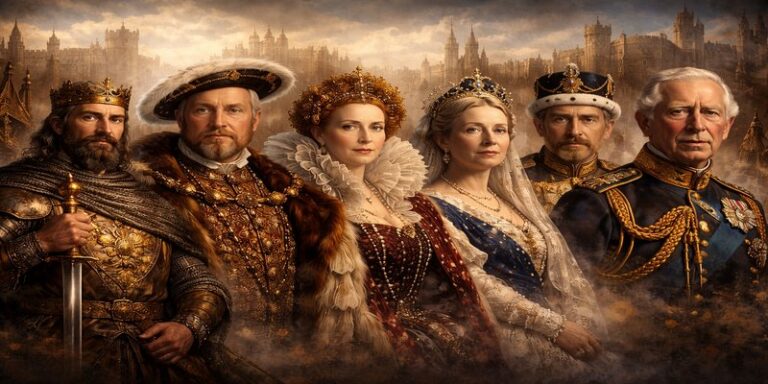
It is one of the most remarkable facts in European history: the current British monarch, King Charles III, can trace his lineage back from Hastings to Windsor more than 950 years to William the Conqueror, the Norman duke who invaded England in 1066. Despite wars, rebellions, civil conflicts, religious upheaval and changing dynasties, the bloodline of England’s monarchy has endured through an intricate web of inheritance, marriage and political settlement.
Understanding this continuity reveals not just a family tree, but the story of how monarchy in Britain evolved from medieval conquest to modern constitutional rule.
1.0 The Norman Beginning: William I (r. 1066–1087)
The story begins with William, Duke of Normandy, who defeated King Harold II at the Battle of Hastings in 1066. Crowned William I of England on Christmas Day that year, he transformed England’s ruling elite, replacing much of the Anglo-Saxon aristocracy with Norman nobles (Bates, 2016).
William established a new royal dynasty and introduced administrative reforms, including the Domesday Book (1086), which recorded land ownership across the kingdom. From that point forward, the English crown passed through his descendants.
The crucial point is this: every subsequent English (and later British) monarch descends genealogically from William I.
2.0 The Plantagenets: Medieval Expansion and Consolidation
William’s line continued through the Norman kings until 1154, when the crown passed to Henry II, founder of the Plantagenet dynasty. Henry was William’s great-grandson through his mother, Empress Matilda (Bartlett, 2000).
The Plantagenets ruled for over three centuries and included monarchs such as:
- Richard I (“the Lionheart”)
- King John (who sealed the Magna Carta in 1215)
- Edward I
- Edward III
- Richard II
Through complex lines of descent, the Plantagenet dynasty split into the rival Houses of Lancaster and York, whose conflict became the Wars of the Roses (Hicks, 2010).
Although dynastic names changed, all remained direct descendants of William the Conqueror.
3.0 The Tudors: A New Name, Old Blood
In 1485, Henry Tudor defeated Richard III at the Battle of Bosworth Field, founding the Tudor dynasty. At first glance, this appears to break the line. However, Henry VII’s claim came through his mother, Margaret Beaufort, who descended from Edward III, and therefore ultimately from William I (Carpenter, 1997).
When Henry married Elizabeth of York, he united the rival Plantagenet branches. Their descendants — including Henry VIII and Elizabeth I — carried forward the same Norman ancestry.
Thus, although surnames shifted, the bloodline remained continuous.
4.0 The Stuarts: The Scottish Connection
When Elizabeth I died childless in 1603, the English throne passed to her nearest Protestant relative, James VI of Scotland, who became James I of England. This event, known as the Union of the Crowns, linked England and Scotland under one monarch (Morrill, 2005).
James descended from Margaret Tudor, daughter of Henry VII. Through her, the Tudor — and therefore Plantagenet and Norman — bloodline continued.
The Stuart kings, including Charles I, Charles II, and James II, were thus direct descendants of William the Conqueror.
Even the constitutional upheavals of the English Civil War and the Glorious Revolution (1688) did not sever this genealogical continuity.
5.0 The Hanoverians: A German Turn with English Roots
After the death of Queen Anne in 1714, Parliament passed the Act of Settlement (1701), ensuring that only Protestant heirs could inherit the throne. The crown passed to George I, Elector of Hanover.
Although German by upbringing, George I was the great-grandson of James I through his mother, Sophia of Hanover. Once again, the line traced back through the Stuarts to the Tudors, the Plantagenets and ultimately William I (Cannadine, 2020).
The Hanoverian dynasty included:
- George III
- George IV
- William IV
- Queen Victoria
Victoria herself married Prince Albert of Saxe-Coburg and Gotha, introducing another dynastic name — but not breaking the genealogical chain.
6.0 From Saxe-Coburg to Windsor
Queen Victoria’s descendants ruled under the house name Saxe-Coburg and Gotha, reflecting Prince Albert’s German heritage. During the First World War, anti-German sentiment prompted George V to change the family name to Windsor in 1917 (Cannadine, 2020).
Despite the name change, the ancestry remained unbroken. Elizabeth II, who reigned from 1952 to 2022, was a direct descendant of Queen Victoria, and therefore of the Hanoverians, Stuarts, Tudors, Plantagenets and William the Conqueror.
Her son, King Charles III, continues that lineage today.
7.0 How Direct Is the Connection?
Genealogically, the line is not symbolic — it is factual. Scholars of royal genealogy demonstrate that:
William I
→ Henry I
→ Empress Matilda
→ Henry II
→ Edward III
→ John of Gaunt
→ Henry VII
→ Margaret Tudor
→ James I
→ Sophia of Hanover
→ George I
→ Queen Victoria
→ Elizabeth II
→ Charles III
While simplified, this illustrates the continuous hereditary thread.
Because medieval and early modern European royalty frequently intermarried, today’s monarch is descended from William the Conqueror multiple times over.
8.0 Continuity Through Change
The remarkable aspect of this lineage is not merely its age, but its survival through profound transformation. England experienced:
- The signing of Magna Carta (1215)
- The Reformation under Henry VIII
- The Civil War and execution of Charles I
- The rise of constitutional monarchy
- The expansion and contraction of empire
Yet throughout these upheavals, hereditary succession persisted.
As Bogdanor (1995) notes, the monarchy’s durability rests partly on this sense of continuity — a living link between medieval kingship and modern constitutional statehood.
9.0 Why It Matters
For many, the connection to William the Conqueror is symbolic of historical depth. It reflects nearly a millennium of adaptation, where the monarchy shifted from warrior kings leading armies to a constitutional sovereign acting on ministerial advice.
The British monarchy is therefore not merely ancient — it is continuous, blending tradition with evolution.
From the battlefield of Hastings in 1066 to the modern constitutional reign of King Charles III, the thread of descent has never been broken. Though dynasties changed names — Norman, Plantagenet, Tudor, Stuart, Hanoverian, Windsor — the genealogical connection endured.
Today’s royal family stands as the latest chapter in a lineage that began with a Norman duke crossing the Channel nearly a thousand years ago. In that sense, the story of Britain’s monarchy is not simply one of crowns and titles, but of extraordinary historical continuity.
References
Bartlett, R. (2000) England under the Norman and Angevin Kings 1075–1225. Oxford: Oxford University Press.
Bates, D. (2016) William the Conqueror. New Haven: Yale University Press.
Bogdanor, V. (1995) The Monarchy and the Constitution. Oxford: Clarendon Press.
Cannadine, D. (2020) The Decline and Fall of the British Aristocracy. New Haven: Yale University Press.
Carpenter, C. (1997) The Wars of the Roses: Politics and the Constitution in England, c.1437–1509. Cambridge: Cambridge University Press.
Hicks, M. (2010) The Wars of the Roses. New Haven: Yale University Press.
Morrill, J. (2005) Stuart Britain: A Very Short Introduction. Oxford: Oxford University Press.