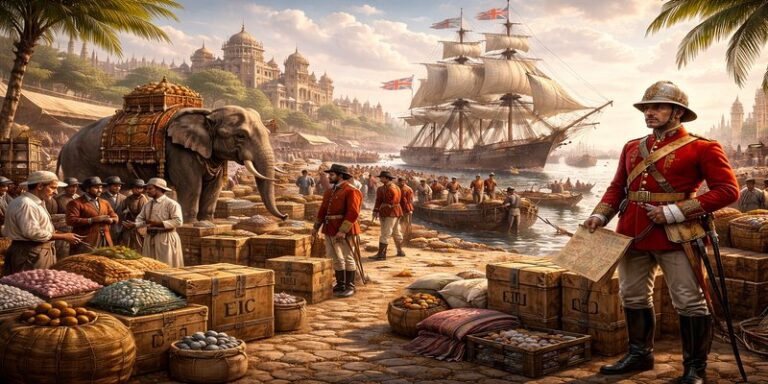
The East India Company (EIC) stands as one of the most influential and controversial organisations in global history. Founded at the turn of the seventeenth century, it began as a commercial enterprise seeking trade with Asia but evolved into a powerful political force that governed vast territories in India. Its activities reshaped British imperial expansion, transformed South Asian economies and societies, and contributed significantly to the development of global capitalism.
By the mid-nineteenth century, the Company controlled large parts of the Indian subcontinent, commanded its own army and collected revenue from millions of subjects. Yet its rule was marked by economic exploitation, administrative reform, military conquest and periodic resistance. The Company’s eventual dissolution in 1858 followed the Indian Rebellion of 1857, marking a decisive shift from corporate to Crown rule. This article explores the origins, expansion, governance and legacy of the East India Company within the broader context of British and global history.
1.0 Origins and Early Commercial Expansion
1.1 Foundation and Royal Charter
The East India Company was established in 1600 when Queen Elizabeth I granted a royal charter to the “Governor and Company of Merchants of London trading into the East Indies”. The charter provided the Company with a monopoly over English trade with Asia (Keay, 1993). At this stage, its aims were purely commercial: to access lucrative markets for spices, textiles and other valuable commodities.
1.2 Trade and Competition
During the seventeenth century, the Company competed with Dutch and Portuguese trading enterprises in the Indian Ocean. It established trading posts, or “factories”, in Surat, Madras (Chennai), Bombay (Mumbai) and Calcutta (Kolkata). Indian cotton textiles, particularly calicoes and muslins, became highly sought after in Europe (Marshall, 1987).
Trade with Asia significantly boosted Britain’s commercial wealth. The Company’s operations contributed to the rise of London as a financial centre, facilitating capital accumulation and overseas investment.
2.0 From Traders to Territorial Rulers
2.1 The Battle of Plassey (1757)
A decisive turning point came in 1757 with the Battle of Plassey, when Company forces led by Robert Clive defeated the Nawab of Bengal. This victory allowed the Company to gain control over Bengal’s revenues, marking the beginning of its territorial rule (Dalrymple, 2019).
Bengal was one of the wealthiest regions in the world at the time. Control over its revenue system provided the Company with immense financial resources, enabling further expansion across the subcontinent.
2.2 Expansion and Administration
Over the following decades, the Company extended its influence through warfare, treaties and annexation. By the early nineteenth century, it controlled most of India either directly or indirectly.
The Company established administrative systems for revenue collection, legal codes and civil service structures. The Permanent Settlement of 1793, introduced in Bengal, aimed to stabilise revenue but often disadvantaged peasants by empowering landlords (zamindars) (Marshall, 1987).
Thus, a private trading corporation transformed into a governing authority over millions of people—an unprecedented development in corporate history.
3.0 Economic Impact and Controversy
3.1 Commercial Exploitation
The Company’s rule significantly altered India’s economic structures. It prioritised export-oriented agriculture and raw material extraction to serve British industrial interests. Cotton, indigo and opium became key commodities.
Critics argue that Company policies contributed to the decline of traditional Indian industries, particularly textiles, as British manufactured goods flooded Indian markets (O’Brien, 2006). This process is often described as part of early globalisation, linking colonial production to metropolitan industry.
3.2 The Bengal Famine (1770)
One of the darkest episodes in Company rule was the Bengal Famine of 1770, which killed millions. Scholars debate the extent to which Company revenue demands exacerbated the crisis, but it is widely acknowledged that administrative failures and prioritisation of revenue collection intensified suffering (Marshall, 1987).
The famine triggered criticism in Britain and led to greater parliamentary oversight of Company activities.
4.0 Reform and Regulation
4.1 Parliamentary Intervention
As the Company’s power expanded, so too did concerns in Britain about corruption and mismanagement. The Regulating Act of 1773 and Pitt’s India Act of 1784 increased government supervision, creating a system of dual control between the Company and the British state (Keay, 1993).
These reforms reflected growing recognition that a private corporation governing vast territories required accountability.
4.2 Cultural and Educational Policies
During the nineteenth century, Company administrators implemented educational and legal reforms. The introduction of English-language education and Western legal codes had lasting effects on Indian society.
Figures such as Thomas Macaulay advocated for the promotion of English education, believing it would create a class of intermediaries between British rulers and Indian subjects. Such policies contributed to the emergence of a Western-educated Indian elite, some of whom later became leaders of nationalist movements.
5.0 Resistance and the End of Company Rule
5.1 The Indian Rebellion of 1857
The most significant challenge to Company authority came in 1857, when widespread revolt erupted among Indian soldiers (sepoys) and civilians. Causes included military grievances, economic hardship and resentment towards cultural interference (Dalrymple, 2019).
Although British forces eventually suppressed the uprising, the rebellion exposed deep tensions within Company rule. It marked a watershed moment in imperial history.
5.2 Transfer to Crown Rule
In 1858, the British government dissolved the East India Company and transferred its territories to the Crown. The Government of India Act established direct imperial rule, ushering in the period known as the British Raj.
The Company, once a commercial enterprise, ceased to exist as a governing power. Its transformation from trader to ruler and eventual dissolution underscores the complexities of corporate imperialism.
6.0 Legacy and Historical Debate
The legacy of the East India Company remains deeply contested. Supporters have emphasised administrative reforms, infrastructure development and integration into global trade networks. Critics highlight exploitation, economic disruption and political subjugation.
Dalrymple (2019) characterises the Company as one of the world’s first multinational corporations, demonstrating both the power and dangers of corporate governance. O’Brien (2006) situates its expansion within the broader dynamics of early modern globalisation, linking trade, finance and empire.
Today, historians continue to reassess the Company’s impact on Britain and India alike, recognising it as a central actor in the making of the modern global economy.
The East India Company began as a commercial venture but evolved into a formidable political authority that reshaped the Indian subcontinent and strengthened British imperial power. Through trade, conquest and administration, it connected Britain to Asian markets and resources, influencing the trajectory of global history.
Yet its rule was marked by contradiction—commercial ambition intertwined with coercion, reform accompanied by exploitation. The Company’s rise and fall illustrate the profound consequences of merging corporate enterprise with imperial governance. Understanding its history is essential for grasping the origins of modern global trade, empire and the enduring legacies of colonialism.
References
Dalrymple, W. (2019) The Anarchy: The Relentless Rise of the East India Company. London: Bloomsbury.
Keay, J. (1993) The Honourable Company: A History of the English East India Company. London: HarperCollins.
Marshall, P.J. (1987) Bengal: The British Bridgehead. Cambridge: Cambridge University Press.
O’Brien, P.K. (2006) ‘Historiographical traditions and modern imperatives for the restoration of global history’, Journal of Global History, 1(1), pp. 3–39.