The British monarchy is one of the oldest continuous institutions in the world. Rich in history, ceremony and symbolism, it can sometimes feel confusing, especially when confronted with titles such as Duke, Duchess, or references to the peerage and the Crown. Yet behind the pageantry lies a structured hierarchy that has evolved over centuries. Understanding the key terms helps make sense of how Britain’s constitutional monarchy operates today.
This article explains essential terminology — from monarch to baron — and places each within its historical and modern context.
1.0 The Monarch
At the top of the hierarchy stands the Monarch — the King or Queen — who serves as the head of state. The current monarch is King Charles III, who acceded to the throne in 2022.
Historically, monarchs exercised extensive executive, judicial and military authority. Medieval kings such as Edward I or Henry V personally led armies and shaped law. Over time, however, Britain developed into a constitutional monarchy, in which the monarch reigns but does not rule (Bogdanor, 1995). Today, the sovereign performs largely ceremonial duties, including opening Parliament and representing the nation abroad.
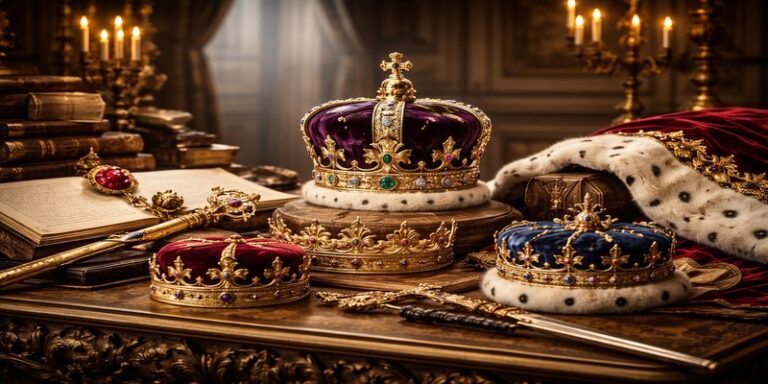
The monarch is also legally embodied in the concept of the Crown, which refers not merely to a physical object but to the authority of the state itself (Bradley, Ewing and Knight, 2018). When laws are enacted, they are passed by the “King-in-Parliament”, reflecting this constitutional role.
2.0 The Heir
An heir is the individual next in line to the throne. In Britain, succession follows hereditary principles set out in statute, most recently updated by the Succession to the Crown Act 2013, which established absolute primogeniture (meaning the eldest child inherits, regardless of gender).
Currently, Prince William, Prince of Wales, is the heir to King Charles III. The title Prince of Wales has traditionally been granted to the heir apparent since the fourteenth century (Cannadine, 2020).
The position of heir carries both symbolic and practical responsibilities, including representing the monarchy at official engagements and preparing for eventual kingship.
3.0 Duke and Duchess
A Duke is the highest rank within the British peerage below the monarch and the royal family. The title originated in continental Europe and was introduced into England in the fourteenth century. Dukes were often close relatives of the monarch and controlled vast lands (Cokayne, 2000).
Historically, dukes were powerful military leaders. For example, the Duke of Lancaster became King Henry IV in 1399, illustrating how ducal authority could translate into royal power.
A Duchess is either:
- The wife of a duke, or
- A woman who holds the title in her own right (though this has been rare).
For instance, Catherine, Princess of Wales, previously held the title Duchess of Cambridge before her husband became heir to the throne.
Royal dukedoms — such as Duke of York — are often granted to members of the royal family. Non-royal dukes also exist, though today their roles are largely ceremonial.
4.0 Duchy
A duchy is the territory or estate traditionally associated with a duke. Importantly, it is not merely a city, but a collection of lands and properties.
Two duchies remain significant today:
- The Duchy of Lancaster, which provides income to the monarch.
- The Duchy of Cornwall, which provides income to the heir to the throne.
The Duchy of Cornwall, established in 1337, was created specifically to provide financial independence to the heir (Britannica, 2023). These duchies are managed as private estates, though they operate within public accountability frameworks.
Thus, a duchy represents both historical territorial power and a modern financial institution.
5.0 Noble and the Aristocracy
A noble is a member of the aristocracy, typically holding a hereditary title. In medieval England, nobles played crucial roles in governance, military leadership and regional administration. They advised the monarch, maintained private armies and controlled vast estates (Carpenter, 1997).
Over time, the political influence of the nobility diminished, particularly after the centralising reforms of the Tudor monarchs and later parliamentary developments. Today, nobility remains primarily ceremonial, though some hereditary peers still sit in the House of Lords.
6.0 The Peerage
The peerage is the formal system of noble titles in Britain. It consists of five ranks:
- Duke
- Marquess
- Earl
- Viscount
- Baron
Each title historically carried land, income and political authority. The rank of earl, for instance, dates back to Anglo-Saxon times, while titles such as marquess and viscount were introduced later to reflect continental influences (Cokayne, 2000).
Peers once formed the political elite of the realm. The House of Lords, the upper chamber of Parliament, was historically composed almost entirely of hereditary peers. Today, reforms such as the House of Lords Act 1999 have significantly reduced hereditary representation (Bradley, Ewing and Knight, 2018).
7.0 Regent
A Regent is someone appointed to govern temporarily on behalf of a monarch who is underage, absent, or incapacitated.
One of the most famous examples is the Prince Regent (later King George IV), who governed from 1811 to 1820 during the mental illness of his father, George III. This period is known as the Regency era, associated with distinctive cultural and architectural styles (Cannadine, 2020).
The role of regent underscores that while monarchy is hereditary, governance must continue uninterrupted.
8.0 The Crown as an Institution
When people refer to “the Crown”, they often mean the institution of monarchy rather than the monarch personally. In legal terms, the Crown represents the state’s executive authority.
For example:
- Criminal prosecutions are brought in the name of the Crown.
- Civil servants work for the Crown.
- Armed forces swear allegiance to the Crown.
As Bogdanor (1995) explains, this abstraction ensures continuity — the Crown never dies, even when a monarch does.
9.0 A Hierarchy of Titles
To visualise the structure:
King / Queen
↓
Prince / Princess
↓
Duke / Duchess
↓
Marquess
↓
Earl
↓
Viscount
↓
Baron
This hierarchy reflects centuries of evolution, blending medieval feudal traditions with modern constitutional practice.
The British monarchy’s terminology reflects layers of history stretching from Norman conquest to modern constitutional reform. Titles such as Duke, Earl, and Baron originated in a feudal world of landholding and military service, while terms such as Crown and Regent highlight the development of constitutional governance.
Today, the monarchy operates within democratic structures, yet its language preserves the memory of medieval power and aristocratic hierarchy. Understanding these terms allows us to appreciate both the continuity and the transformation of one of the world’s most enduring political institutions.
References
Bogdanor, V. (1995) The Monarchy and the Constitution. Oxford: Clarendon Press.
Bradley, A.W., Ewing, K.D. and Knight, C.J.S. (2018) Constitutional and Administrative Law. 17th edn. Harlow: Pearson.
Britannica (2023) Duchy of Cornwall. Available at: https://www.britannica.com/topic/Duchy-of-Cornwall.
Cannadine, D. (2020) The Decline and Fall of the British Aristocracy. New Haven: Yale University Press.
Carpenter, C. (1997) The Wars of the Roses: Politics and the Constitution in England, c.1437–1509. Cambridge: Cambridge University Press.
Cokayne, G.E. (2000) The Complete Peerage of England, Scotland, Ireland, Great Britain and the United Kingdom. Gloucester: Alan Sutton.