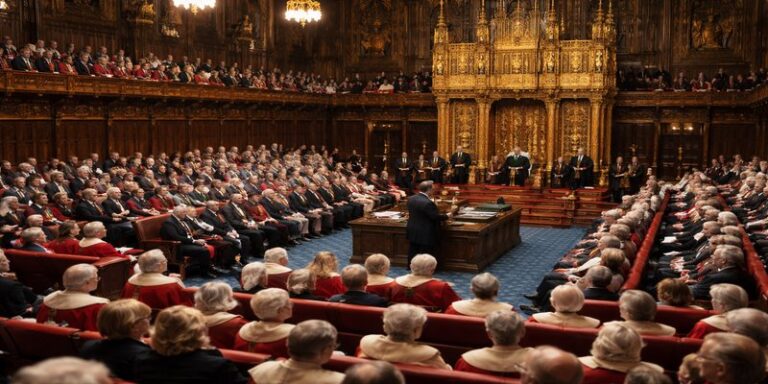
The House of Lords is the upper chamber of the Parliament of the United Kingdom, working alongside the House of Commons and the monarch to form the legislative authority of the state. Although it is unelected, it plays a central role in scrutinising legislation, revising bills, and debating public policy. Over the centuries, its powers and composition have evolved significantly, particularly as Britain developed into a constitutional monarchy grounded in the principle of parliamentary sovereignty. This article explores the historical development, composition, powers, criticisms, and continuing relevance of the House of Lords within the British political system.
1.0 Historical Development
1.1 Medieval Origins
The origins of the House of Lords lie in the medieval King’s Council, composed of bishops and leading nobles who advised the monarch. Following the Norman Conquest (1066), English kings relied on powerful landholders and church leaders for governance and taxation (Carpenter, 2003). By the fourteenth century, Parliament had evolved into a bicameral institution, separating into the House of Commons and the House of Lords.
The Lords consisted of two groups:
- Lords Temporal – hereditary nobles
- Lords Spiritual – senior bishops of the Church of England
For centuries, the Lords exercised considerable authority, often rivaling or exceeding that of the Commons.
1.2 Early Modern Power
During the Tudor and early Stuart periods, the House of Lords played a significant role in legislation and high-profile trials, including impeachment proceedings. However, the English Civil War (1642–1651) and the temporary abolition of the monarchy and House of Lords under Oliver Cromwell demonstrated that its existence was not invulnerable (Kishlansky, 1996).
The Glorious Revolution (1688) further reshaped the constitutional settlement, reinforcing parliamentary authority over royal prerogative. Although the House of Lords retained influence, the balance of power gradually shifted toward the elected Commons.
2.0 Composition of the House of Lords
2.1 Life Peers
Today, most members are life peers, appointed under the Life Peerages Act 1958. Life peers are nominated by political parties or recommended by the House of Lords Appointments Commission, and formally appointed by the monarch. Their titles are not hereditary.
Life peers are often distinguished individuals from fields such as law, academia, science, business, and public service. According to Russell (2013), this professional diversity enhances the Lords’ reputation as an expert revising chamber.
2.2 Hereditary Peers
Before 1999, hereditary peers automatically held seats in the House of Lords. The House of Lords Act 1999 removed this automatic right, leaving only 92 hereditary peers as a transitional arrangement (Shell, 2007). These remaining members are elected internally by fellow hereditary peers.
2.3 Lords Spiritual
The House of Lords also includes 26 senior bishops of the Church of England, known as the Lords Spiritual. Their presence reflects the historical relationship between church and state in Britain.
3.0 Powers and Functions
3.1 Legislative Scrutiny
The principal function of the House of Lords is legislative scrutiny. Bills typically pass through both Houses, and the Lords often propose amendments to clarify, refine, or improve legislation. Because members are not subject to electoral pressures, they can focus on detailed examination rather than party politics (Russell and Sciara, 2007).
For example, the Lords have amended legislation on issues such as asylum policy, constitutional reform, and public health, frequently prompting the government to reconsider aspects of proposed laws.
3.2 Delaying Power
The House of Lords cannot ultimately block legislation passed by the House of Commons. Under the Parliament Acts of 1911 and 1949, it may delay most public bills for up to one year but cannot veto them permanently (Bogdanor, 2009). It also cannot block “money bills” relating to taxation and public expenditure.
This limitation reflects the democratic principle that the elected Commons should prevail.
3.3 Committee Work and Debate
The Lords undertake extensive committee work, investigating complex issues such as artificial intelligence, constitutional reform, and international relations. These committees often produce influential reports that shape public debate.
Debates in the House of Lords are generally regarded as less adversarial than those in the Commons, allowing for more reflective discussion.
4.0 Reform and Criticism
4.1 Concerns about Legitimacy
One of the principal criticisms of the House of Lords is its unelected nature. Critics argue that in a modern democracy, legislative authority should derive from popular mandate (McLean and McMillan, 2009).
Others question the size of the chamber, which regularly exceeds 700 members, making it one of the largest legislative bodies in the world.
4.2 Arguments for Retention
Supporters contend that the Lords’ lack of electoral pressure enhances its independence. As Russell (2013) notes, members often demonstrate high levels of policy expertise and cross-party collaboration.
Reform proposals have ranged from partial election to complete replacement with an elected second chamber. However, attempts at comprehensive reform have repeatedly stalled due to political disagreement.
5.0 Constitutional Significance
The House of Lords operates within the framework of parliamentary sovereignty, whereby Parliament is the supreme legal authority in the United Kingdom. Although the Commons holds primacy, the Lords contributes significantly to the quality of legislation.
Its evolving role reflects broader constitutional development: from a chamber dominated by hereditary aristocracy to one increasingly composed of appointed experts. This transformation mirrors the shift from aristocratic governance to representative democracy.
Moreover, the Lords provides an institutional check within Britain’s uncodified constitution. While not a rival to the Commons, it acts as a forum for reconsideration and revision.
The House of Lords has undergone profound transformation since its medieval origins as a council of nobles and bishops. Once a powerful aristocratic chamber, it is now primarily a revising and scrutinising body within a constitutional monarchy.
Although its unelected status generates debate, its expertise, independence, and deliberative character contribute significantly to the legislative process. The restrictions imposed by the Parliament Acts ensure that democratic legitimacy remains with the House of Commons, while the Lords enhances the quality of lawmaking.
In this way, the House of Lords represents both continuity and change: a historic institution adapted to modern democratic principles. Its future reform remains uncertain, but its constitutional importance endures.
References
Bogdanor, V. (2009) The New British Constitution. Oxford: Hart Publishing.
Carpenter, D. (2003) The Struggle for Mastery: Britain 1066–1284. London: Penguin.
Kishlansky, M. (1996) A Monarchy Transformed: Britain 1603–1714. London: Penguin.
McLean, I. and McMillan, A. (2009) State of the Union: Unionism and the Alternatives in the United Kingdom since 1707. Oxford: Oxford University Press.
Russell, M. (2013) The Contemporary House of Lords: Westminster Bicameralism Revived. Oxford: Oxford University Press.
Russell, M. and Sciara, M. (2007) ‘Why Does the Government Get Defeated in the House of Lords?’, British Politics, 2(3), pp. 299–322.
Shell, D. (2007) The House of Lords. Manchester: Manchester University Press.