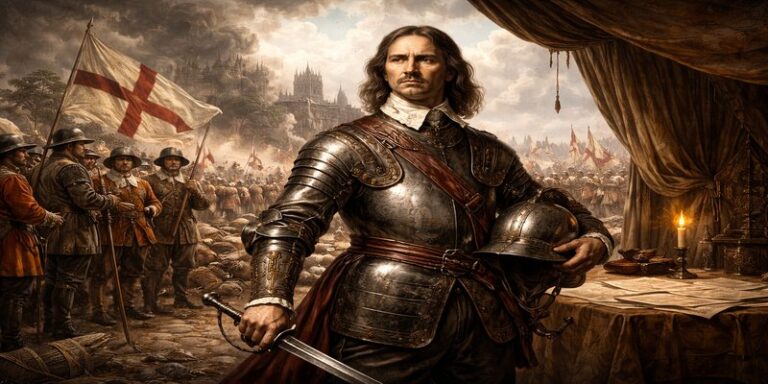
Few figures in British history provoke as much debate as Oliver Cromwell (1599–1658). To some, he was a champion of parliamentary liberty and religious reform; to others, he was a regicidal dictator whose rule undermined constitutional order. Emerging from relative obscurity as a minor gentry landowner, Cromwell rose to prominence during the English Civil Wars (1642–1651) and became the central political figure in the brief experiment with republican government known as the Commonwealth.
Cromwell’s leadership reshaped the monarchy, parliament and the relationship between religion and politics. His actions culminated in the unprecedented execution of King Charles I in 1649 and the establishment of a republic. Yet the period of the Protectorate (1653–1658) also revealed the tensions inherent in revolutionary change. This article explores Cromwell’s life, military career, political authority and contested legacy.
1.0 Early Life and Religious Convictions
1.1 Background and Education
Oliver Cromwell was born in Huntingdon in 1599 into a modest but respectable gentry family. Educated at Sidney Sussex College, Cambridge, he absorbed the Puritan religious ideals that would later shape his worldview (Morrill, 2007). Although not initially destined for national prominence, Cromwell’s deep Protestant faith profoundly influenced his political and military actions.
1.2 Puritan Beliefs
Cromwell adhered to a strand of Protestantism that emphasised moral discipline, biblical authority and opposition to perceived Catholic influence within the Church of England. Religious tensions in early seventeenth-century England formed the backdrop to his rise. As Hill (1972) argues, religion was inseparable from politics in this period, fuelling conflict between Crown and Parliament.
2.0 The English Civil Wars
1.1 Conflict with Charles I
The reign of King Charles I was marked by disputes over taxation, royal prerogative and religious reforms. Charles’ decision to rule without Parliament between 1629 and 1640 heightened tensions. When conflict erupted in 1642, Cromwell sided with Parliament against the King.
1.2 Military Leadership and the New Model Army
Cromwell quickly distinguished himself as a capable cavalry commander. His disciplined “Ironsides” regiment became renowned for both military effectiveness and moral seriousness. In 1645, Parliament reorganised its forces into the New Model Army, a professional and ideologically committed fighting force (Gaunt, 2014).
The decisive victory at the Battle of Naseby (1645) effectively ended Royalist resistance. Cromwell’s leadership demonstrated not only tactical skill but also organisational vision, helping transform Parliament’s military capacity.
3.0 Regicide and the Commonwealth
3.1 The Trial and Execution of Charles I
After years of renewed conflict and failed negotiations, radical elements within Parliament and the Army moved against the King. In January 1649, Charles I was tried and executed for treason—an unprecedented act in European history.
Cromwell supported the regicide, viewing it as necessary to secure the revolution and prevent further bloodshed (Morrill, 2007). The monarchy and House of Lords were abolished, and England was declared a Commonwealth.
3.2 The Republican Experiment
The Commonwealth (1649–1653) represented a bold attempt to establish a republic. However, divisions within Parliament and the Army created instability. Frustrated with political stagnation, Cromwell dissolved the Rump Parliament in 1653.
4.0 Lord Protector and the Protectorate
4.1 Establishment of the Protectorate
Later in 1653, Cromwell was appointed Lord Protector under the Instrument of Government—the first written constitution in English history. This marked the beginning of the Protectorate (1653–1658).
Although the new system retained elements of parliamentary governance, Cromwell wielded considerable executive authority. Critics argue that his rule resembled a military dictatorship, while supporters contend that he sought stability amid revolutionary turmoil (Hutton, 2000).
4.2 Domestic Policies
Cromwell pursued policies aimed at moral reform and religious toleration for Protestant sects. While Anglican structures were weakened, Cromwell permitted a degree of religious pluralism uncommon for the time.
His regime also introduced administrative reforms, including attempts at legal codification and fiscal stability. However, resistance persisted, and several parliaments were dissolved amid conflict.
5.0 Ireland and Scotland
5.1 Campaign in Ireland
Cromwell’s 1649 campaign in Ireland remains one of the most controversial aspects of his career. The sieges of Drogheda and Wexford resulted in large-scale killings. For many Irish historians, Cromwell symbolises brutality and colonial oppression (Ó Siochrú, 2008).
5.2 Scotland and Consolidation
In Scotland, Cromwell defeated Royalist forces at Dunbar (1650) and Worcester (1651), consolidating Commonwealth control. These victories extended republican authority across the British Isles, though at significant human and political cost.
6.0 Foreign Policy and Naval Power
Cromwell strengthened England’s navy and pursued an assertive foreign policy. The Navigation Acts promoted English maritime commerce, challenging Dutch dominance (Pincus, 1995). Military expeditions against Spain and alliances with Protestant powers reflected Cromwell’s strategic and religious priorities.
These measures laid groundwork for England’s later emergence as a global naval power.
7.0 Death and Restoration
Cromwell died in 1658, likely from malaria or kidney disease. His son Richard succeeded him but lacked political and military support. By 1660, the monarchy was restored under Charles II, marking the end of the republican experiment.
In a symbolic act of retribution, Cromwell’s body was exhumed and posthumously executed in 1661. This dramatic gesture underscored the depth of division surrounding his legacy.
8.0 Legacy and Historical Debate
Cromwell’s reputation has fluctuated over centuries. Nineteenth-century historians often celebrated him as a defender of parliamentary liberty. Twentieth-century scholarship offered more nuanced interpretations, emphasising both his authoritarian tendencies and constitutional contributions (Hutton, 2000).
Some view him as a pioneer of constitutional government, helping limit monarchical power. Others highlight his role in violent suppression in Ireland and his dissolution of parliaments.
As Morrill (2007) notes, Cromwell was both a product of his turbulent times and a transformative agent within them.
Oliver Cromwell remains one of the most complex figures in British history. His rise from provincial gentry to military commander and head of state reflects the extraordinary upheavals of the seventeenth century. Through civil war, regicide and republican governance, Cromwell reshaped England’s political landscape.
Yet his legacy is deeply contested. He advanced parliamentary authority and religious reform but exercised concentrated executive power and sanctioned harsh military campaigns. The tensions between liberty and authority that defined his era continue to resonate in debates about constitutional governance.
Understanding Cromwell requires acknowledging both his achievements and controversies. He was neither simple hero nor straightforward tyrant, but a central actor in a revolutionary age that fundamentally altered the trajectory of British history.
References
Gaunt, P. (2014) The English Civil Wars: A Military History. London: I.B. Tauris.
Hill, C. (1972) The World Turned Upside Down: Radical Ideas During the English Revolution. London: Temple Smith.
Hutton, R. (2000) The British Republic 1649–1660. London: Palgrave.
Morrill, J. (2007) Oliver Cromwell. Oxford: Oxford University Press.
Ó Siochrú, M. (2008) God’s Executioner: Oliver Cromwell and the Conquest of Ireland. London: Faber & Faber.
Pincus, S. (1995) Protestantism and Patriotism: Ideologies and the Making of English Foreign Policy 1650–1668. Cambridge: Cambridge University Press.