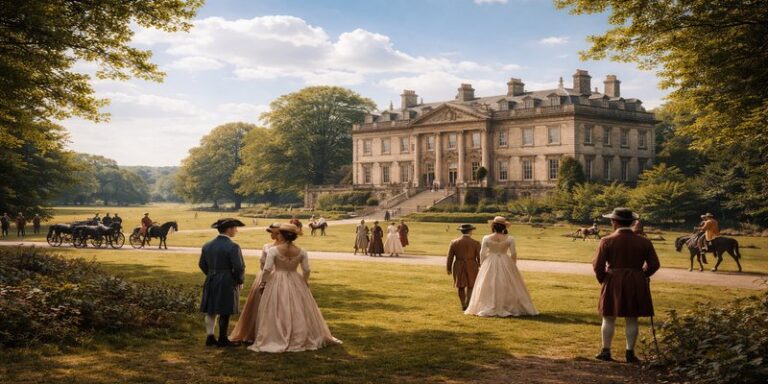
The concept of the gentry occupies an important place in the social and political history of the United Kingdom. Situated below the titled nobility yet clearly above common citizens, the gentry formed a distinct and influential social stratum from the late medieval period through to the nineteenth century. They were typically landowners, often residing in country estates, and played a pivotal role in shaping local governance, parliamentary representation, and rural society. Understanding the historical context of the gentry offers valuable insight into the development of Britain’s class structure, political institutions, and patterns of land ownership. This article explores the origins, characteristics, functions, and gradual transformation of the gentry within British society.
1.0 Origins and Emergence of the Gentry
1.1 Medieval Foundations
The roots of the gentry class can be traced to the later Middle Ages, particularly after the Norman Conquest of 1066, when land became the central marker of wealth and status (Carpenter, 1994). Below the great nobles—such as dukes and earls—there emerged a layer of knights and esquires who held land directly or indirectly from the Crown. Over time, many of these families consolidated their holdings and established themselves as hereditary landowners.
By the fifteenth century, the term “gentry” was increasingly used to describe these untitled but socially prominent landholders (Heal and Holmes, 1994). Unlike the peerage, they did not hold hereditary titles such as baron or viscount, yet they were recognised as part of the “gentle” class, distinguished by birth, wealth, and manners.
2.0 Social Position and Hierarchy
2.1 Between Nobility and Commoners
In the traditional social hierarchy of the United Kingdom, the gentry ranked below the nobility but above the majority of the population. The nobility comprised titled peers who sat in the House of Lords, while the gentry typically held no peerage but were recognised as socially superior to tradespeople, labourers, and tenant farmers (Stone, 1965).
The gentry itself was internally stratified. It included:
- Baronets (hereditary titles without peerage status)
- Knights
- Esquires
- Wealthy untitled landowners
Despite lacking formal noble titles, members of the gentry were often addressed with honourifics and enjoyed considerable prestige.
2.2 Land as the Basis of Status
The defining characteristic of the gentry was ownership of landed estates. Land not only generated income through rents but also symbolised stability, lineage, and authority. As Mingay (1976) explains, the landed estate functioned as both an economic asset and a cultural emblem of family continuity.
Country houses became visible representations of status. These estates were frequently centres of rural administration and social life, hosting events, gatherings, and charitable activities. Ownership of land also conferred political influence, especially in counties where voting rights were linked to property qualifications.
3.0 Political Influence and Governance
3.1 Role in Local Administration
Members of the gentry played a central role in local governance. They often served as:
- Justices of the Peace
- Sheriffs
- Deputy lieutenants
According to Holmes (1982), the local administration of early modern England relied heavily on the unpaid service of the gentry. Their responsibilities included maintaining law and order, overseeing poor relief, collecting taxes, and enforcing statutes.
Because these roles were unpaid, they were accessible primarily to those with independent means—reinforcing the dominance of landowners in public life.
3.2 Representation in Parliament
The gentry also had a significant presence in the House of Commons. Many Members of Parliament during the seventeenth and eighteenth centuries came from gentry families (Stone, 1965). Although they did not hold noble titles, their wealth and local standing enabled them to contest parliamentary seats, particularly in county constituencies.
This influence ensured that legislation often reflected the interests of landowners, particularly regarding agriculture, enclosure, and property rights. As Cannadine (1990) notes, Britain’s political system evolved in close connection with its landed elite.
4.0 Cultural Identity and Values
4.1 The Ideal of the “Gentleman”
The gentry were closely associated with the cultural ideal of the “gentleman”—a figure defined not only by wealth but also by education, manners, and moral conduct. Conduct literature from the sixteenth and seventeenth centuries emphasised virtues such as honour, civility, and public duty (Heal and Holmes, 1994).
Education became a crucial marker of status. Sons of the gentry frequently attended institutions such as Eton or Oxford and Cambridge, reinforcing networks of influence and shared identity.
4.2 Patronage and Social Leadership
Beyond politics, the gentry exercised leadership in social and cultural spheres. They funded churches, schools, and local charities. Their patronage extended to architecture, landscaping, and the arts. This reinforced their image as guardians of rural society.
However, this leadership was paternalistic. Tenant farmers and labourers depended economically on landowners, creating a hierarchical but interdependent rural structure (Mingay, 1976).
5.0 Transformation in the Modern Era
5.1 Industrialisation and Economic Change
The Industrial Revolution significantly altered the economic foundations of British society. Wealth increasingly derived from commerce and industry rather than land. As a result, the dominance of the landed gentry gradually declined (Cannadine, 1990).
New industrial elites emerged, challenging the traditional prestige of hereditary landowners. While many gentry families adapted—investing in railways or industry—others struggled to maintain their estates amid falling agricultural profits in the late nineteenth century.
5.2 Political Reform and Democratisation
Reform Acts in the nineteenth century expanded the electorate and reduced the political monopoly of landowners. The Reform Act of 1832, in particular, reshaped parliamentary representation, diminishing the influence of rural elites (Evans, 2000).
Over time, democratic reforms and social mobility blurred the rigid distinctions between gentry and other classes. Although some families retained wealth and influence, the social and political supremacy of the gentry was no longer assured.
6.0 Legacy and Historical Significance
Despite their decline as a dominant political force, the gentry left a lasting imprint on British institutions and culture. The architecture of country houses, patterns of land ownership, and traditions of local governance bear their mark.
Moreover, literary representations—from Jane Austen’s novels to Victorian social commentary—frequently centre on gentry families, reflecting their cultural prominence in the eighteenth and early nineteenth centuries. As a social category, the gentry illustrate how land, lineage, and governance intersected in shaping Britain’s historical development.
The gentry of the United Kingdom occupied a distinctive and influential position in the country’s social hierarchy. Positioned below the nobility yet above common citizens, they were primarily defined by land ownership, local authority, and cultural prestige. Through their roles in county administration and parliamentary representation, they shaped the political and social landscape of Britain for centuries.
However, economic transformation and political reform gradually reduced their dominance. The rise of industrial wealth and democratic expansion challenged the traditional foundations of landed power. Nevertheless, the historical significance of the gentry endures, offering valuable insight into the evolution of Britain’s class system and political institutions. Their story reflects broader themes of continuity and change within British history.
References
Cannadine, D. (1990) The Decline and Fall of the British Aristocracy. New Haven: Yale University Press.
Carpenter, C. (1994) Locality and Polity: A Study of Warwickshire Landed Society, 1401–1499. Cambridge: Cambridge University Press.
Evans, E.J. (2000) The Forging of the Modern State: Early Industrial Britain, 1783–1870. London: Longman.
Heal, F. and Holmes, C. (1994) The Gentry in England and Wales, 1500–1700. London: Macmillan.
Holmes, G. (1982) Augustan England: Professions, State and Society, 1680–1730. London: George Allen & Unwin.
Mingay, G.E. (1976) The Gentry: The Rise and Fall of a Ruling Class. London: Longman.
Stone, L. (1965) The Crisis of the Aristocracy, 1558–1641. Oxford: Clarendon Press.
Encyclopaedia Britannica (2023) ‘Gentry’. Available at: https://www.britannica.com (Accessed: 1 March 2026).