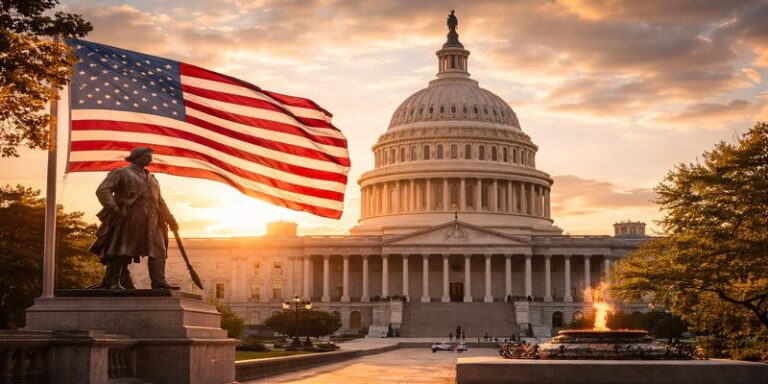
The field of American history is vast, dynamic, and deeply contested. Modern historians approach the subject not simply as a chronological sequence of events, but as an evolving conversation about democracy, power, race, capitalism, reform, war, and identity. Foundational reference works such as The Reader’s Companion to American History (Foner and Garraty, 2014) and Interpretations of American History (Couvares, 2000) demonstrate the diversity of perspectives within the discipline. Meanwhile, studies of historiography (Unger, 1967; Noble, 1985; Parish, 2013) reveal how interpretations have shifted over time—from progressive narratives emphasising reform to New Left critiques focusing on inequality and power structures.
Across textbooks and public memory (Moreau, 2003; Lindaman and Ward, 2006; Foster, 1999), historians observe recurring debates over how key events such as the American Revolution, Civil War, industrialisation, the Progressive Era, the World Wars, the Cold War, and the Civil Rights Movement should be understood. These themes form the backbone of American historical scholarship.
1.0 The American Revolution and the Founding of the Republic
The American Revolution (1775–1783) stands as the foundational event of the United States. Traditionally framed as a struggle for liberty against British tyranny, recent scholarship emphasises its complexity. It was simultaneously a war for independence, a civil conflict, and a social transformation.
Heideking (2017) situates the Revolution within a broader pattern of American modernity, highlighting how republican ideals coexisted with slavery and limited suffrage. The drafting of the US Constitution (1787) established a federal system balancing central authority with state power, embedding principles such as separation of powers and checks and balances.
For example, the debates between Federalists and Anti-Federalists illustrate early tensions between national unity and local autonomy—tensions that continue to shape American politics.
2.0 Slavery, Sectionalism and the Civil War
No topic has generated more historiographical debate than the Civil War (1861–1865). Earlier interpretations sometimes downplayed slavery as the primary cause, emphasising states’ rights or economic differences. However, modern historians overwhelmingly identify slavery and racial inequality as central causes (Towers, 2011).
The war’s consequences were transformative. The Emancipation Proclamation (1863) and the Thirteenth, Fourteenth and Fifteenth Amendments sought to redefine citizenship and equality. Sklar (1992) refers to the post-war constitutional settlement as a “Second Constitution”, marking a shift towards federal authority and civil rights protections.
Yet Reconstruction’s promise was undermined by segregation and racial violence. The long struggle for equality underscores the continuity between the Civil War era and the twentieth-century Civil Rights Movement.
3.0 Industrialisation and the Gilded Age
The late nineteenth century witnessed rapid industrialisation, urban growth, and corporate expansion. Schlesinger (1999) describes American history as cyclical, marked by alternating periods of reform and conservatism. Industrial growth created unprecedented wealth but also stark inequality.
Railways, steel production, and oil industries reshaped the economy. Figures such as Andrew Carnegie and John D. Rockefeller symbolised entrepreneurial success, while labour unrest—such as the Pullman Strike (1894)—highlighted social tensions.
Couvares (2000) notes that historians increasingly examine how industrial capitalism influenced social life, immigration patterns, and class relations. Industrialisation also contributed to America’s emergence as a global power.
4.0 The Progressive Era
In response to industrial excesses, the Progressive Era (c. 1890–1920) sought political and social reform. Progressives advocated regulation of monopolies, expansion of democracy, and social justice initiatives.
Unger (1967) observes that progressive historians of the early twentieth century viewed reform movements as essential correctives to corporate power. Later scholars have offered more critical assessments, questioning whose interests reforms truly served (Noble, 1985).
For instance, President Theodore Roosevelt’s trust-busting policies aimed to regulate large corporations, while activists such as Jane Addams championed urban social reform. However, progressive reforms often excluded African Americans and immigrants, reflecting contradictions within the movement.
5.0 The United States in the World Wars
The twentieth century saw the United States transform from a continental republic into a global superpower. Participation in World War I marked a decisive entry onto the world stage, though isolationist sentiments resurfaced in the interwar years.
World War II proved more transformative. The war effort stimulated economic recovery after the Great Depression and expanded federal authority. It also exposed contradictions between fighting fascism abroad and maintaining racial segregation at home.
Carroll (2003) highlights how wartime mobilisation reshaped gender roles and national identity. The internment of Japanese Americans remains a stark example of civil liberties curtailed during crisis.
6.0 The Cold War and Global Leadership
The Cold War (c. 1947–1991) structured American foreign and domestic policy for decades. Walker (1995) shows how textbook interpretations of Cold War origins reflect broader political debates. Early narratives often portrayed US actions as defensive responses to Soviet aggression; later scholarship questioned American interventionism.
Domestically, anti-communist sentiment fuelled McCarthyism, while internationally, conflicts in Korea and Vietnam tested American resolve. Jewett (2012) connects Cold War politics to the expansion of scientific research and university systems, demonstrating the interplay between knowledge, democracy, and state power.
7.0 The Civil Rights Movement and Social Change
The Civil Rights Movement of the 1950s and 1960s represents a watershed in American history. Building upon Reconstruction’s unfinished promises, activists challenged segregation and discrimination.
Landmark legislation—the Civil Rights Act (1964) and Voting Rights Act (1965)—sought to dismantle institutional racism. Isserman and Kazin (2000) situate civil rights within the broader upheavals of the 1960s, including feminist, student, and anti-war movements.
Yet, as Foster (1999) notes, textbook portrayals often simplify these struggles, emphasising consensus over conflict. The movement’s legacy continues to shape debates about race, equality, and national identity.
8.0 Historiography and Historical Memory
American history is not merely about events; it is also about interpretation. Historiographical debates—from progressive interpretations to New Left critiques (Unger, 1967)—demonstrate shifting scholarly priorities. Noble (1985) questions whether traditional narratives overemphasise national coherence at the expense of diversity and dissent.
Textbook studies (Moreau, 2003; Lindaman and Ward, 2006) reveal how educational materials reflect political and cultural struggles. For example, portrayals of the Civil War, Cold War, and civil rights often vary depending on regional and ideological contexts.
Historical memory, as Cook (2007) shows in his study of Civil War commemorations, plays a powerful role in shaping public understanding. Monuments, anniversaries, and museums become arenas for contesting the past.
American history encompasses revolution and reform, conflict and compromise, expansion and introspection. From the founding ideals of liberty and republicanism to the unresolved challenges of racial inequality and global responsibility, the field remains vibrant and contested.
Modern scholarship emphasises complexity rather than triumphalism. By integrating political, social, economic, and cultural perspectives, historians continue to reassess what it means to understand the American past. In doing so, they demonstrate that history is not static, but an ongoing dialogue between evidence, interpretation, and contemporary concerns.
References
Carroll, B. (2003) American Masculinities: A Historical Encyclopedia. Thousand Oaks: Sage.
Cook, R.J. (2007) Troubled Commemoration: The American Civil War Centennial, 1961–1965. Baton Rouge: Louisiana State University Press.
Couvares, F.G. (2000) Interpretations of American History, Vol. I: Patterns and Perspectives. New York: Free Press.
Foner, E. and Garraty, J.A. (2014) The Reader’s Companion to American History. Boston: Houghton Mifflin.
Foster, S.J. (1999) ‘The struggle for American identity: Treatment of ethnic groups in United States history textbooks’, History of Education, 28(3), pp. 251–278.
Heideking, J. (2017) ‘The pattern of American modernity from the revolution to the civil war’, in Multiple Modernities. London: Routledge.
Isserman, M. and Kazin, M. (2000) America Divided: The Civil War of the 1960s. New York: Oxford University Press.
Jewett, A. (2012) Science, Democracy, and the American University: From the Civil War to the Cold War. Cambridge: Cambridge University Press.
Lindaman, D. and Ward, K. (2006) History Lessons: How Textbooks from Around the World Portray US History. New York: New Press.
Moreau, J. (2003) Schoolbook Nation: Conflicts over American History Textbooks from the Civil War to the Present. Ann Arbor: University of Michigan Press.
Noble, D.W. (1985) The End of American History. Minneapolis: University of Minnesota Press.
Parish, P.J. (2013) Reader’s Guide to American History. London: Routledge.
Schlesinger, A.M. (1999) The Cycles of American History. Boston: Houghton Mifflin.
Towers, F. (2011) ‘Partisans, new history, and modernization: The historiography of the Civil War’s causes, 1861–2011’, Journal of the Civil War Era, 1(2), pp. 237–264.
Walker, J.S. (1995) ‘The origins of the Cold War in United States history textbooks’, Journal of American History, 81(4), pp. 1653–1666.