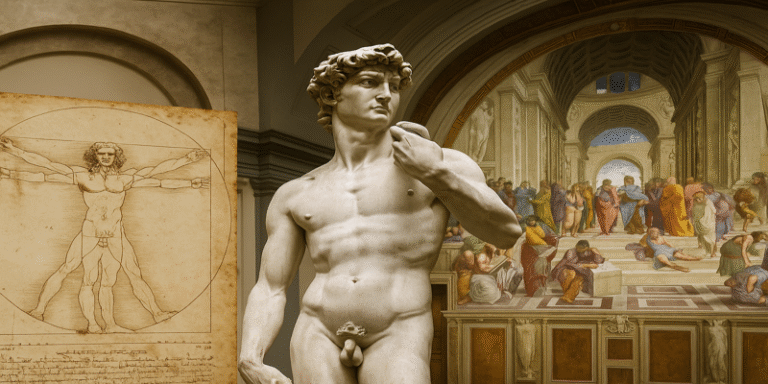
✧ Imagine walking through the streets of Florence in the fifteenth century. Merchants bargain in crowded squares, scholars pore over rediscovered classical texts, and artists experiment with new ways of seeing the world. Churches and palaces rise with elegant symmetry, while workshops buzz with sketches, pigments, and ideas. This was the world of the Renaissance — a period of extraordinary cultural renewal that reshaped Europe and helped lay the foundations of the modern age.
The Renaissance was far more than an artistic movement. It was a broad rebirth of learning, creativity, and intellectual ambition that emerged in Italy during the fourteenth century and spread across Europe over the next two hundred years. Inspired by the literature, philosophy, and art of ancient Greece and Rome, Renaissance thinkers placed fresh emphasis on human potential, reason, and observation. The result was a profound transformation in art, education, science, literature, and political thought (Burke, 1998).
What made the Renaissance so remarkable was not only its beauty, but its boldness. It challenged inherited assumptions, celebrated individual achievement, and encouraged people to study both the world around them and their own place within it. From Leonardo da Vinci and Michelangelo to Erasmus and Copernicus, Renaissance figures expanded the limits of what human beings could imagine and accomplish.
This article explores the origins, ideas, artistic breakthroughs, scientific advances, and enduring legacy of the Renaissance, showing why this period remains one of the most influential in world history.
1.0 The Origins of the Renaissance
1.1 Why Italy Became the Cradle of the Renaissance
The beginnings of the Renaissance are usually traced to the wealthy city-states of northern Italy, especially Florence, Venice, and Milan. These urban centres were enriched by trade, banking, and manufacturing, which created the economic conditions for cultural patronage and experimentation. Powerful families such as the Medici used their wealth to support artists, scholars, and architects, helping Florence become a vibrant centre of innovation (Welch, 2011).
Italy’s connection to the ruins and texts of ancient Rome also played an important role. Scholars and writers developed a deep admiration for classical civilisation and sought to recover its learning. According to Burke (1998), the revival of ancient texts was central to the intellectual energy of the period. The works of Petrarch and Boccaccio were especially significant, as they encouraged renewed engagement with classical literature and moral philosophy.
1.2 Social and Political Change in the Renaissance
The decline of feudal structures and the growth of urban life also encouraged new ways of thinking. As commercial life expanded, a rising mercantile class gained both influence and confidence. This shift weakened older medieval hierarchies and created space for more secular and practical concerns. In this setting, the Renaissance flourished as a movement that valued education, civic life, and worldly achievement alongside religious belief.
2.0 Humanism and the Intellectual Heart of the Renaissance
2.1 What Was Renaissance Humanism?
At the centre of the Renaissance stood humanism, an intellectual movement that emphasised the dignity, capacity, and moral responsibility of human beings. Humanists believed that the study of grammar, rhetoric, history, poetry, and moral philosophy could cultivate virtue and prepare individuals for active participation in society (Kristeller, 1961).
Unlike medieval scholasticism, which often focused on abstract theological debate, humanism turned attention towards human experience, ethical reflection, and classical wisdom. Yet Renaissance humanism was not necessarily anti-religious. Rather, it often sought to reconcile Christianity with classical learning, creating a richer and more balanced vision of human life (Nauert, 2006).
2.2 Humanism in Literature and Education
Writers such as Erasmus of Rotterdam and Thomas More show how the Renaissance encouraged critical thought. Erasmus’s In Praise of Folly used wit and satire to expose corruption and hypocrisy within society and the Church, while still affirming sincere Christian belief. More’s Utopia imagined an ideal society and invited reflection on justice, government, and social organisation.
Humanism also transformed education. The studia humanitatis became the basis of a new curriculum, promoting intellectual breadth and eloquence rather than narrow theological training (Black, 2001). This reform had lasting consequences, influencing the development of modern liberal education and the belief that learning should shape character as well as knowledge.
3.0 Artistic Innovation in the Renaissance
3.1 The Renaissance and the New Vision of Art
Few aspects of the Renaissance are more celebrated than its art. Renaissance artists did not simply produce beautiful works; they redefined what art could do. They studied nature, anatomy, geometry, and perspective in order to create more realistic and expressive representations of the world.
The development of linear perspective was one of the most important breakthroughs of the age. Pioneered by Filippo Brunelleschi and explained by Leon Battista Alberti, perspective allowed artists to create the illusion of depth on a flat surface with mathematical precision (Edgerton, 2009). This represented a dramatic departure from much medieval art, which often appeared flatter and less concerned with spatial realism.
3.2 Leonardo, Michelangelo, and Raphael
Leonardo da Vinci embodies the spirit of the Renaissance perhaps more than any other figure. His Vitruvian Man reflects the belief that the human body mirrors cosmic order and proportion, combining artistic skill with scientific curiosity (Kemp, 2006). Leonardo’s notebooks also reveal an extraordinary desire to understand everything from anatomy to engineering.
Michelangelo’s David captures another key Renaissance ideal: the celebration of human strength, dignity, and inner resolve. The sculpture draws inspiration from classical forms, yet it also conveys psychological intensity and moral confidence (Hauser, 2005). Likewise, Raphael’s paintings, such as The School of Athens, bring together philosophers of antiquity in a harmonious visual statement about knowledge, balance, and intellectual greatness.
3.3 Architecture and Classical Balance
Architecture during the Renaissance also reflected a revived admiration for antiquity. Designers embraced symmetry, proportion, and clarity, drawing inspiration from Roman buildings and the theories of Vitruvius. Brunelleschi’s churches and Alberti’s façades reveal this return to order and harmony, marking a clear shift away from some medieval forms (Wittkower, 1999).
4.0 The Scientific Spirit of the Renaissance
4.1 Observation, Inquiry, and New Knowledge
Although the Renaissance is often associated most strongly with art and literature, it also encouraged major advances in scientific thought. The same humanist curiosity that led scholars back to classical texts also inspired them to question inherited ideas and rely more on observation and evidence.
According to Lindberg (2007), the recovery of ancient scientific works helped stimulate new investigations into astronomy, anatomy, and mathematics. Yet Renaissance scholars did more than preserve old knowledge; they tested it, refined it, and sometimes overturned it.
4.2 Key Examples of Renaissance Science
One of the most revolutionary developments of the Renaissance came from Nicolaus Copernicus, whose De revolutionibus orbium coelestium argued that the Earth moved around the Sun rather than standing at the centre of the universe. This heliocentric model challenged centuries of accepted belief and opened the way for modern astronomy.
In medicine, Andreas Vesalius transformed anatomical study through direct dissection and careful illustration. His work corrected many longstanding errors inherited from ancient authorities and demonstrated the value of empirical investigation. The Renaissance commitment to firsthand observation can also be seen in the later work of Galileo, who used instruments and mathematics to study motion and the heavens.
These developments show that the Renaissance helped create a culture in which questioning, testing, and discovering became central to knowledge itself.
5.0 The Spread of the Renaissance Across Europe
5.1 Printing and the Movement of Ideas
The ideas of the Renaissance did not remain confined to Italy. One major reason for their spread was the invention of the printing press by Johannes Gutenberg in the mid-fifteenth century. Printing made books more available, lowered costs, and accelerated the circulation of classical texts, religious debates, and new scholarship (Eisenstein, 1983).
Through books, trade routes, diplomacy, and travel, Renaissance culture reached France, Germany, the Low Countries, England, and beyond. As it spread, it adapted to local traditions and concerns.
5.2 The Northern Renaissance
In Northern Europe, the Renaissance often took on a more explicitly religious and moral tone. Artists such as Jan van Eyck and Albrecht Dürer combined remarkable technical precision with spiritual seriousness. Scholars such as Erasmus used humanist methods to call for reform, clarity, and ethical renewal.
This northern form of the Renaissance also helped prepare the ground for broader religious and political transformations, including the Protestant Reformation. The period therefore had consequences far beyond painting and sculpture; it reshaped European intellectual life at multiple levels.
6.0 The Enduring Legacy of the Renaissance
The influence of the Renaissance can still be felt today. Its emphasis on individual potential, critical thinking, creativity, and education helped shape the modern Western world. The period encouraged the idea that human beings are capable of understanding nature, improving society, and creating works of lasting beauty.
Modern universities, museums, scientific inquiry, and liberal arts education all owe something to Renaissance ideals. The period also changed how people viewed themselves. No longer seen only as subjects within a fixed divine order, individuals were increasingly understood as thinking, creating, and morally responsible beings.
As Burke (1998) argues, the Renaissance was not simply a revival of the past, but a transformation of the present through the rediscovery of earlier traditions. Its greatness lies in this fusion of memory and invention, of inherited wisdom and bold experimentation.
∎ The Renaissance was a turning point in European history because it brought together learning, creativity, and human ambition in a new and powerful way. Born in the Italian city-states and shaped by economic growth, classical revival, and humanist education, it transformed the arts, sciences, literature, and philosophy. Figures such as Leonardo, Michelangelo, Erasmus, and Copernicus did not merely reflect their age; they helped define it.
More importantly, the Renaissance changed how people thought about knowledge and humanity itself. It celebrated the possibility that individuals could learn, create, question, and improve the world around them. That is why the period continues to fascinate scholars, students, and readers alike. In many ways, the Renaissance was the moment Europe began to imagine modernity.
References
Black, R. (2001) Humanism and Education in Medieval and Renaissance Italy: Tradition and Innovation in Latin Schools from the Twelfth to the Fifteenth Century. Cambridge: Cambridge University Press.
Burke, P. (1998) The European Renaissance: Centres and Peripheries. Oxford: Blackwell.
Edgerton, S.Y. (2009) The Mirror, the Window, and the Telescope: How Renaissance Linear Perspective Changed Our Vision of the Universe. Ithaca: Cornell University Press.
Eisenstein, E.L. (1983) The Printing Revolution in Early Modern Europe. Cambridge: Cambridge University Press.
Hauser, A. (2005) The Social History of Art: Volume 2 – Renaissance, Mannerism, Baroque. London: Routledge.
Kemp, M. (2006) Leonardo da Vinci: The Marvellous Works of Nature and Man. Oxford: Oxford University Press.
Kristeller, P.O. (1961) Renaissance Thought: The Classic, Scholastic, and Humanist Strains. New York: Harper Torchbooks.
Lindberg, D.C. (2007) The Beginnings of Western Science. Chicago: University of Chicago Press.
Nauert, C.G. (2006) Humanism and the Culture of Renaissance Europe. Cambridge: Cambridge University Press.
Welch, E. (2011) Art and Society in Italy, 1350–1500. Oxford: Oxford University Press.
Wittkower, R. (1999) Architectural Principles in the Age of Humanism. London: Academy Editions.