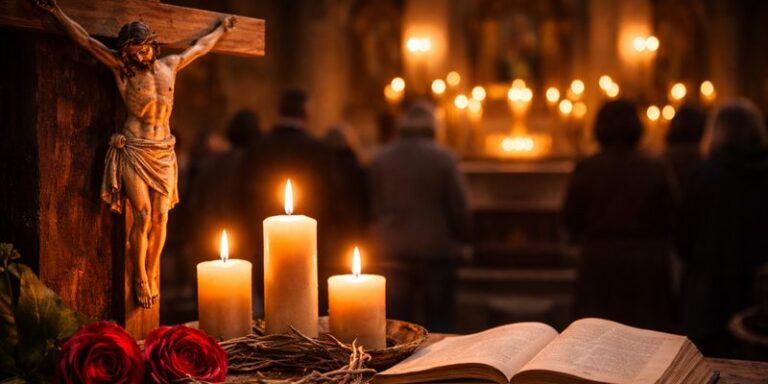
✧ Every year, millions of Christians around the world pause in solemn reflection on Good Friday, one of the most significant days in the Christian calendar. Observed during Holy Week, Good Friday commemorates the crucifixion and death of Jesus Christ, events that stand at the centre of Christian theology and spiritual reflection. While Easter Sunday celebrates the resurrection, Good Friday focuses on sacrifice, suffering and redemption.
Despite its sombre tone, Good Friday occupies a deeply meaningful place in Christian worship and belief. The day invites believers to contemplate the profound theological claim that the death of Jesus on the cross represents an act of divine love and reconciliation between humanity and God (Wright, 2016). Churches across the world mark Good Friday with solemn liturgies, prayers, fasting and symbolic rituals, emphasising remembrance rather than celebration.
The significance of Good Friday extends beyond religious ritual. It has influenced art, literature, theology and cultural traditions for centuries. Understanding the meaning and history of Good Friday therefore provides valuable insight into both Christian doctrine and global cultural heritage. This article explores the origins, theological meaning and traditions of Good Friday, explaining why it remains a powerful moment of reflection in the Christian year.
2.0 The Historical Origins of Good Friday
2.1 Biblical Foundations of Good Friday
The observance of Good Friday is rooted in the New Testament accounts of the crucifixion of Jesus Christ. According to the Gospels of Matthew, Mark, Luke and John, Jesus was arrested, tried and sentenced to death by crucifixion under the Roman governor Pontius Pilate (Matthew 27; Mark 15; Luke 23; John 19).
Crucifixion was a brutal form of Roman execution typically reserved for rebels and criminals. The Gospel narratives describe how Jesus was mocked, scourged and forced to carry his cross before being crucified outside Jerusalem at a place called Golgotha. Christians interpret this event not merely as a historical execution but as a redemptive act with profound spiritual significance (Farwell, 2004).
The early Christian community quickly recognised the importance of remembering the Passion—the suffering and death of Jesus. Over time, this remembrance developed into the liturgical observance now known as Good Friday, part of the three-day Easter celebration known as the Paschal Triduum.
2.2 Development of Good Friday in Christian Tradition
Historical evidence suggests that Good Friday liturgies emerged in the early centuries of Christianity, particularly in Jerusalem where believers gathered to commemorate the events of the crucifixion (Ramshaw, 2004). By the fourth century, detailed accounts of Holy Week observances describe prayers, scripture readings and pilgrimages to sites associated with the Passion.
During the medieval period, the traditions surrounding Good Friday became more elaborate. Churches introduced dramatic liturgical elements such as the Veneration of the Cross, the reading of the Passion narrative, and devotional practices reflecting on Christ’s suffering (Johnson, 2004).
Modern Christian denominations continue to observe Good Friday, although the form of worship varies. Roman Catholic, Anglican, Lutheran and Orthodox traditions all maintain distinctive, yet related liturgies centred on prayer, scripture and contemplation.
3.0 The Theological Meaning of Good Friday
3.1 Good Friday and the Theology of the Cross
The central theological meaning of Good Friday lies in the crucifixion of Jesus Christ. Within Christian belief, the cross is not merely an instrument of death but a symbol of sacrifice, salvation and reconciliation.
Many theologians interpret the crucifixion as the moment when Christ willingly endured suffering for the sake of humanity. According to this understanding, the death of Jesus reveals the depth of divine love and the possibility of forgiveness (Wright, 2016).
Theologians often describe this idea using the concept of atonement, the belief that Christ’s death restores the broken relationship between God and humanity. Although different Christian traditions explain atonement in various ways, the underlying message remains consistent: Good Friday represents a turning point in the story of salvation.
3.2 Paradox of the Name “Good Friday”
The name Good Friday may appear paradoxical because the day commemorates suffering and death. Scholars suggest several explanations for the term.
One interpretation proposes that “good” originally meant holy or sacred, reflecting the day’s religious significance. Another explanation suggests that the term reflects the belief that the crucifixion ultimately leads to the good news of resurrection celebrated at Easter (Ramshaw, 2004).
This paradox lies at the heart of Christian theology. The tragedy of the crucifixion is understood simultaneously as the pathway to redemption and hope.
4.0 Good Friday Worship and Rituals
4.1 Liturgical Practices on Good Friday
Across Christian denominations, Good Friday services are characterised by simplicity, solemnity and reflection. Unlike many other church celebrations, the day avoids festive elements such as music or decoration.
Typical Good Friday liturgies include:
- Reading of the Passion narrative, recounting the events of the crucifixion
- Prayers of intercession, asking for peace and reconciliation
- Veneration of the Cross, where worshippers approach a cross as a symbol of devotion
- Periods of silence and contemplation
In many traditions, the Eucharist (Holy Communion) is not celebrated on Good Friday. Instead, the service emphasises remembrance of Christ’s suffering.
These practices reflect the theological belief that Good Friday invites believers to confront the reality of suffering and sacrifice within the Christian narrative.
4.2 The Stations of the Cross
Another widely recognised devotional practice associated with Good Friday is the Stations of the Cross. This ritual involves reflecting on fourteen moments from the final journey of Jesus to the crucifixion.
Participants move from station to station—often represented by images or sculptures—meditating on events such as:
- Jesus being condemned by Pilate
- Carrying the cross
- Falling under its weight
- Being crucified
The Stations of the Cross allow believers to engage with the Passion story through prayer, reflection and symbolic participation.
5.0 Cultural and Global Traditions of Good Friday
5.1 Good Friday Observances Around the World
Although Good Friday is fundamentally a religious observance, it has also inspired diverse cultural traditions.
In many countries, the day is marked by public holidays, processions and acts of remembrance. For example:
- In the Philippines, dramatic reenactments of the crucifixion take place during Holy Week.
- In Spain, elaborate Holy Week processions carry statues depicting scenes from the Passion.
- In Italy, traditional processions move through historic city streets accompanied by prayers and music.
These traditions illustrate how Good Friday blends theology, culture and community identity.
5.2 Good Friday in the United Kingdom
In the United Kingdom, Good Friday has long been recognised as a public holiday. Churches hold special services focusing on the Passion narrative, and many communities observe quiet reflection.
One notable tradition is the consumption of hot cross buns, small spiced buns marked with a cross symbolising the crucifixion. Although primarily a cultural custom today, the tradition reflects the enduring influence of Good Friday on British heritage.
6.0 The Continuing Relevance of Good Friday
6.1 Ethical and Spiritual Reflection
The message of Good Friday continues to resonate beyond religious boundaries. Themes such as sacrifice, injustice, suffering and compassion speak to universal human concerns.
The story of the crucifixion highlights the moral tension between power and innocence, violence and forgiveness. Many scholars note that the Passion narrative invites reflection on social justice and human dignity (Pawlikowski and John, 2013).
For this reason, Good Friday remains an important moment for ethical reflection as well as spiritual devotion.
6.2 Good Friday in Contemporary Society
In modern society, Good Friday still plays a significant role in Christian life. Churches continue to gather for prayer, scripture reading and contemplation of the cross.
At the same time, the day has become an opportunity for broader cultural reflection on themes of suffering, hope and renewal. For many believers, the meaning of Good Friday is inseparable from the hope of Easter, reminding Christians that darkness and sacrifice can lead to transformation and new life.
∎ Good Friday stands as one of the most profound and reflective days in the Christian calendar. Rooted in the biblical account of the crucifixion of Jesus Christ, the observance has developed over centuries into a rich tradition of prayer, liturgy and cultural expression.
The significance of Good Friday lies not only in historical remembrance but also in its theological message. Through the symbolism of the cross, Christians interpret the death of Jesus as an act of sacrifice, reconciliation and divine love.
Across different cultures and denominations, the traditions associated with Good Friday continue to invite reflection on the meaning of suffering, justice and redemption. Even in an increasingly secular world, the themes embodied in Good Friday remain powerful reminders of the enduring human search for hope, forgiveness and renewal.
References
Farwell, J.W. (2004) This Is the Night: Suffering, Salvation and the Liturgies of Holy Week. London: T&T Clark.
Henrix, H.H. (2008) ‘The controversy surrounding the 2008 Good Friday prayer in Europe’, Studies in Christian-Jewish Relations, 3(1).
Johnson, H. (2004) ‘Fashioning devotion: the art of Good Friday preaching in medieval England’. Brepols.
Pawlikowski, J.T. and John, T. (2013) ‘Signs of the times: Christian-Jewish bonding and the liturgy of Holy Week’, New Theology Review, 26(2), pp. 5–18.
Ramshaw, G. (2004) The Three-Day Feast: Maundy Thursday, Good Friday and Easter. Minneapolis: Augsburg Fortress.
Wright, N.T. (2016) The Day the Revolution Began: Rethinking the Meaning of Jesus’s Crucifixion. London: SPCK.