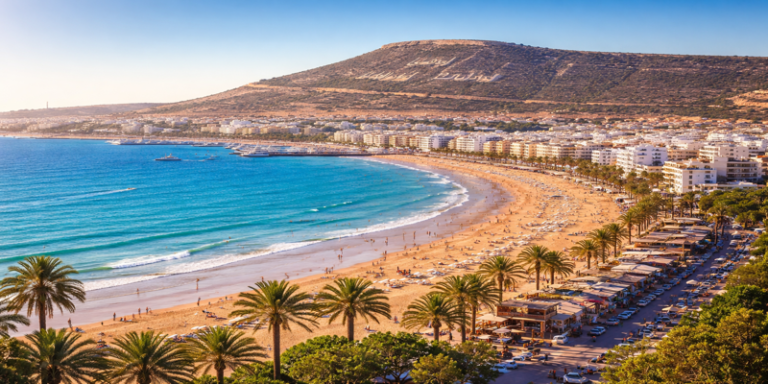
Tucked along Morocco’s Atlantic coast, Agadir stands as a shining emblem of resilience, cultural dynamism, and modern tourism. Often overlooked in favour of Marrakech or Fes, Agadir has undergone a significant transformation, especially following the devastating 1960 earthquake, which almost entirely flattened the city. Today, it has reinvented itself as a leading destination for both domestic and international travellers, boasting a unique blend of sun-drenched beaches, Berber heritage, and contemporary leisure.
1.0 A City Reborn: History and Transformation
The history of Agadir is punctuated by both catastrophe and rebirth. The earthquake of 1960 killed around 15,000 people and destroyed 90% of the city (Almeida-García, 2018). Rather than rebuilding on the original ruins, Moroccan authorities opted to reconstruct the city entirely, just a few kilometres south of the original site. This gave Agadir a modern urban layout unlike the labyrinthine medinas of other Moroccan cities (Caffyn & Jobbins, 2003).
Agadir became a symbol of Morocco’s post-independence modernisation. The new city was designed with European-style boulevards, seafront promenades, and wide avenues, reflecting Morocco’s ambitions to promote a tourism-driven economy (Adeniyi & Folarin, 2021).
2.0 Tourism and Economy: Morocco’s Coastal Jewel
Tourism is the lifeblood of Agadir’s economy. The city draws over a million visitors annually, mostly from France, Germany, the UK, and increasingly, Eastern Europe. According to Moumni (2024), tourism in Agadir represents not only an economic engine but also a tool for soft power, enabling Morocco to project a liberal and welcoming image to the world.
The Moroccan government invested heavily in Vision 2020, a national tourism strategy that prioritised Agadir as a “sun and sea” destination. The city’s infrastructure was expanded, including the international airport, new hotels, and eco-resorts (Dobruszkes & Mondou, 2013). Yet, tourism in Agadir is not without critique. Scholars argue for more inclusive and sustainable development, especially considering the marginalisation of local Amazigh (Berber) communities (Selkani, 2024).
3.0 Cultural Landscape and Attractions
Although modern in appearance, Agadir’s cultural identity remains deeply Berber. The nearby Agadir Oufella (the hilltop fortress destroyed in the earthquake) has been partly restored and now includes a museum chronicling the city’s past.
Must-Visit Attractions:
- Souk El Had: A sprawling traditional market with over 3,000 stalls offering spices, handicrafts, and textiles.
- La Médina d’Agadir: A reconstructed medina built in the 1990s by Italian architect Coco Polizzi, celebrating traditional Berber architecture.
- Vallée des Oiseaux: A peaceful bird park in the heart of the city, ideal for families.
- Agadir Marina: Upscale waterfront area with cafés, boutiques, and boat tours.
For nature lovers, the Souss-Massa National Park is just an hour’s drive south, offering views of rare bird species, wetlands, and dunes.
4.0 Gastronomy: Flavours of the Souss Region
Moroccan cuisine is a major draw for visitors, and Agadir doesn’t disappoint. According to El Hafid et al. (2017), gastronomy is a core component of Morocco’s tourism appeal. In Agadir, fresh seafood features heavily due to its coastal location.
Notable Dishes:
- Tagine of fish with preserved lemon and olives
- Sardine meatballs, a local delicacy
- Amlou: A delicious mix of almonds, honey, and argan oil
- Mint tea and Harira soup are staples
Places to Eat:
- Le Petit Pecheur: For freshly grilled seafood at reasonable prices.
- Pure Passion: A high-end restaurant at the Marina with sunset views.
- Dome Restaurant: Moroccan-European fusion in a romantic setting.
- La Scala: Known for elegant ambiance and refined Moroccan dishes.
5.0 Where to Stay: Comfort by the Coast
Agadir offers accommodation to suit all budgets, from luxury resorts to charming guesthouses.
Top Picks:
- Sofitel Agadir Royal Bay Resort – Five-star luxury, private beach, and traditional architecture.
- Riad Villa Blanche – Boutique riad with spa, ideal for couples seeking peace.
- Kenzi Europa Hotel – Centrally located and family-friendly.
- Atlantica Ifri Surf Accommodation – Budget-friendly option popular with surfers.
For eco-conscious travellers, Paradis Plage Surf Yoga & Spa outside the city offers sustainable tourism practices with yoga retreats.
6.0 Agadir’s Unique Tourism Identity
What distinguishes Agadir from other Moroccan cities is its ability to offer a relaxed, coastal lifestyle while still connecting visitors with authentic Moroccan culture. It serves as a gateway to the Sahara, with desert tours often beginning here, and a starting point for exploration of the southern Atlas and Anti-Atlas Mountains.
Agadir’s tourism branding hinges on accessibility, safety, and relaxation, which appeals particularly to European visitors. Yet, scholars like Bougroudi (2024) caution that digital narratives, such as travel blogs and vlogs, often present Agadir as merely a beach resort, ignoring its historical, ecological, and cultural richness.
7.0 Challenges and Sustainable Futures
Agadir faces several challenges moving forward. Climate change, coastal erosion, and overdevelopment threaten its ecological integrity. The Moroccan government has made strides towards eco-tourism by integrating protected zones like the Souss-Massa Park into national strategies (Chakouk et al., 2025).
There’s also a growing call for community-based tourism, which prioritises local participation and equitable wealth distribution. The work of Berred & Berred (2021) highlights how rural geo-tourism and cultural activities in areas like Tata and the Anti-Atlas can diversify tourism and reduce pressure on coastal hubs.
8.0 Final Thoughts
Agadir stands today not only as a symbol of Moroccan resilience but also as a model for reimagining tourism in the Global South. Its evolution—from a tragic past to a vibrant present—makes it a compelling case study for urban reinvention, cultural negotiation, and sustainable travel.
Whether you’re a sun-seeker, a foodie, a historian, or a cultural enthusiast, Agadir offers a rich tapestry of experiences that reflect both modern Morocco and ancient Amazigh traditions.
References
Almeida-García, F. (2018). Analysis of tourism policy in a developing country: The case of Morocco. Journal of Policy Research in Tourism, Leisure and Events. https://doi.org/10.1080/19407963.2017.1312420.
Caffyn, A., & Jobbins, G. (2003). Governance capacity and stakeholder interactions in the development and management of coastal tourism. Journal of Sustainable Tourism. https://doi.org/10.1080/09669580308667204.
Moumni, O. (2024). Decolonising Moroccan Tourism. International Journal of African Renaissance Studies.
Bougroudi, Z. (2024). Tourist Image of Southern Backcountry Morocco Through Online Narratives. Springer.
Chakouk, S. et al. (2025). Ecotourism and Cultural Tourism in Morocco. Cogent Social Sciences. https://doi.org/10.1080/23311886.2025.2551096
Selkani, I. (2024). Culture and Tourism in Morocco. Springer.
El Hafid, M. et al. (2017). Moroccan Gastronomy as a Key Factor of Tourism Attractiveness. Springer.
Dobruszkes, F. & Mondou, V. (2013). Aviation liberalization as a means to promote international tourism: The EU–Morocco case. Journal of Air Transport Management. https://doi.org/10.1016/j.jairtraman.2013.01.011
Adeniyi, O. & Folarin, O. (2021). Managing Tourism for Economic Development in Africa. Springer.