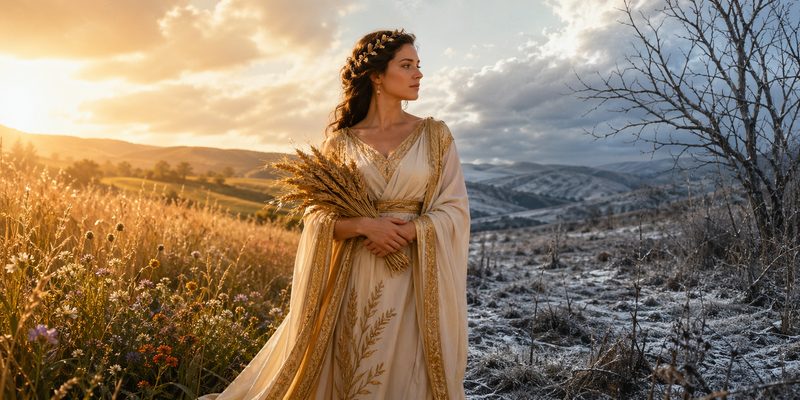
✧ Before weather forecasts, climate science and school diagrams of the Earth’s tilt, ancient people looked at the land itself for answers. Fields turned golden, trees lost their leaves, seeds disappeared into the soil and, after months of cold silence, green shoots returned. To the ancient Greeks, this yearly rhythm was not just a natural process. It was a story of loss, longing, return and renewal.
The myth of Demeter and the Seasons offered one of the most powerful explanations for why the world moves through spring, summer, autumn and winter. Demeter, the Greek goddess of grain, agriculture and fertility, was believed to hold the life of the earth in her hands. When her daughter Persephone vanished into the Underworld, the earth itself seemed to mourn. When Persephone returned, the world bloomed again.
This ancient myth remains compelling because it turns the changing year into something deeply human: a mother’s grief, a daughter’s divided life and nature’s promise that darkness does not last forever.
1.0 Who Was Demeter? The Goddess Behind the Harvest
In Greek mythology, Demeter was one of the Olympian deities and the daughter of Cronus and Rhea. Her name was closely connected with the earth’s fertility, especially the growth of wheat, barley and other crops. In a society where survival depended on successful harvests, Demeter was not a minor figure. She represented food, stability and the fragile bond between human beings and the land.
Ancient Greek religion often linked divine power with everyday needs. Demeter’s worship reflected this connection. She was honoured in rural rituals, harvest festivals and especially in the famous Eleusinian Mysteries, sacred rites associated with hope, fertility and the afterlife (Keller, 1988). These rites centred on the story of Demeter and Persephone, showing how closely the myth was tied to agriculture and seasonal change.
The story of Demeter and the Seasons therefore did more than entertain. It helped explain why crops failed, why winter came and why spring felt like a miracle.
2.0 Demeter and the Seasons: The Loss of Persephone
The central story appears most fully in the Homeric Hymn to Demeter, an ancient Greek poem usually dated to the early Archaic period. In the myth, Persephone, daughter of Demeter and Zeus, is gathering flowers when Hades, ruler of the Underworld, takes her away to be his queen. Demeter hears her daughter’s cry and begins a desperate search across the world (Homeric Hymn to Demeter, c. seventh–sixth century BCE).
Her grief is not private. It changes nature itself. Demeter withdraws her divine blessing from the earth. Crops stop growing, fields become barren and famine threatens humankind. In mythic terms, this is the first great winter: a season of absence, hunger and silence.
The myth of Demeter and the Seasons presents winter not merely as cold weather, but as the emotional condition of the earth. Nature withers because Demeter mourns. The land becomes a mirror of divine sorrow.
3.0 Why There Are Seasons in the Demeter Myth
The explanation for the seasons comes through a compromise. Zeus eventually intervenes, but Persephone has eaten pomegranate seeds in the Underworld. Because of this, she cannot fully return to the upper world. She must spend part of each year with Hades and part of each year with Demeter.
When Persephone returns to her mother, Demeter’s joy restores fertility to the earth. Flowers appear, crops grow and warmth returns. This period represents spring and summer, the seasons of growth and abundance. When Persephone descends again, Demeter grieves once more. The land becomes bare, producing autumn and winter.
In this way, Demeter and the Seasons explains the cycle of nature through a repeating pattern: departure, sorrow, return and renewal. Ancient audiences did not separate myth from meaning. The myth gave emotional shape to agricultural reality. Seeds are buried, hidden and later reborn; Persephone too disappears underground and returns.
Scholars have often noted this connection between the myth and the agricultural year. Richardson (2015) links Demeter with ploughing, sowing, reaping and storing the harvest, while Nilsson (1972) places Demeter’s worship within the broader context of Greek folk religion and farming life. The myth worked because it matched what people saw in the fields.
4.0 Agriculture, Food and the Ancient Greek Imagination
For modern readers, seasons may seem mainly atmospheric: winter coats, spring flowers, summer holidays and autumn leaves. For ancient farming communities, seasonal change could mean survival or crisis. A poor harvest meant hunger. A delayed rain could create fear. A successful crop brought relief and celebration.
This is why the story of Demeter and the Seasons mattered so much. It explained uncertainty through divine relationship. If the earth failed, the cause was not random; it belonged to a sacred drama. The goddess who gave grain could also withhold it.
Demeter’s anger in the myth also gives her unusual power. Even Zeus cannot ignore the consequences of her grief. Without Demeter’s cooperation, humans cannot offer sacrifices to the gods because crops cannot grow. The myth therefore gives agriculture cosmic importance: the fertility of the earth supports both human society and divine honour (Alderink, 1982).
A useful example is the Greek grain field. In autumn, seeds are placed beneath the soil, apparently dead or lost. During winter, little may be seen. In spring, new growth emerges. The myth transforms this process into a sacred story: Persephone’s descent resembles the hidden seed, while her return resembles germination and rebirth.
5.0 The Pomegranate: A Small Fruit with a Large Meaning
One of the most memorable details in Demeter and the Seasons is the pomegranate. Persephone’s eating of its seeds binds her partly to the Underworld. The fruit becomes a symbol of connection, transformation and divided belonging.
The pomegranate’s many seeds make it a fitting image of fertility, yet in the myth it is also connected with death and the Underworld. This double meaning is important. Greek mythology often treats life and death not as opposites, but as forces locked in a cycle. The seed must go into the dark earth before new growth can appear.
Arthur (1977) interprets the pomegranate as a key symbol in the Homeric Hymn to Demeter, connecting political, social and religious meanings. For general readers, its role is easier to grasp: it marks the moment Persephone becomes part of two worlds. She belongs both to her mother’s bright fields and to the shadowed realm below.
6.0 Demeter and the Seasons in Religion and Ritual
The myth was not only a story told beside a fire. It formed part of religious practice. At Eleusis, near Athens, Demeter and Persephone were honoured in mystery rites that became among the most important religious traditions of ancient Greece. Although many details of these rites remain unknown, they appear to have offered initiates a sense of hope connected with fertility, death and renewal (Keller, 1988).
The popularity of the Eleusinian Mysteries shows that Demeter and the Seasons spoke to more than farming concerns. It addressed a universal human question: what happens after loss? The return of Persephone suggested that absence could be followed by restoration. The buried seed, the winter field and the grieving mother all pointed towards renewal.
Johnston (2013) also emphasises that myths of Demeter could vary across festivals and communities. This matters because Greek mythology was never a single fixed book. It was a living tradition, reshaped by local worship, poetry and ritual.
7.0 Why the Myth Still Matters Today
The story of Demeter and the Seasons continues to appeal because it links the natural world with emotional truth. Winter can feel like waiting. Spring can feel like return. Autumn can feel like letting go. The myth gives these experiences a language.
It also encourages respect for the environment. Demeter’s power reminds readers that food does not simply appear; it depends on soil, weather, labour and ecological balance. In an age concerned with climate change and food security, an ancient agricultural goddess may seem surprisingly relevant.
Most importantly, the myth presents nature as cyclical rather than final. Loss is real, but it is not the whole story. Persephone returns. Seeds rise. The earth wakes.
∎ The ancient Greek explanation for the seasons may not be scientific, but it remains deeply meaningful. The myth of Demeter and the Seasons turns the year into a moving story of separation and reunion, barrenness and abundance, darkness and light.
Through Demeter’s grief, winter arrives. Through Persephone’s return, spring begins. The tale helped ancient people understand the agricultural world around them, but it also offered comfort: the cold months would pass, the fields would grow again and life would continue.
In that sense, Demeter’s myth still lives wherever the first green shoots break through the soil.
References
Alderink, L.J. (1982). ‘Mythical and Cosmological Structure in the Homeric Hymn to Demeter’. Numen, 29(1), pp. 1–16. Available at: https://www.jstor.org/stable/3269929.
Arthur, M. (1977). ‘Politics and Pomegranates: An Interpretation of the Homeric Hymn to Demeter’. Arethusa, 10(1), pp. 7–47. Available at: https://www.jstor.org/stable/26307824.
Burkert, W. (1985). Greek Religion: Archaic and Classical. Oxford: Blackwell.
Homeric Hymn to Demeter. (c. seventh–sixth century BCE). In: Athanassakis, A.N. (trans.) (2004). The Homeric Hymns. 2nd edn. Baltimore: Johns Hopkins University Press.
Johnston, S.I. (2013). ‘Demeter, Myths, and the Polyvalence of Festivals’. History of Religions, 52(4), pp. 370–401. Available at: https://www.journals.uchicago.edu/doi/full/10.1086/669646.
Keller, M.L. (1988). ‘The Eleusinian Mysteries of Demeter and Persephone: Fertility, Sexuality, and Rebirth’. Journal of Feminist Studies in Religion, 4(1), pp. 27–54. Available at: https://www.jstor.org/stable/25002068.
Nilsson, M.P. (1972). Greek Folk Religion. Philadelphia: University of Pennsylvania Press.
Richardson, N.J. (2015). ‘Demeter’. In: Eidinow, E. and Kindt, J. (eds.) The Oxford Handbook of Ancient Greek Religion. Oxford: Oxford University Press.
Strolonga, P. (2015). ‘Structural Symmetry and Parallelism in the Homeric Hymn to Demeter’. Ariadne, 21, pp. 15–44. Available at: https://ejournals.lib.uoc.gr/Ariadne/article/view/184.
The Editors of Encyclopaedia Britannica. (2024). ‘Demeter’. Encyclopaedia Britannica. Available at: https://www.britannica.com/topic/Demeter-Greek-goddess.