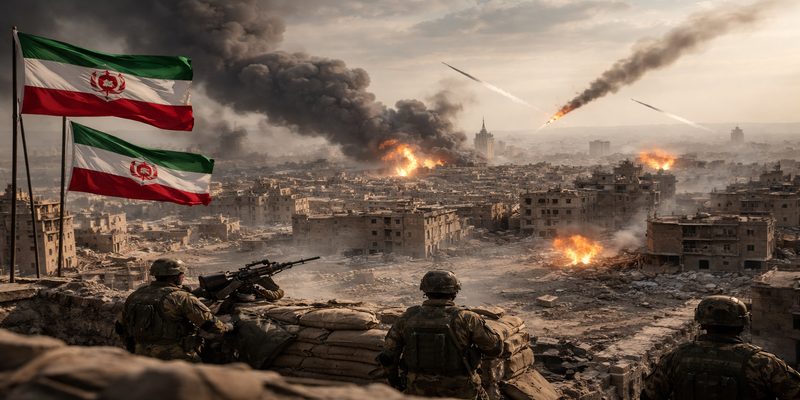
The 2026 Iran war represents one of the most significant geopolitical tensions shaping the Middle East today. Over recent years, growing rivalry between Iran, Israel, the United States, and regional actors has created a volatile political environment where security concerns, ideological differences, and strategic interests intersect. As these tensions intensify, analysts warn that the conflict could reshape the political landscape of the Middle East and influence global security.
Understanding the Iran war requires examining a complex network of historical rivalries, military strategies, and diplomatic disputes. Iran’s regional ambitions, its controversial nuclear programme, and its alliances with various political and military groups have contributed to rising tensions across the region (Mahmoudian, 2024).
Unlike traditional wars, the Iran war often unfolds through indirect confrontations such as proxy wars, cyber operations, economic sanctions, and diplomatic pressure. These dynamics make the conflict difficult to predict and highlight the growing complexity of modern geopolitical competition.
1.0 Background of the Iran War
The Iran war is rooted in decades of political transformation and regional competition. Since the 1979 Iranian Revolution, Iran has pursued a foreign policy that emphasises independence from Western influence and resistance to perceived external pressure.
This transformation altered Iran’s relationship with many countries in the region. Tensions particularly increased with Israel and the United States, both of which view Iran’s regional activities and military capabilities as security concerns (Mousavian & Chitsazian, 2020).
Over time, disputes surrounding Iran’s nuclear programme, regional alliances, and ideological influence have intensified. These factors gradually contributed to the strategic rivalry that forms the foundation of the 2026 Iran war.
2.0 Major Causes of the Iran War
2.1 Iran’s Nuclear Programme
One of the most significant drivers of the 2026 Iran war is the ongoing dispute surrounding Iran’s nuclear programme. Western governments and Israel have expressed concerns that Iran’s nuclear capabilities could potentially lead to the development of nuclear weapons.
Iran, however, insists that its nuclear programme is designed for peaceful energy and scientific purposes. This disagreement has led to years of diplomatic negotiations, sanctions, and political tensions (Kumar, 2024).
2.2 Strategic Rivalry Between Iran and Israel
Another major factor behind the 2026 Iran war is the deep strategic rivalry between Iran and Israel. Both countries perceive each other as significant security threats.
Israel has repeatedly warned that Iran’s military expansion and regional alliances could endanger its national security. Meanwhile, Iran strongly criticises Israeli policies in the region. This rivalry has resulted in covert operations, cyber-attacks, and occasional military confrontations (Pinfold, Jones & Ehteshami, 2025).
3.0 Proxy Wars Across the Middle East
A defining feature of the 2026 Iran war is the use of proxy conflicts. Instead of direct warfare, Iran and its rivals often compete through allied groups operating in different countries.
These proxy conflicts have appeared in several parts of the Middle East, including Syria, Lebanon, Iraq, and Yemen. Such conflicts allow states to expand their influence while avoiding direct confrontation, although they still contribute to regional instability (Abbasi, 2025).
4.0 Key Actors in the 2026 Iran War
4.1 Iran
Iran plays the central role in the 2026 Iran War. Iranian leaders argue that their foreign policy aims to protect national sovereignty and regional security. At the same time, Iran seeks to maintain influence across the Middle East through political alliances and strategic partnerships.
4.2 Israel
Israel remains one of the most significant actors involved in the 2026 Iran war. Israeli policymakers view Iran’s nuclear ambitions and regional influence as major security threats. Consequently, Israel has adopted a strategy aimed at limiting Iran’s military expansion in the region.
4.3 United States
The United States has also played an important role in shaping the 2026 Iran war. Through economic sanctions, diplomatic negotiations, and security cooperation with regional allies, the United States has significantly influenced the balance of power in the Middle East (Korshenko, 2025).
4.4 Regional Powers
Other regional powers, including Saudi Arabia and Gulf states, also influence the dynamics of the 2026 Iran war. These countries often adjust their diplomatic and military strategies in response to Iran’s policies and regional ambitions (Beck, 2020).
5.0 Regional Implications of the 2026 Iran War
The 2026 Iran conflict has profound implications for the stability of the Middle East. One major consequence is the shifting balance of power among regional states. Countries often strengthen alliances or adjust their security policies in response to Iranian influence.
For example, some states have increased cooperation with Israel and Western powers to counterbalance Iran’s regional activities. Others have attempted diplomatic engagement with Iran to reduce tensions.
Another important concern is the risk of escalation. Even limited confrontations or proxy conflicts could potentially expand into larger regional wars if miscalculations occur.
6.0 Global Consequences of the War
Beyond the Middle East, the 2026 Iran war carries global consequences. The region plays a critical role in the global energy market, and instability could affect oil supply, trade routes, and economic stability.
In addition, major global powers such as Russia, China, and European states are often involved in diplomatic discussions related to Iran. Their involvement reflects how regional conflicts can quickly become international geopolitical issues.
Scholars argue that tensions involving Iran illustrate the interconnected nature of modern global politics, where local conflicts can influence international security dynamics (Roomi, 2023).
7.0 Possible Future Developments
The future of the 2026 Iran war remains uncertain. Several possible scenarios could emerge.
One scenario involves continued proxy conflicts and strategic rivalry, where tensions remain but do not escalate into direct war. Another possibility is diplomatic progress through negotiations aimed at reducing tensions and resolving disputes over nuclear policy.
However, there is also a risk that regional incidents could trigger broader military confrontation. For this reason, many analysts emphasise the importance of diplomacy and international cooperation in managing the 2026 Iran war.
The 2026 Iran war reflects the complexity of modern geopolitical competition in the Middle East. Driven by historical rivalries, ideological differences, and strategic interests, the conflict involves multiple actors and extends beyond Iran’s borders.
Understanding this conflict requires examining the interplay between nuclear politics, regional alliances, and proxy warfare. As the situation continues to evolve, diplomatic engagement and conflict management will play crucial roles in preventing further escalation.
Ultimately, the 2026 Iran war demonstrates how regional disputes can influence global politics, economic stability, and international security. The decisions made by political leaders and international institutions will shape the future of the Middle East for years to come.
References
Abbasi, A. (2025). Proxy wars and regional instability: Israel–Iran conflict in the Middle East. ASSAJ Journal.
Beck, M. (2020). The aggravated struggle for regional power in the Middle East: American allies Saudi Arabia and Israel versus Iran. Global Policy.
Korshenko, A. (2025). Understanding US Foreign Policy in Iran and the Middle East: A General Review Study. Journal of Humanities and Education Development.
Kumar, S. (2024). Israel’s threat perception: Analysis of Israel and Iran’s relations and Iran’s nuclear ambition. SSRN.
Mahmoudian, A. (2024). Iran–Israel Conflict: A New Stage Emerges. Global and National Security Institute.
Mousavian, S.H. & Chitsazian, M.R. (2020). Iran’s Foreign Policy in the Middle East: A Grand Strategy. Middle East Policy.
Pinfold, R.G., Jones, C. & Ehteshami, A. (2025). Collision course: How Iran and Israel brought the Middle East to the brink of war. Global Policy.
Roomi, F. (2023). The Iran–Israel conflict: An ultra-ideological explanation. Middle East Policy.