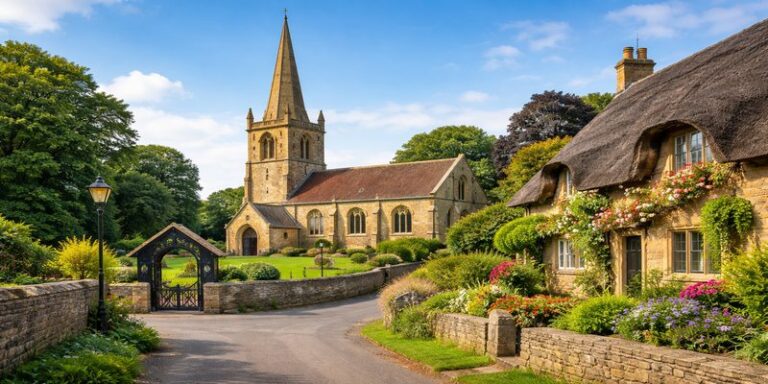
The Church of England is one of the most historically significant Christian institutions in Britain and remains an important part of the country’s religious, cultural and public life. Although church attendance in England has changed over time, the Church of England still plays a visible role through parish ministry, schools, chaplaincy, ceremonies of national importance, and its constitutional relationship with the state. It is the mother church of the wider Anglican Communion, yet it also has a distinct identity shaped by English history, the Reformation, and centuries of theological development (Chapman, 2006; McCullough, 2014). To understand the Church of England, it is necessary to look not only at its origins but also at its beliefs, worship, organisation and ongoing debates. This article explores those areas and explains why the Church of England continues to matter in contemporary Britain.
1.0 The History of the Church Of England
1.1 The origins of the Church of England
The roots of the Church of England go back well before the sixteenth century. Christianity existed in England long before the English Reformation, and the medieval English Church was part of Western Christendom under papal authority. However, the form now recognised as the Church of England emerged during the Tudor period, especially under Henry VIII and Elizabeth I (Moorman, 1980; MacCulloch, 2004).
Henry VIII’s break with Rome in the 1530s was initially driven more by politics, dynastic concerns and royal authority than by a full theological revolution. Yet the consequences were far-reaching. Royal supremacy over the English Church was asserted, and later reigns saw major doctrinal and liturgical developments. Under Edward VI, reform became more explicitly Protestant, while under Mary I England briefly returned to Roman obedience. Elizabeth I then shaped a more lasting settlement in which the monarch became Supreme Governor of the Church and English Protestant identity took institutional form (Milton, 2017; McCullough, 2014).
1.2 The Elizabethan Settlement
The Elizabethan Settlement is central to the identity of the Church of England. It established a structure that was episcopal, liturgical and national, while also reformed in doctrine. The Book of Common Prayer and the Thirty-Nine Articles became especially important in defining its worship and theology (Bicknell, 2008; Collister, 2024). This settlement did not remove all tensions, but it created a framework broad enough to contain different emphases within one national church.
2.0 Beliefs and Theology of the Church Of England
2.1 A Broad Christian Tradition
The Church of England is often described as a broad church, meaning that it contains a range of theological viewpoints. Some Anglicans emphasise Catholic continuity, sacramental worship and tradition, while others stress Reformation teaching, preaching and scriptural authority. There are also more liberal strands that engage strongly with modern scholarship and social change (Chapman, 2013; Spencer and Galgalo, 2023).
This breadth is one reason the Church of England can appear difficult to define. It is neither Roman Catholic nor simply Protestant in a narrow sense. Instead, Anglican theology has often tried to hold together Scripture, tradition and reason, though the balance between them varies across different schools of thought (Avis, 2002; Locke, 2016).
2.2 Prayer Book, Sacraments and Doctrine
The historic identity of the Church of England is closely linked to the Book of Common Prayer, which shaped public worship for centuries and remains deeply influential even where modern liturgies are used. Baptism and Holy Communion are central sacraments, and the Church retains the threefold order of bishops, priests and deacons. The Thirty-Nine Articles remain a historic doctrinal standard, though in everyday parish life many worshippers may know the liturgy and pastoral ministry more clearly than formal articles of religion (Bicknell, 2008; Collister, 2024).
3.0 How the Church of England is organised
3.1 Parishes, Bishops and Dioceses
A distinctive feature of the Church of England is its parish system. England is divided into parishes, each intended historically to ensure that every person lives within the care of a local church community. This gives the Church of England a territorial and public character that differs from many free churches.
Parishes belong to dioceses, each overseen by a bishop. Above these sit the provinces of Canterbury and York, led by their archbishops. This episcopal structure links local ministry with national leadership and historical continuity (Avis, 2007; Chapman, 2006).
3.2 An Established Church
The Church of England is also the established church in England. That means it has a formal relationship with the British state. The monarch has a constitutional role, bishops sit in the House of Lords, and the Church is involved in important public ceremonies such as coronations, national services of remembrance and civic observances. This established position is one of the main reasons the Church of England remains prominent beyond its regular worshipping population (Gregory, 2017).
4.0 Worship and Everyday Life in the Church Of England
4.1 Variety in Worship
Worship in the Church of England varies widely. One parish may hold a formal sung Eucharist with robes, incense and choir, while another may offer a simpler service with contemporary music and informal preaching. This variety reflects the Church’s broad identity and local flexibility.
For example, some congregations follow traditional Prayer Book patterns, while others use modern liturgical resources such as Common Worship. Seasonal events including Christmas, Easter, baptisms, weddings and funerals remain among the points where many people encounter the Church of England, even if they do not attend regularly.
4.2 Pastoral and Social Role
The Church of England is not only a worshipping body but also a social and pastoral institution. Clergy and lay leaders often support local communities through food banks, schools, chaplaincies, youth work, elder care and crisis response. In rural areas especially, the parish church may still function as a visible centre of local identity.
5.0 The Church of England in Modern Society
5.1 Challenges and Debate
Like many historic churches in Europe, the Church of England faces significant challenges, including secularisation, declining attendance in some areas, internal disagreement and questions about relevance in a plural society. Debates over gender, sexuality, authority, safeguarding and establishment have all shaped recent public discussion.
At the same time, the Church of England continues to adapt. It remains active in education, public ethics and national conversation. It also retains symbolic importance in British life, especially at moments of grief, celebration or constitutional significance.
5.2 Why It Still Matters
The significance of the Church of England today lies partly in numbers, but even more in its public reach. It is present in villages, towns, cities, schools, hospitals, prisons, universities and the armed forces. It carries historical memory, national symbolism and local pastoral presence all at once. Even critics of establishment often recognise that the Church of England still serves as a bridge between private faith and public life.
The Church of England is best understood as a historic national church shaped by the English Reformation, sustained by a broad Anglican theology, and expressed through parishes, bishops and public service. Its identity has always involved a balance of continuity and change: Catholic heritage and Protestant reform, local parish care and national constitutional role, inherited liturgy and modern adaptation. In contemporary Britain, the Church of England faces real pressures, yet it remains a significant religious and civic institution. Its continuing importance lies not only in doctrine or history, but also in its ability to connect worship, community and public life across England.
References
Avis, P. (2002) Anglicanism and the Christian Church. London: T&T Clark. Available at: https://www.torrossa.com/it/resources/an/5201441.
Avis, P. (2007) ‘Anglican ecclesiology’, in The Routledge Companion to the Christian Church. Abingdon: Routledge. Available at: https://api.taylorfrancis.com/content/chapters/edit/download?identifierName=doi&identifierValue=10.4324/9780203936078-14&type=chapterpdf.
Bicknell, E.J. (2008) A Theological Introduction to the Thirty-Nine Articles of the Church of England. Eugene, OR: Wipf and Stock. Available at: https://books.google.com/books?id=2j77DwAAQBAJ.
Chapman, M. (2006) Anglicanism: A Very Short Introduction. Oxford: Oxford University Press. Available at: https://books.google.com/books?id=RLEL9Xxy9E8C.
Chapman, M. (2013) ‘Anglican theology’, in The Routledge Companion to Modern Christian Thought. Abingdon: Routledge. Available at: https://api.taylorfrancis.com/content/chapters/edit/download?identifierName=doi&identifierValue=10.4324/9780203387856-50&type=chapterpdf.
Collister, C. (2024) ‘The theology of the Church of England: The origins of Anglican orthodoxy’, Cranmer Theological Journal. Available at: https://cranmerjournal.org/index.php/CTJ/article/view/2024.201.
Gregory, J. (2017) The Oxford History of Anglicanism, Volume II: Establishment and Empire, 1662–1829. Oxford: Oxford University Press. Available at: https://books.google.com/books?id=L583DwAAQBAJ.
Locke, K.A. (2016) The Church in Anglican Theology: A Historical, Theological and Ecumenical Exploration. Abingdon: Routledge. Available at: https://api.taylorfrancis.com/content/books/mono/download?identifierName=doi&identifierValue=10.4324/9781315614687&type=googlepdf.
MacCulloch, D. (2004) ‘The birth of Anglicanism’, Ecclesiastical Law Journal, 7(35), pp. 368–374. Available at: https://www.cambridge.org/core/journals/ecclesiastical-law-journal/article/birth-of-anglicanism/9174B2771494F62F4D00CCE030177E2F.
McCullough, P. (2014) ‘“Anglicanism” and the origins of the Church of England’, Ecclesiastical Law Journal, 16(2), pp. 181–193. Available at: https://www.cambridge.org/core/journals/ecclesiastical-law-journal/article/anglicanism-and-the-origins-of-the-church-of-england/0C20C4E457C5F32694119D355606BFCC.
Milton, A. (2017) The Oxford History of Anglicanism, Volume I: Reformation and Identity c.1520–1662. Oxford: Oxford University Press. Available at: https://books.google.com/books?id=ldj_DQAAQBAJ.
Moorman, J.R.H. (1980) A History of the Church in England. London: A&C Black. Available at: https://books.google.com/books?id=UTckDwAAQBAJ.
Spencer, S. and Galgalo, J. (2023) ‘Anglican theology’, St Andrews Encyclopaedia of Theology. Available at: https://www.saet.ac.uk/Christianity/AnglicanTheology.pdf.