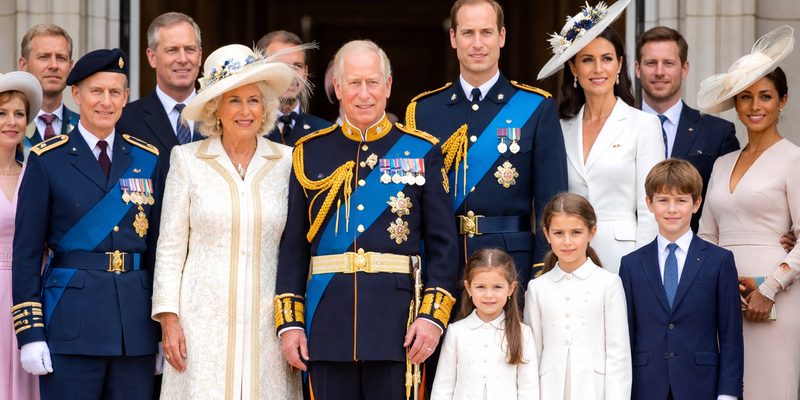
The British Royal Family is best understood as a family (the wider House of Windsor) and an institution (the Crown, which sits at the centre of the UK’s constitutional monarchy). In everyday life, most people encounter the monarchy through a relatively small group of senior royals who undertake public duties, support charities, and represent the state at ceremonial moments. Meanwhile, a larger network of titled relatives sits behind them—important for family lineage and succession, even if many live largely private lives.
Note on scope: the Royal Family is extensive. To keep this a readable general-interest overview, the list below focuses on the living, publicly prominent members of the House of Windsor and close titled relatives who commonly appear in official contexts and succession discussions.
1.0 The House of Windsor
The modern dynasty is the House of Windsor, adopted in 1917. The current family structure flows chiefly from King Charles III, whose reign follows the long reign of Queen Elizabeth II. In constitutional terms, the monarch’s practical political power is limited and exercised according to law and convention—an arrangement often described as dignified (symbolic and unifying) alongside efficient (governmental) institutions (Bagehot, 1872/2001; Turpin and Tomkins, 2011; Blackburn, 2022).
A quick “family tree” map
- King George VI → Queen Elizabeth II → King Charles III
- King Charles III → Prince William → Prince George (and siblings)
- King Charles III → Prince Harry (and children)
- Charles III’s siblings: Princess Anne, Prince Andrew, Prince Edward
2.0 The core monarchy: the Sovereign and the next generation
The Sovereign and Consort
- King Charles III — Head of State of the United Kingdom and (separately) monarch of other realms. As monarch, he embodies the legal idea of the Crown, acting within constitutional limits and conventions (Blackburn, 2022; Turpin and Tomkins, 2011).
- Queen Camilla — Queen Consort, supporting the King through public engagements and charitable patronage.
The Immediate Heirs
- Prince William, Prince of Wales — the King’s elder son and heir apparent. He supports national causes and prepares for future kingship.
- Catherine, Princess of Wales — William’s wife; a prominent public figure with charitable work (often focusing on early childhood, mental health, and community initiatives).
The Wales children (next in the line)
- Prince George of Wales — William and Catherine’s eldest child; second in line after his father under modern succession rules.
- Princess Charlotte of Wales — their second child; her place in succession reflects the end of male-preference primogeniture for those born after October 2011 (Succession to the Crown Act 2013).
- Prince Louis of Wales — their third child.
Example of constitutional change: A century ago, a younger brother would automatically have outranked an elder sister. The Succession to the Crown Act 2013 changed that for those born after 28 October 2011, making succession depend on birth order, not gender (UK Parliament, 2013).
3.0 The King’s other branch: the Duke of Sussex and family
- Prince Harry, Duke of Sussex — the King’s younger son. He stepped back from being a “working royal” and undertakes a different public profile, but remains part of the wider royal family and the line of succession.
- Meghan, Duchess of Sussex — Harry’s wife; engaged in public initiatives and media projects.
- Prince Archie of Sussex — Harry and Meghan’s elder child.
- Princess Lilibet of Sussex — their younger child.
This branch illustrates a modern reality: being in the royal family does not always mean carrying out official duties. The institution increasingly distinguishes between working royals and relatives who are royal by birth but live more privately.
4.0 The King’s siblings and their families
The Princess Royal’s family
- Anne, Princess Royal — the King’s sister; widely known for long-standing public service and patronages.
- Sir Timothy Laurence — Anne’s husband.
- Peter Phillips — Anne’s son.
- Zara Tindall (née Phillips) — Anne’s daughter; an accomplished equestrian and public figure.
- Mike Tindall — Zara’s husband.
The Duke of York’s family
- Prince Andrew, Duke of York — the King’s brother. While he remains a member of the family, his public role has been significantly curtailed in recent years.
- Princess Beatrice — Andrew’s elder daughter.
- Princess Eugenie — Andrew’s younger daughter.
The Duke of Edinburgh’s family
- Prince Edward, Duke of Edinburgh — the King’s younger brother (the title “Duke of Edinburgh” was re-created for him).
- Sophie, Duchess of Edinburgh — Edward’s wife; a prominent working royal with charitable roles.
- Lady Louise Windsor — their daughter.
- James, Earl of Wessex — their son.
5.0 The “extended” Windsor family: Gloucester, Kent, and other close relatives
Beyond the King’s immediate family, there are additional titled relatives descended from earlier monarchs (notably King George V). Two branches often mentioned in royal contexts are:
- Prince Richard, Duke of Gloucester — a cousin of the late Queen Elizabeth II; undertakes some official engagements.
- Prince Edward, Duke of Kent — another cousin of the late Queen; historically active in public duties (with roles sometimes changing over time).
- Princess Alexandra — cousin of the late Queen; has undertaken public duties.
These relatives show how the monarchy functions as a networked institution: not just one nuclear family, but a web of kinship that supports ceremonial life—especially at state occasions.
7.0 How lineage and succession actually work
The legal rules
Succession is governed by a mixture of statute and constitutional convention. The most widely cited modern change is the Succession to the Crown Act 2013, which:
- ended male-preference succession for those born after 28 October 2011;
- adjusted certain rules on marriage and succession;
- set requirements around consent for certain royal marriages (UK Parliament, 2013).
The constitutional reality
In practice, the monarch’s role is best framed as constitutional and representative, with political authority exercised by elected ministers. Scholars describe the UK monarchy as operating through conventions that shape the relationship between Monarch and Prime Minister and the wider executive (Blackburn, 2022; Monaghan, 2025). This is why royal family lineage matters: it underpins a stable, legally recognised method for determining the head of state, even while day-to-day governance rests with Parliament and government (Turpin and Tomkins, 2011; Barber, 2021).
The British Royal Family today is both family and framework: a living set of relatives—some highly public, others largely private—anchoring the constitutional idea of the Crown. At its centre stands King Charles III, supported by Queen Camilla, with the next generation led by the Prince and Princess of Wales and their children. Around them orbit siblings, cousins, and extended branches who reflect the monarchy’s long lineage. Whether one views the institution through the lens of tradition, public service, or constitutional stability, the story of “who’s who” only makes full sense when connected to the rules and conventions that keep succession orderly and the monarchy’s role politically limited but symbolically significant.
References
Bagehot, W. (1872/2001) The English Constitution. London: Penguin Classics.
Barber, N.W. (2021) The United Kingdom Constitution: An Introduction. Oxford: Oxford University Press.
Blackburn, R. (2022) ‘The Constitutional Role and Working of the Monarchy in the United Kingdom’. Jahrbuch des öffentlichen Rechts der Gegenwart. Available at: https://kclpure.kcl.ac.uk/ws/portalfiles/portal/167996669/The_Constitutional_Role_and_BLACKBURN_2022_GREEN_AAM.pdf (Accessed: 4 March 2026).
Cox, N. (2020) The Royal Prerogative and Constitutional Law: A Search for the Quintessence of Executive Power. Abingdon: Routledge.
Lyon, A. (2016) Constitutional History of the United Kingdom. Abingdon: Routledge.
Monaghan, C. (2025) ‘Muddling-Through Constitutionalism in the United Kingdom: The Importance of the Relationship Between the Monarch and the Prime Minister’. In: European Yearbook of Constitutional Law 2024. Cham: Springer. Available at: https://link.springer.com/chapter/10.1007/978-94-6265-699-4_4 (Accessed: 4 March 2026).
Turpin, C. and Tomkins, A. (2011) British Government and the Constitution: Text and Materials. 7th edn. Cambridge: Cambridge University Press.
UK Parliament (2013) Succession to the Crown Act 2013. Available at: https://www.legislation.gov.uk/ukpga/2013/20/contents/enacted (Accessed: 4 March 2026).