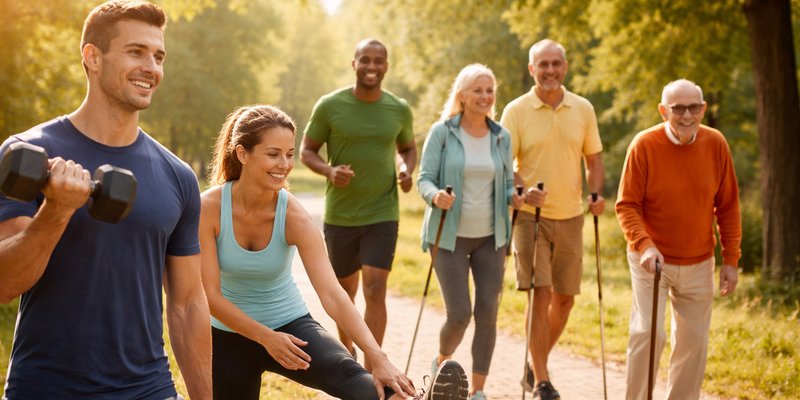
A substantial body of evidence from textbooks, longitudinal cohort studies, systematic reviews and global health guidelines demonstrates that maintaining physical activity, muscular strength, balance, sleep hygiene and metabolic health across the lifespan significantly improves quality of life, functional independence and longevity. Research consistently shows that habits formed in early adulthood influence later health outcomes, while targeted interventions—particularly resistance training, weight-bearing exercise, balance work and social engagement—reduce risks of chronic disease, frailty and falls in later life. The following article synthesises findings from leading academic sources and reputable organisations to outline how to care for the body and ensure physical wellbeing across each decade of adulthood.
1.0 Caring for Your Body Through the Decades: An Evidence-Based Approach
Maintaining health across the lifespan is not about short bursts of motivation but about building sustainable systems of physical activity, nutrition, sleep and preventative care. According to the World Health Organization (WHO, 2020), regular physical activity reduces the risk of cardiovascular disease, diabetes, cancer, depression and cognitive decline. However, the type and emphasis of health behaviours should evolve as the body ages.
1.1 Your 20s: Building the Physiological Foundation
Your twenties represent a crucial period for establishing peak bone mass, muscle strength and cardiovascular capacity. Shephard (2024) emphasises that early adulthood is a window during which lifestyle behaviours strongly influence later morbidity patterns.
The WHO (2020) recommends that adults aged 18–64 engage in at least 150–300 minutes of moderate-intensity aerobic activity weekly, alongside muscle-strengthening activities on two or more days per week. Resistance training during this decade supports the development of maximal muscle mass, which becomes protective later against sarcopenia—the age-related loss of muscle.
Sleep is equally critical. Garfield, Llewellyn and Kumari (2016), analysing data from the English Longitudinal Study of Ageing (ELSA), highlight strong associations between physical activity, sleep duration and mental wellbeing. Establishing consistent sleep routines in your twenties (7–9 hours nightly) supports cognitive and metabolic regulation.
Example: A 25-year-old who incorporates structured strength training, adequate sleep and mobility work is building a physiological “reserve” that may delay frailty decades later.
1.2 Your 30s: Mobility, Posture and Preventative Health
In the thirties, career demands and sedentary behaviour often increase. Prolonged sitting is linked to metabolic dysfunction and musculoskeletal strain (WHO, 2020).
This decade should prioritise:
- Mobility and flexibility training
- Postural correction
- Regular health screenings
Sedentary work environments increase the risk of lower back pain and reduced hip mobility. Incorporating yoga or dynamic stretching may improve joint health and functional movement. Resistance training remains important to maintain muscle mass and metabolic rate.
From a metabolic perspective, Trayhurn and Bing (2006) explain that energy balance mechanisms adapt over time, meaning subtle increases in caloric intake can gradually lead to weight gain. Monitoring diet and maintaining consistent activity becomes increasingly important.
Example: A 38-year-old office worker who integrates short walking breaks, resistance sessions twice weekly and annual blood pressure checks is reducing long-term cardiovascular risk.
1.3 Your 40s: Recovery, Metabolism and Joint Protection
During the forties, subtle declines in metabolic rate, hormonal levels and connective tissue resilience begin. Shephard (2024) notes that while functional capacity remains high, recovery time may lengthen.
Strategies include:
- Increasing recovery time between intense workouts
- Monitoring body composition and waist circumference
- Choosing lower-impact cardiovascular exercise (e.g., swimming, cycling)
Resistance training remains essential but should be balanced with adequate rest. Overuse injuries become more common in this decade.
Sleep continues to influence mental and physical health. Garfield et al. (2016) demonstrate that insufficient sleep combined with low activity correlates with increased depressive symptoms in midlife and older adults.
Example: A 45-year-old recreational runner may benefit from cross-training and incorporating mobility sessions to protect knee and hip joints.
1.4 Your 50s: Preserving Muscle and Bone Density
From the fifth decade onward, sarcopenia and bone density loss accelerate. Pfeifer, Begerow and Minne (2001) demonstrate links between muscle strength, balance and fracture risk among postmenopausal women with osteoporosis. Weight-bearing and resistance exercise are therefore critical.
Similarly, da Costa and da Cunha (2014) highlight that resistance training improves strength, balance and bone mineral density, particularly in populations with osteoarthritis.
WHO (2020) guidelines specifically recommend that older adults incorporate multicomponent physical activity, combining:
- Strength training
- Balance training
- Functional exercises
Nutrition also becomes important—adequate protein intake and vitamin D status support musculoskeletal health (Pfeifer et al., 2001).
Example: A 55-year-old who performs resistance training twice weekly and practices balance drills (e.g., single-leg stands) may reduce fall risk significantly.
1.5 Your 60s: Balance, Functional Independence and Daily Movement
The sixties often mark transition into retirement, providing opportunities for structured health routines. However, physical inactivity increases risks of falls and chronic disease.
Garfield et al. (2016) show that continued physical activity in later adulthood correlates with improved mental wellbeing. Moreover, balance deficits are strongly associated with falls (Pfeifer et al., 2001).
Multicomponent programmes—including strength, aerobic and balance training—are most effective (WHO, 2020).
Example: A 65-year-old walking daily, attending community strength classes and engaging in Tai Chi may maintain independence longer.
1.6 Your 70s: Social Engagement and Professional Guidance
Maintaining independence becomes paramount. Weinger and Beverly (2014) note that structured resistance training in older adults improves grip strength, walking speed and balance, particularly among individuals managing chronic conditions such as diabetes.
Functional fitness—being able to climb stairs, carry groceries and rise from a chair—predicts long-term independence. Physical therapists can design tailored interventions for individuals with mobility limitations.
Social engagement also matters. Physical activity performed socially improves adherence and psychological wellbeing (WHO, 2020).
Example: Group exercise classes for seniors provide both physical stimulus and social connection, both predictors of longevity.
1.7 Your 80s and Beyond: Stability, Cognitive Engagement and Adaptation
In advanced age, the focus shifts to fall prevention, cognitive stimulation and maintaining dignity through independence.
Shephard (2024) emphasises that even small amounts of physical activity confer substantial benefit. WHO (2020) states that “some activity is better than none,” particularly when adapted to ability.
Balance training, assisted walking, chair-based resistance exercises and gentle mobility routines are effective. Pfeifer et al. (2001) underline that muscle strength and balance significantly reduce fracture risk.
Cognitive health also benefits from physical activity, particularly when combined with mental engagement (Garfield et al., 2016).
Example: An 85-year-old performing supervised resistance band exercises and daily short walks can meaningfully preserve functional capacity.
Across every decade, the evidence converges on several core principles:
- Consistency outweighs intensity
- Resistance training is essential throughout life
- Balance training becomes increasingly critical after 60
- Sleep and metabolic health influence long-term outcomes
- Social and psychological wellbeing are inseparable from physical health
Rather than viewing ageing as inevitable decline, research suggests it can be understood as a process strongly shaped by lifestyle behaviours. Establishing strong foundations early, adapting training intelligently and prioritising functional capacity later in life can dramatically influence both lifespan and healthspan.
References
da Costa, P.R. and da Cunha, S.D. (2014) ‘Whole-body vibration and benefits for people with osteoarthritis: a systematic review’, International Journal of Medicine and Medical Sciences, 6(9), pp. 201–210. Available at: https://academicjournals.org/journal/IJMMS/article-full-text/C8D40AD46975.
Garfield, V., Llewellyn, C.H. and Kumari, M. (2016) ‘The relationship between physical activity, sleep duration and depressive symptoms in older adults: The English Longitudinal Study of Ageing (ELSA)’, Preventive Medicine Reports, 4, pp. 512–516. Available at: https://www.sciencedirect.com/science/article/pii/S2211335516301127.
Pfeifer, M., Begerow, B. and Minne, H.W. (2001) ‘Vitamin D status, trunk muscle strength, body sway, falls, and fractures among postmenopausal women with osteoporosis’, Experimental and Clinical Endocrinology & Diabetes, 109(2). Available at: https://www.thieme-connect.com/products/all/doi/10.1055/s-2001-14831.
Shephard, R. (2024) Physical Activity and Aging. London: Taylor & Francis. Available at: https://www.taylorfrancis.com/books/mono/10.4324/9781032684772/physical-activity-aging-roy-shephard.
Trayhurn, P. and Bing, C. (2006) ‘Appetite and energy balance signals from adipocytes’, Philosophical Transactions of the Royal Society B, 361(1471), pp. 1237–1249. Available at: https://pmc.ncbi.nlm.nih.gov/articles/PMC1642696/.
Weinger, K. and Beverly, E.A. (2014) ‘Diabetes self-care and the older adult’, Western Journal of Nursing Research, 36(9), pp. 1272–1298. Available at: https://pmc.ncbi.nlm.nih.gov/articles/PMC4125543/.
World Health Organization (2020) WHO Guidelines on Physical Activity and Sedentary Behaviour. Geneva: WHO. Available at: https://www.who.int/publications/i/item/9789240015128.
NHS (2023) Physical activity guidelines for adults and older adults. Available at: https://www.nhs.uk/live-well/exercise/.